What Specific Changes Is AI Bringing to Academic Writing?
AI transforms every stage of the academic writing process, from initial research through final editing, creating both opportunities and challenges.
Research and Information Gathering
AI accelerates research by quickly summarizing complex papers, identifying key studies in a field, and explaining difficult concepts. Students can input research questions and receive synthesized overviews within seconds rather than spending hours on preliminary reading.
However, AI sometimes fabricates citations—creating realistic-sounding but nonexistent research papers. A 2024 study analyzing AI-generated academic content found 27% of citations were partially or completely fabricated. Students must verify every AI-provided source independently.
Brainstorming and Outlining
AI excels at generating multiple approaches to topics, suggesting organizational structures, and identifying counterarguments. Students use AI to overcome blank page paralysis and explore angles they hadn't considered.
Research from MIT shows students using AI for brainstorming generate 34% more diverse ideas than those brainstorming independently. However, over-reliance on AI-generated outlines can limit creative thinking and produce generic structures lacking originality.
Drafting Assistance
AI can generate topic sentences, suggest transitions, and provide alternative phrasings for awkward sentences. Some students use AI to create complete first drafts, then heavily revise, while others write independently and use AI for specific problem sections.
The ethical boundary remains contested. Most institutions consider AI-generated drafts requiring only minor edits as academic dishonesty, while using AI to improve specific sentences in student-written work falls into greyer territory. Always check your institution's specific policies.
Grammar and Style Improvement
AI-powered tools like Grammarly provide sophisticated grammar checking, style suggestions, and clarity improvements beyond traditional spell-checkers. This application generates the least controversy—most institutions accept grammar assistance as equivalent to consulting writing centers.
Studies show students using AI grammar tools reduce error rates by 68% and improve readability scores significantly. This assistance particularly benefits non-native English speakers and students with writing-related learning disabilities.
Citation and Formatting
AI assists with citation formatting, bibliography creation, and style guide compliance. Tools generate properly formatted citations from URLs, DOIs, or article titles, reducing technical errors that previously cost students points.
However, AI-generated citations require verification—formatting may be incorrect, and source information sometimes contains errors. Always double-check citations against original sources and style guide requirements.
Revision and Feedback
AI provides instant feedback on draft quality, identifying weak arguments, unclear explanations, and organizational issues. This immediate iteration capability accelerates improvement compared to waiting days for professor or peer feedback.
Students using AI for multiple revision cycles produce work scoring 19% higher on rubric measures according to educational research, though this advantage disappears if students don't critically evaluate AI suggestions.
Students working with a trusted essay writing services benefit from understanding these AI applications, as professional services increasingly incorporate AI tools while maintaining human expertise for critical thinking and original analysis.
What Are the Ethical Boundaries of AI Use in Academic Writing?
Clear ethical guidelines help students leverage AI appropriately while maintaining academic integrity and developing genuine skills.
Generally Acceptable AI Uses
Most institutions accept these AI applications as legitimate academic assistance:
1. Research assistance:
Using AI to find relevant sources, understand complex concepts, and identify research gaps, provided all sources are independently verified.
2. Brainstorming:
Generating topic ideas, exploring different angles, and developing organizational structures, provided final approach and execution remain original.
3. Grammar and editing:
Correcting grammar errors, improving sentence clarity, and enhancing readability while preserving original content and ideas.
4. Citation formatting:
Generating properly formatted citations and bibliographies, provided all source information is verified.
5. Translation assistance:
For non-native English speakers, using AI to help express ideas more fluently, provided the thinking and analysis remain the student's own.
Generally Prohibited AI Uses
These applications typically violate academic integrity policies:
1. Content generation:
Having AI write paragraphs, sections, or complete papers that you submit with minimal modification.
2. Idea replacement:
Using AI-generated arguments, analysis, or conclusions without developing your own understanding and perspective.
3. Paraphrasing sources:
Using AI to rewrite source material while claiming it as your original synthesis.
4. Exam assistance:
Using AI during closed-book exams or take-home tests where outside resources are prohibited.
5. Data fabrication:
Using AI to generate fake research data, statistics, or experimental results.
The Grey Zone Requiring Clarification
Some uses fall into ambiguous territory requiring explicit instructor guidance:
1. Outlining assistance:
Is having AI create detailed outlines acceptable if you write all content yourself?
2. Revision suggestions:
Can you implement AI's substantial reorganization recommendations?
3. Conceptual explanations:
May you include AI explanations of concepts if properly cited?
Always ask instructors explicitly about boundaries for specific assignments. A 2024 survey found 67% of students who violated AI policies thought their use was acceptable, highlighting confusion about boundaries. Documentation prevents misunderstandings—email questions and save responses.
Transparency as Best Practice
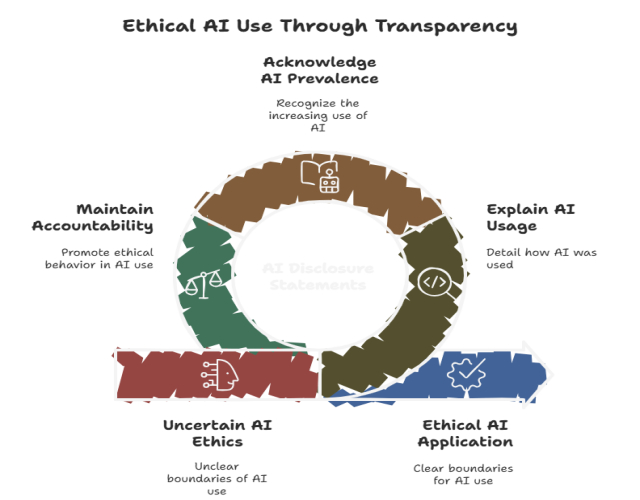
When uncertain about boundaries, transparency provides protection. Some institutions now require AI disclosure statements where students explain how AI was used in their work. This approach acknowledges AI's inevitability while maintaining accountability.
Being transparent about AI use demonstrates integrity even when technically prohibited use occurs, often resulting in educational conversations rather than academic penalties.
How Do Universities Detect AI-Generated Writing?
Understanding detection helps students make informed choices about AI use and avoid unintentional violations.
- AI Detection Software
Universities deploy multiple tools including Turnitin AI Detection, GPTZero, Originality.ai, and ZeroGPT. These analyze writing patterns, sentence structure variation, and linguistic markers distinguishing AI from human writing.
Current detection achieves 70-92% accuracy depending on the tool and content type. However, false positives occur in 15-25% of cases, incorrectly flagging human writing as AI-generated. This creates legitimate concerns about students being wrongly accused.
- Detection Limitations
AI detectors struggle with: - Heavily edited AI content with significant human revision - Technical writing with naturally consistent terminology - Short text samples under 300 words - Non-English languages and translations - Mixed human and AI writing
A 2025 study found detection accuracy drops to 64% for content that's 50% human-written and 50% AI-generated, making partial AI use harder to identify than complete AI generation.
- Human Detection Methods
Experienced instructors identify AI writing through:
- Style inconsistency:
Sudden changes in writing quality, vocabulary sophistication, or argumentation depth between assignments.
- Topic-specific knowledge gaps:
AI-generated work often lacks specific examples, misses current developments, or includes outdated information.
- Generic analysis:
AI produces broad, surface-level analysis lacking the specific insights and connections human students develop through genuine engagement.
- Assignment-specific impossibilities:
Responses referencing in-class discussions the AI couldn't access, or personal experiences the AI couldn't have.
- Verification Techniques
Professors increasingly use verification methods beyond detection software:
- In-class writing samples: Comparing submitted work against timed, supervised writing to establish each student's baseline style and capability.
- Process documentation: Requiring drafts, outlines, research notes, and revision histories demonstrating work development.
- Oral defenses: Asking students to explain their arguments, methodology, and sources in conversation, revealing whether genuine understanding exists.
- Personalized questions: Including assignment elements requiring specific course knowledge, personal reflection, or original synthesis AI cannot produce.
Students using different essay writing services should verify services produce genuinely human-written content that passes both automated and human detection, as sophisticated professors identify AI patterns even when software doesn't.
What Skills Must Students Develop in the AI Era?
AI changes which writing skills matter most, requiring students to adapt their development priorities.
Critical Evaluation of AI Outputs
Students must verify AI-generated information, identify logical fallacies in AI arguments, recognize fabricated citations, and assess whether AI suggestions actually improve their work. Blind trust in AI outputs creates significant academic risks.
Research shows students who systematically verify AI information avoid 91% of errors compared to those accepting outputs uncritically.
Prompt Engineering
Getting useful AI outputs requires precise, well-structured questions providing adequate context and specifying desired output characteristics. Vague prompts produce generic, unhelpful responses.
Students proficient in prompt engineering complete research tasks 38% faster than those using basic queries, making this a valuable efficiency skill.
Synthesis and Original Analysis
AI summarizes and explains existing information well but struggles with genuine synthesis across sources, original insights requiring intuitive leaps, and nuanced arguments acknowledging complexity. These human capabilities become more valuable as AI handles basic tasks.
Employers increasingly prioritize synthesis and original thinking—the skills AI can't replicate—over information processing AI performs efficiently.
Contextual Understanding
AI misses subtle context, cultural nuances, and implicit assumptions affecting interpretation. Students must develop contextual awareness AI lacks, particularly for complex social, historical, or cultural topics.
Meta-Cognitive Awareness
Students need clear understanding of when AI helps versus hurts their learning. Using AI to avoid developing necessary skills creates long-term disadvantages. Strategic AI use enhances capabilities rather than replacing them.
Studies indicate students with strong meta-cognitive awareness use AI 45% more effectively than those lacking self-awareness about their learning needs.
Ethical Reasoning
Navigating AI use requires sophisticated ethical judgment about acceptable assistance boundaries, transparency requirements, and long-term learning impacts. This reasoning develops through practice and reflection.
Students working with a fast essay writing services should consider these services as learning opportunities, studying how professional writers structure arguments and synthesize sources rather than treating completed work as final products requiring no engagement.
Conclusion: Navigating Academic Writing's AI Revolution
AI has irrevocably changed academic writing, creating both powerful tools and serious pitfalls. Success requires understanding these key principles:
- AI is a tool, not a replacement for genuine thinking, learning, and skill development
- Ethical boundaries vary by institution and instructor—always clarify expectations explicitly rather than assuming
- Detection technology continues improving but remains imperfect, creating both risk of getting caught and false accusation risks
- Strategic AI use enhances learning when it removes obstacles while preserving substantive intellectual work
- Skills AI can't replicate become more valuable—synthesis, original analysis, contextual understanding, and ethical reasoning
The students succeeding in this new landscape aren't those avoiding AI or those using it to bypass learning. They're those using AI strategically to enhance their capabilities while developing the uniquely human skills that AI cannot replicate and employers increasingly demand.
Develop clear personal ethics about AI use. Understand your institution's policies thoroughly. Use AI transparently when uncertain. Focus on building genuine understanding rather than optimizing grades through shortcuts. These principles protect both your academic standing and your long-term professional development.
Academic writing in the AI era requires more sophisticated thinking, not less. It demands stronger critical evaluation, more rigorous verification, and clearer ethical reasoning. Students who embrace these challenges while leveraging AI appropriately position themselves for success in academic environments and careers where AI is ubiquitous but human judgment remains irreplaceable.
The future belongs not to those who can use AI best, but to those who can think best while using AI responsibly. Develop that capability now, and you'll thrive regardless of how technology continues evolving.