-19820.jpg)
What Makes Group Study and Solo Study Different?
Group study and solo study engage different cognitive processes and serve distinct learning purposes. Understanding these fundamental differences prevents you from using the wrong approach for your current learning needs.

Solo Study: Deep Processing and Personalized Learning
When you study alone, you control your pace, depth, and focus completely. You can spend 30 minutes on a single difficult concept without feeling pressure to move on. You can review material you already understand quickly and linger on challenging sections. This personalization is the solo study's greatest strength.
Solo study also enables deep concentration work. Without social obligations or conversation, your brain can enter flow states where complex problem solving and concept integration become possible. Research on cognitive load shows that learning difficult new material requires focused attention that social interaction disrupts.
A 2024 study tracked 600 engineering students learning calculus. Students who did their initial problem solving in solo sessions mastered concepts 25% faster than students who attempted initial learning in groups. The solo students could work at their own pace without distraction, while group students experienced constant interruptions and social pressure to keep pace with others.
Group Study: Testing Understanding and Collaborative Learning
Group study's power comes from explaining concepts to others and hearing alternative perspectives. When you explain a topic to a classmate, you discover gaps in your understanding that felt complete when studying alone. When someone asks, "But why does that work?" you must articulate the reasoning you had only vaguely grasped.
Groups also provide immediate feedback and error correction. If you misunderstand something, a group member can catch it immediately rather than letting you practice incorrect methods. This real-time correction prevents the reinforcement of errors that solo study sometimes allows.
Research from educational psychology demonstrates this clearly. A 2023 study examined 800 students preparing for biology exams. Students who used group study sessions to test their understanding after solo learning scored 18% higher than students who only studied alone. The group testing revealed misunderstandings, while there was still time to correct them.
The Social Dimension of Learning
Group study provides motivation and accountability that solo study lacks. When you commit to meeting a study group, you're more likely to actually study. Group members can push each other to tackle difficult material they'd avoid alone. This social pressure becomes productive rather than distracting when used strategically.
However, groups can also enable social loafing, where students rely on others to carry the cognitive load. This happens when groups aren't structured properly, turning study sessions into social time with minimal learning. Effective group study requires clear goals and active participation from everyone.
For students managing heavy academic loads and finding that unstructured group sessions consume more time than they provide value, many use an essay writing service for specific assignments, allowing them to focus group time on genuine collaborative learning rather than generic work sessions.
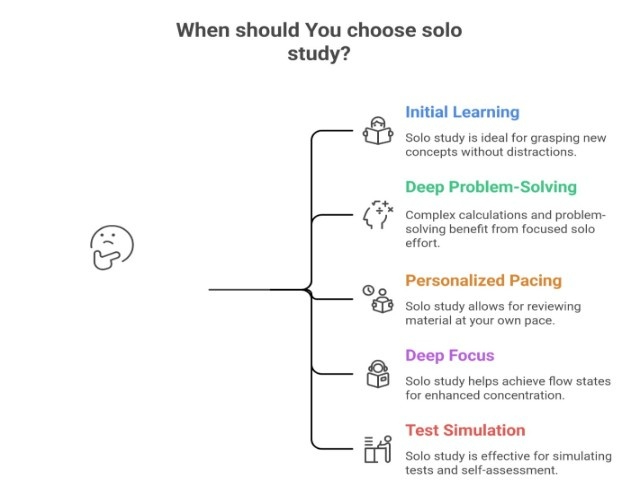
When Should You Choose Solo Study?
Solo study is essential for specific learning tasks where groups become counterproductive. Recognize these situations and commit to studying alone.
1. Initial Learning of New Material
Study alone when encountering content for the first time. Your brain needs uninterrupted focus to process new concepts, build initial understanding, and create mental frameworks. Group discussion before you have basic comprehension leads to confusion rather than clarity.
Read your textbook alone. Watch lecture videos alone. Work through your first pass at understanding new material in focused solo sessions. Only after you have baseline comprehension should you bring concepts to a group for testing and refinement.
Students who try to learn new material in groups report feeling overwhelmed and confused. They spend mental energy following others' explanations rather than building their own understanding. Solo initial learning lets you work at your natural pace and develop personal connections to material.
2. Deep Problem-Solving and Complex Calculations
Work on challenging STEM problems alone first before discussing them with groups. Wrestling with difficult problems independently builds problem solving skills that copying group solutions never develops. The struggle is where learning happens.
When you immediately jump to group problem solving, you risk becoming a passive observer watching stronger students work. You don't develop your own problem-solving approaches. You don't learn to persist through difficulty. These skills only come from solo struggle.
After you've attempted problems independently, even if you got stuck or made mistakes, group discussion becomes valuable for understanding alternative approaches and correcting errors. But that solo attempt first is non negotiable for skill development.
3. Personalized Pacing and Review
Study alone when you need to move at your own speed. Maybe you need extra time on thermodynamics, but breeze through kinematics. Maybe you already understand the material that everyone else is confused about. Groups force you into average pacing that serves no one optimally.
Use solo study for:
This strategic time allocation ensures you spend effort where you actually need it rather than where group consensus dictates. |
4. Deep Focus and Flow States
Choose solo study for tasks requiring sustained concentration. Writing complex analyses, working through mathematical proofs, or creating detailed study guides demands uninterrupted cognitive flow. Even well intentioned group members break concentration with questions or discussions.
Research on cognitive performance shows that it takes 15 to 20 minutes to achieve deep focus after each interruption. In a 2 hour group study session with frequent interruptions, you might achieve only 20 to 30 minutes of actual deep work. Those same 2 hours alone could provide 90+ minutes of focused productivity.
For tasks where depth matters more than breadth, comprehensive essay outlining, complex problem analysis, creative synthesis, and solo study produce superior results.
5. Test Simulation and Self-Assessment
Practice exams should be completed alone under realistic conditions. You won't have group members helping during the actual exam. Solo practice tests reveal your true preparation level without the false confidence that group problem-solving creates.
Take practice exams in exam like conditions: timed, closed notes, no interruptions. This honest assessment shows exactly where you need more work. Group practice test sessions often devolve into collective problem-solving that masks individual weaknesses.
Many students find that while they handle solo practice tests and problem solving independently, they benefit from professional essay writing support for major papers, creating bandwidth for the intensive solo practice that builds exam readiness.
When Should You Choose Group Study?
Group study serves specific purposes that solo study cannot achieve. Use groups strategically for these high value activities.

1. Testing Your Understanding Through Teaching
Join a study group after you've studied solo to test whether you truly understand the material. Explaining concepts to others reveals gaps in your knowledge. If you can't articulate something clearly, you don't understand it well enough yet.
Research calls this the teaching effect; teaching material to someone else is one of the most powerful learning techniques available. A 2024 study found that students who regularly explained concepts to peers retained 40% more information than students who only studied independently.
Create group sessions specifically for teaching rounds: each person explains a different topic to the group. This forces everyone to prepare and gives everyone practice articulating understanding. The questions others ask expose weaknesses in your grasp of the material.
2. Getting Alternative Perspectives and Approaches
Use groups when you're stuck on concepts that solo study isn't clarifying. Other students approach problems differently and might have insights that unlock your understanding. Their alternative explanations can provide the "aha moment" your solo work missed.
This is especially valuable in subjects like physics, economics, or philosophy, where multiple valid approaches exist. Hearing how others think about problems expands your cognitive toolkit. One group member's metaphor or visualization might make everything click.
Group problem solving sessions work best after everyone has attempted problems independently. Come prepared with specific questions and difficulties. "I got stuck at step 3 on problem 7" generates more value than "Can someone explain this whole chapter?"
3. Maintaining Motivation and Accountability
Join study groups when you struggle with procrastination or motivation. The social commitment creates accountability that self-discipline sometimes can't provide. Knowing others expect you to show up prepared increases follow-through.
Groups are particularly valuable during long-term projects or when preparing for comprehensive exams. The sustained effort required becomes more manageable with peer support. Group members can encourage each other through difficult material and celebrate progress together.
However, don't let group study replace solo work. Groups supplement individual effort; they don't substitute for it. Students who only study in groups often discover too late that they've been socially engaged but haven't actually learned the material.
4. Dividing and Conquering Large Content Volumes
Use study groups to efficiently cover large amounts of material by dividing topics and teaching each other. For cumulative finals covering 15 weeks of content, groups can assign each member 2 to 3 weeks to master and then teach.
This works when everyone takes the division seriously and actually masters their assigned material. It fails when people show up unprepared, and everyone ends up confused. Set clear expectations: each person presents their topics as if teaching a class, with examples, practice problems, and the ability to answer questions.
Research shows this approach works well for breadth but not depth. Use it for a comprehensive review after you've already learned the material initially through solo study. Don't use it as your primary learning method, or you'll have a shallow understanding full of gaps.
5. Verbal Processing and Discussion-Based Subjects
Group study excels for humanities subjects requiring interpretation and argumentation. Discussing literature, debating historical interpretations, or analyzing philosophical arguments benefits from multiple perspectives and verbal processing.
When preparing for essay exams or discussion-based courses, group study sessions that simulate class discussions help you refine arguments and consider counterpoints. Verbal debate strengthens your thinking in ways that silent reading cannot.
For students managing multiple discussion-based courses and finding that group essay prep consumes too much time, many use a reliable essay writing service for specific papers, allowing them to focus group time on genuine intellectual exchange rather than basic assignment completion.
Group Study vs Solo Study: A Complete Comparison
Understanding exactly when to use each approach maximizes learning efficiency and prevents wasted time.
| Situation | Best Approach | Why |
|---|---|---|
| First exposure to new material | Solo Study | Need uninterrupted focus for initial comprehension; groups create cognitive overload |
| Testing understanding | Group Study | Explaining to others reveals knowledge gaps; questions expose weak areas |
| Complex problem-solving | Solo First, Then Group | Independent struggle builds skills; group discussion provides alternatives |
| Memorization and drilling | Solo Study | Personalized pacing; no benefit from social interaction for rote tasks |
| Getting unstuck | Group Study | Alternative perspectives can provide breakthroughs |
| Maintaining motivation | Group Study | Social accountability increases follow-through |
| Deep concentration work | Solo Study | Interruptions prevent flow states needed for complex thinking |
| Practice exams | Solo Study | Must simulate real exam conditions without help |
| Dividing large content | Group Study | Efficient for a comprehensive review of broad material |
| Discussion and debate | Group Study | Multiple perspectives strengthen argumentation |
| Personalized weak areas | Solo Study | Groups can't address your specific gaps efficiently |
| Final exam preparation | Both (Strategically) | Solo for practice tests; group for concept review |
Time Allocation Recommendations
For typical coursework, optimal allocation is approximately:
|
For comprehensive exams or major projects:
|
For discussion-based humanities courses:
|
These ratios ensure you develop a deep personal understanding while gaining group benefits. Students who invert these ratios primarily studying in groups consistently underperform despite feeling socially engaged and busy.
Choosing Your Approach: Decision Framework
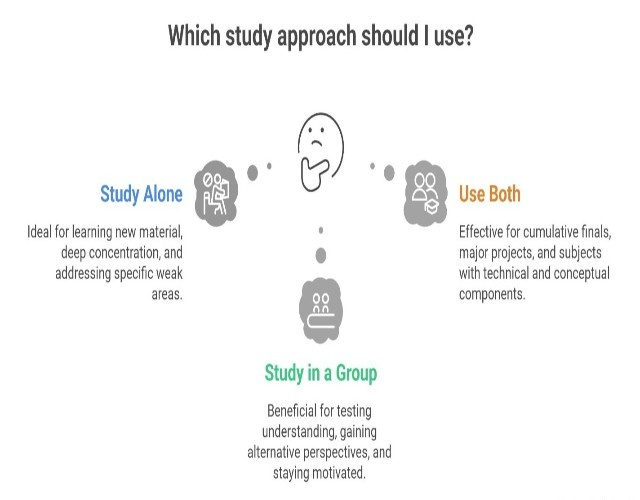
Study alone if:
|
Study in a group if:
|
Use both when:
|
For students discovering they've over-relied on one approach and need to rebalance quickly, combining corrected study strategies with targeted support from a trusted essay writing service for specific papers can help restore academic performance while building better study habits.
How to Make Group Study Actually Effective
Most study groups fail because they lack structure and a clear purpose. Follow these guidelines to make group sessions productive.

1. Set Clear Goals Before Each Session
Decide exactly what the group will accomplish before meeting. "Study for the midterm" is too vague. "Review chapters 5 to 7, quiz each other on key concepts, work through practice problems 15 to 20 together" is specific and actionable.
Send session goals 24 hours in advance so everyone can prepare. Unprepared group members waste everyone's time. If someone consistently shows up unprepared, remove them from the group. This isn't social time, it's learning time.
2. Limit Group Size to 3-5 People
Groups larger than 5 become inefficient with too much social overhead and too little active participation per person. Groups smaller than 3 lack diversity of perspectives. The sweet spot is 3 to 4 people for most subjects, occasionally 5 for dividing large content volumes.
Choose group members at similar skill levels when possible. Mixed ability groups often devolve into tutoring sessions where strong students teach and weak students passively receive. Everyone learns more in groups where participants contribute roughly equally.
3. Use Active Study Techniques
Don't just read notes together or highlight textbooks. These passive activities don't benefit from group settings. Instead, actively engage
Active techniques force engagement and reveal understanding gaps. Passive group reading is social time masquerading as studying. |
4. Assign Roles and Rotate Responsibilities
Structure prevents social loafing. Assign roles for each session:
|
Rotate these roles each session so everyone practices different skills and shares responsibility. This structure transforms groups from casual chat into productive learning environments.
5. Schedule Regular Short Sessions
Frequent 60-90 minute sessions work better than occasional marathon meetings. Meet 2 to 3 times per week for focused work rather than once per week for 4 hours. Shorter sessions maintain energy and focus while fitting more easily into busy schedules.
End sessions by setting goals for the next meeting and individual solo work. This creates continuity and accountability. Everyone knows what to prepare and what the group will accomplish next time.
6. Use Physical Spaces That Support Focus
Choose study locations that minimize distractions and enable productive work. Libraries with group study rooms work well. Coffee shops often have too much ambient noise and social energy. Dorm rooms invite social conversation rather than focused study.
The space should have:
- Large tables for spreading out materials.
- Whiteboards or large paper for working through problems.
- Minimal distractions and quiet enough for concentration.
- Enough space for everyone to work comfortably,
Physical environment significantly impacts group productivity. Choose intentionally.
Many students find that well structured group study sessions complement their solo work effectively, while using a fast essay writing service for specific high-stakes papers allows them to maintain this balanced approach without overwhelming time pressure.
Common Mistakes Students Make With Both Approaches
Avoid these errors that sabotage learning, whether you study alone or in groups.
Solo Study Mistakes
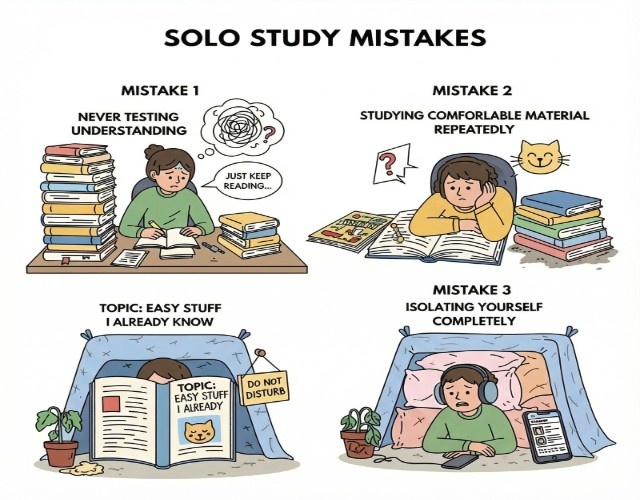
Mistake 1: Never Testing Understanding
Students read and review material repeatedly, but never test whether they can actually recall and apply it. Solo study without self-testing creates illusions of competence. You recognize information when you see it, but can't produce it from memory.
| Solution: Build regular self testing into solo study. After each study session, close your notes and write everything you remember. Create practice questions and answer them without referring to materials. Solo study should include more retrieval practice than passive review. |
Mistake 2: Studying Comfortable Material Repeatedly
When studying alone, students naturally gravitate toward topics they already understand while avoiding difficult material. This feels productive but doesn't address actual weaknesses. You end up over-prepared in some areas and dangerously unprepared in others.
| Solution: Use practice tests and self assessment to identify weak areas, then force yourself to tackle them in solo sessions. Make solo study time about addressing gaps, not reinforcing strengths. Schedule specific solo sessions for your most difficult topics. |
Mistake 3: Isolating Yourself Completely
Some students avoid groups entirely and never test their understanding against others or get external perspectives. They develop an idiosyncratic understanding full of blind spots that groups would have caught.
| Solution: Even if you primarily study alone, schedule occasional group sessions to test your understanding and get feedback. Complete independence isn't optimal; strategic social validation reveals errors solo study misses. |
Group Study Mistakes
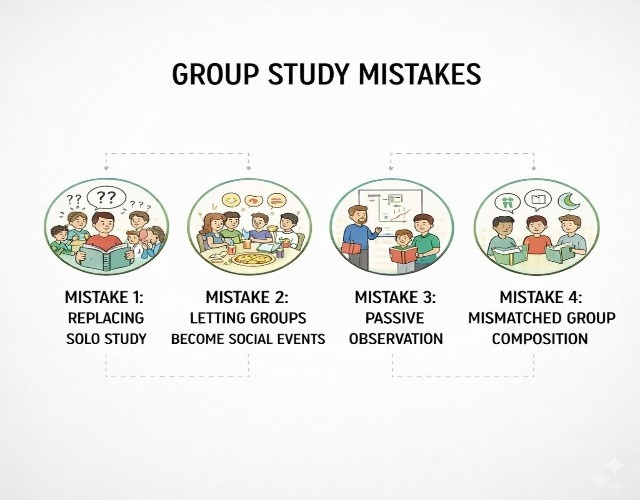
Mistake 1: Replacing Solo Study With Group Study
Students attend group sessions without doing the prerequisite solo work. They arrive unprepared, contribute little, and rely on others to explain everything. This creates a false sense of confidence; they feel busy and engaged, but haven't actually learned.
| Solution: Make solo study primary and group study supplementary. Arrive at groups having already studied independently. Use groups to test and refine understanding, not to receive initial explanations. |
Mistake 2: Letting Groups Become Social Events
Study groups often devolve into social gatherings with occasional studying. Students chat about weekend plans, gossip about classes, and spend 30 minutes of every hour off-task. This social time feels like studying because you're with classmates discussing school.
| Solution: Set strict time boundaries and norms. "First 75 minutes we study without social conversation. Last 15 minutes we can chat." Have a designated facilitator who keeps the group on task. If a group consistently wastes time, leave it. |
Mistake 3: Passive Observation Instead of Active Participation
In groups, weaker students often watch stronger students solve problems without engaging themselves. They copy solutions and think they understand because they followed along. Then they get to exams and can't perform independently.
| Solution: Require everyone to attempt problems independently before group discussion. Each person must articulate their approach. Don't allow passive spectators; if someone consistently doesn't contribute, they shouldn't attend. |
Mistake 4: Mismatched Group Composition
Groups with vastly different skill levels become inefficient. Strong students grow frustrated repeating basics. Weak students feel overwhelmed and embarrassed. Different-paced students create scheduling conflicts over how much to cover per session.
| Solution: Choose group members at similar levels and with compatible study goals. It's okay to have separate groups for different courses or to leave groups that don't match your needs. Compatibility matters more than friendship. |
For students discovering they've made these mistakes and need immediate academic recovery, combining corrected study approaches with strategic support from a legit essay writing service for upcoming papers can stabilize performance while building sustainable habits.
Conclusion: Strategic Use of Both Approaches Maximizes Learning
The research is clear: students who strategically combine group study and solo study score 15-20% higher than those who exclusively use either method. Solo study builds deep understanding and personal problem solving skills through focused practice. Group study tests that understanding, provides alternative perspectives, and maintains motivation through social accountability. The key is knowing when to use each approach rather than defaulting to one pattern.
Key Takeaways:
- Use solo study for initial learning, deep concentration work, practice testing, and personalized pacing (70% of time)
- Use group study for testing understanding through teaching, getting alternative perspectives, and maintaining accountability (30% of time)
- Study alone first, then bring a prepared understanding to groups for testing and refinement
- Structure group sessions with clear goals, active techniques, and assigned roles to prevent social loafing
- Choose group members at similar skill levels with compatible goals and work ethics
- Test yourself independently to verify that group study is actually improving your capabilities
Stop defaulting to comfortable patterns that don't serve your learning needs. Study alone when deep focus, personalized pacing, or honest self-assessment matters. Studying in groups when testing understanding, gaining perspectives, or maintaining motivation provides value. This strategic flexibility transforms both approaches from habits into tools you deploy intentionally.
For students managing demanding academic schedules while implementing this balanced study approach, strategic use of an urgent essay writing service for specific high stakes assignments allows you to maintain optimal study practices across all courses without compromising on solo practice, group participation, or assignment quality.
Assess your current patterns today. Are you over relying on groups and avoiding necessary solo practice? Are you isolating yourself and missing valuable group feedback? Adjust toward strategic balance and watch your learning effectiveness compound.