-20004.jpg)
What Is a Reflective Essay?
A reflective essay is a piece of writing where you examine a personal experience and explore what you learned from it. Unlike other essays that analyze external subjects, reflection focuses inward, on your thoughts, feelings, and growth.
The key difference
- Narrative essay: Tells a story with vivid details.
- Reflective essay: Tells a story AND analyzes what it means for your development
Every reflective essay has three core elements
- Description: What happened (the experience itself)
- Reflection: How you felt and what you thought
- Analysis: What you learned and how you changed
What makes a reflective essay "academic"?
You're not just journaling. You're using your experience as evidence to explore broader themes: growth, learning, identity, challenge, and perspective shifts.
The characteristics of reflective writing include introspection, honesty, and making connections between experience and learning. You're essentially answering: "What happened, so what, and now what?"
Struggling to Put Your Experience into Words?
Our writers help you transform personal experiences into polished reflective essays.
- 100% human written
- Custom written from scratch for every order
- Delivered on time, every time
- Unlimited revisions
No AI. Just real writers, real results.
Order NowWhen You'll Write Reflective Essays
Reflective essays appear across different contexts:
1. Academic Settings
- Nursing students reflecting on clinical experiences.
- Education majors analyzing teaching practicums.
- English classes examining personal responses to literature.
- Psychology courses exploring self awareness.
2. Professional Settings
- Job applications and internship reflections.
- Performance reviews and professional development.
- Portfolio reflections for certifications.
3. Personal Development
- Scholarship applications.
- College admission essays (Common App prompts).
- Study abroad or service learning reflections.
The format stays the same, only the subject changes.
How to Write a Reflective Essay (Step by Step)
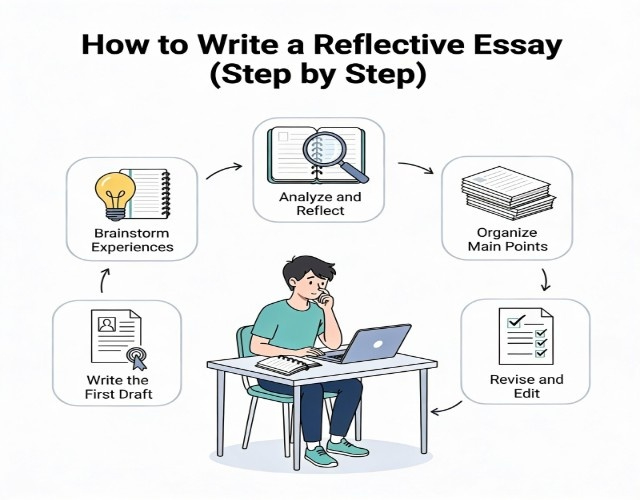
Writing a reflective essay doesn't require special talent, just an honest examination of your experience. Here's how to do it.
Step 1: Choose Your Experience
Pick something meaningful, not just convenient. The best reflective essays examine experiences that genuinely changed you.
Strong choices
|
Weak choices
|
The test: Can you identify a specific before and after? If you're the same person at the end as the beginning, the experience isn't reflective material yet.
| Need inspiration? Check our reflective essay topics organized by category: education, personal growth, career, relationships, and more. |
Step 2: Map Your Experience
Before writing, answer these questions:
What happened?
|
How did you feel?
|
What did you learn?
|
These questions form your raw material. Jot down honest answers; you'll organize them later.
Step 3: Identify Your Thesis
Yes, reflective essays need a thesis. It's not just storytelling.
Your thesis should capture the lesson or insight that the experience taught you.
Formula:
[Experience] taught me/revealed/showed me [specific insight about yourself, others, or life]
Examples:
| Weak: "I will write about my first job." Strong: "My disastrous first shift as a server taught me that failure is often the best teacher, when you're willing to learn from it." |
| Weak: "Studying abroad was a good experience." Strong: "Living in Spain forced me to confront my assumptions about communication, revealing that connection transcends language when you lead with curiosity." |
Your thesis should be specific and meaningful, not vague or obvious.
Step 4: Create Your Structure
Reflective essays follow a clear structure that balances narrative and analysis.
Introduction
- Hook with a vivid moment or question.
- Brief context about the experience.
- Thesis statement (your main insight)
Body Paragraphs (typically 3 to 5)
- Chronological narrative OR thematic organization.
- Each paragraph includes: description + reflection + analysis.
- Show, don't just tell, use specific details
Conclusion:
- Summarize key insight.
- Explain how you've changed.
- Project forward, how will this affect your future?
How long? Most reflective essays run 500 to 1,500 words, depending on the assignment. Check your prompt.
Step 5: Write With Honesty
Reflection requires vulnerability. Don't sanitize your experience to sound impressive.
Be honest about
|
Why authenticity matters: Generic reflections earn generic grades. Specific, honest examination of real struggles shows genuine learning.
Example:
Generic: "I learned teamwork is important." The second example is vulnerable (admitting the mistake) and specific (showing exactly what happened and what changed). |
Step 6: Balance Description and Analysis
The biggest mistake in reflective writing? Too much storytelling, not enough reflection.
The 40 to 60 Rule
|
How to analyze
|
Example paragraph balance
Description (40%): "During my first clinical rotation, I froze when asked to start an IV. My hands shook, and I couldn't find the vein. The patient looked uncomfortable, and my supervisor had to take over."
Analysis (60%): "That moment forced me to confront the gap between classroom confidence and real world pressure. I realized I'd been so focused on memorizing procedures that I hadn't prepared emotionally for the responsibility of causing someone pain, even therapeutic pain. This experience taught me that nursing competence isn't just technical skill, it's the ability to manage your own anxiety while maintaining patient trust. Now, I practice mindfulness techniques before clinical shifts and remind myself that every expert once had shaking hands."
Notice: The experience is brief. The reflection is deep.
Step 7: Revise for Depth
First drafts tend to skim the surface. Revision is where you dig deeper.
Revision questions
|
Read your draft and highlight every sentence that analyzes or reflects. If less than 60% of your essay is highlighted, you need more analysis.
How to Start a Reflective Essay
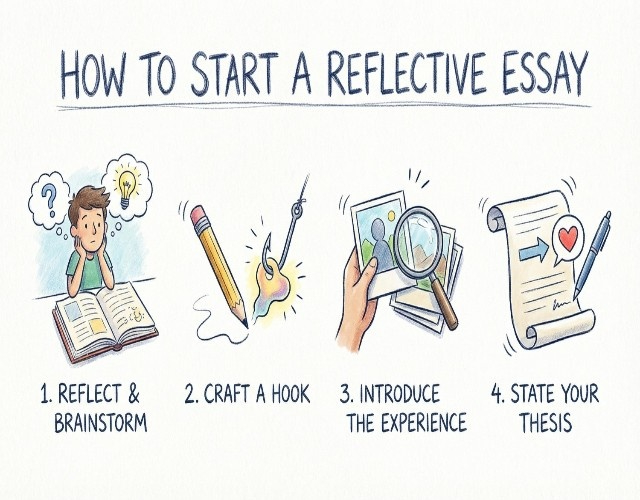
Your opening sets the tone for everything that follows. Here's how to hook readers immediately.
Opening Strategy #1: Start In the Middle of the Action
Drop readers directly into a pivotal moment, no preamble.
- Example:
"The patient's daughter was screaming at me, and I had no idea what to say. My hands were still shaking from missing the IV insertion for the third time. This was hour two of my first clinical rotation, and I already wanted to quit nursing." - Why it works: Immediate tension. Readers want to know what happens next and how you handled it.
Opening Strategy #2: Begin With a Realization
Open with the insight itself, then backtrack to show how you got there.
- Example:
"I used to think asking for help was a weakness. Then I failed organic chemistry and realized the opposite was true: refusing help was the real weakness, and it was costing me everything I'd worked for." - Why it works: The thesis is clear from sentence one. Now you've set up the "before" mindset, and readers want to see the transformation.
Opening Strategy #3: Use a Striking Contrast
Juxtapose your before and after to highlight the change.
- Example:
"Six months ago, I would have called myself a perfectionist. Today, I'd call myself recovering. The difference? I've learned that perfectionism isn't about excellence, it's about fear disguised as standards." - Why it works: Immediately establishes growth. The contrast makes readers curious about what happened between "before" and "after."
Opening Strategy #4: Start With Dialogue
A powerful quote from the experience can hook readers instantly.
- Example:
"'You're trying too hard to be what you think we want,' my interviewer said, mid sentence. I froze. She'd seen through my carefully rehearsed answers, and in that moment, I realized I had no idea who I actually was outside of achievement metrics." - Why it works: Dialogue is active and immediate. It feels like a scene from a movie, pulling readers into the moment.
What Your Opening Must Include:
| A hook: Something that grabs attention (vivid moment, surprising insight, tension). |
| Context: Brief setup (when/where/what happened). |
| Thesis: Your main insight or lesson. |
Keep it under 150 words. Get to the point fast, you can provide background later if needed.
Common Opening Mistakes
- Starting with broad philosophical statements
"Throughout human history, people have learned from their mistakes..." - Dictionary definitions
"Merriam Webster defines reflection as..." - Overly formal announcements
"This essay will examine my experience during my internship and discuss what I learned about professional communication." - Too much setup before getting to the story
Don't spend 200 words on background. Hook first, context later.
How to End a Reflective Essay (Conclusion Strategies)
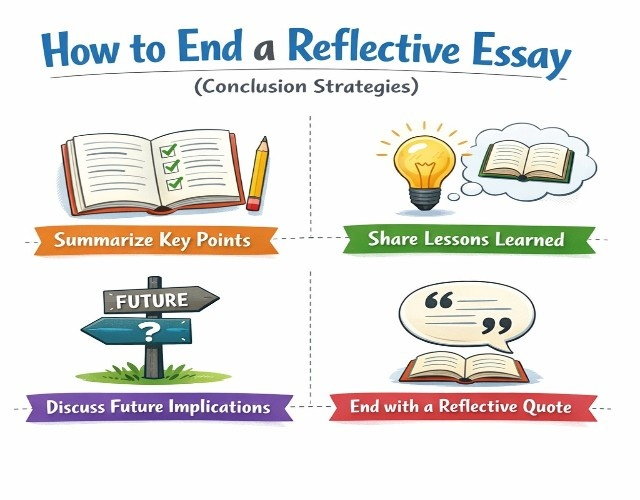
Your conclusion should feel like closure, not just a summary. Here's how to end powerfully.
Conclusion Strategy #1: The Full Circle Ending
Return to an image or moment from your introduction, but show how your understanding has changed.
Example:
- Opening: "I stood in front of my debate team, about to announce my decision to quit."
- Closing: "That moment in front of my debate team, the one where I said 'I quit', felt like failure at the time. Now I see it differently. Walking away wasn't giving up on success; it was redefining it. Sometimes the bravest thing you can do is stop doing what you're good at to discover what actually matters to you."
- Why it works: Creates satisfying narrative structure. Readers recognize the callback and see how your interpretation evolved.
Conclusion Strategy #2: The Forward Projection
Show how this lesson will affect your future choices.
- Example:
"I won't claim I've mastered patience. Old habits resurface when I'm stressed. But now I catch myself. When I feel the urge to control every detail of a project, I hear Sarah's voice: 'Did you even want a team?' That question stops me every time. Moving forward, I'm committed to asking more questions and making fewer assumptions. Leadership isn't something I am; it's something I practice, imperfectly, one decision at a time." - Why it works: Shows ongoing growth. Reflection isn't a one time epiphany; it's a continuous process.
Conclusion Strategy #3: The Universal Truth
Connect your specific experience to a broader life lesson.
- Example:
"My host mother in Osaka taught me something I hadn't learned in any classroom: connection doesn't require perfection. Whether you're stumbling through a new language, navigating an unfamiliar culture, or just trying to make a friend, the willingness to be imperfect is what creates real human bonds. Competence impresses people. Vulnerability connects them." - Why it works: Elevates your personal story to universal wisdom. Others can apply your insight to their own lives.
Conclusion Strategy #4: The Honest Assessment
Acknowledge complexity; you haven't "fixed" everything, but you've grown.
- Example:
"I can't say I'm glad Mr. Chen died during my shift. I'm not. His death was tragic, and his daughter's grief was real. But I am grateful for what that moment taught me about nursing. I'll never be the nurse who saves every patient; that nurse doesn't exist. But I can be the nurse who stays present when saving isn't possible. That's not the nursing career I imagined, but it's the one I'm choosing." - Why it works: Avoids false positivity. Real reflection acknowledges ongoing struggle while showing growth.
Common Conclusion Mistakes
- Starting with "In conclusion..."
Readers know it's the conclusion, don't announce it. - Introducing completely new information
Your conclusion resolves existing threads; it doesn't open new ones. - Just repeating your introduction verbatim
Reframe your insight to show evolution, don't copy paste. - Ending abruptly with no closure
Your last sentence should feel final, not like you ran out of space. - Overpromising future change
"I will never make this mistake again" sounds naive. "I'm now aware of this pattern and actively working on it" sounds mature.
Need Help Turning Experience into Insight?
We Write Reflective Essays That Actually Reflect You
- Thoughtful, introspective writing (not generic filler)
- Academic structure that balances story + analysis
- Tailored for nursing, teaching, internships, admissions & more
- Delivered fast with revisions included
You focus on the experience, our writers turn it into a polished reflective essay that earns grades.
Order NowReflective Essay Structure & Format
Here's the standard structure with guidance for each section.
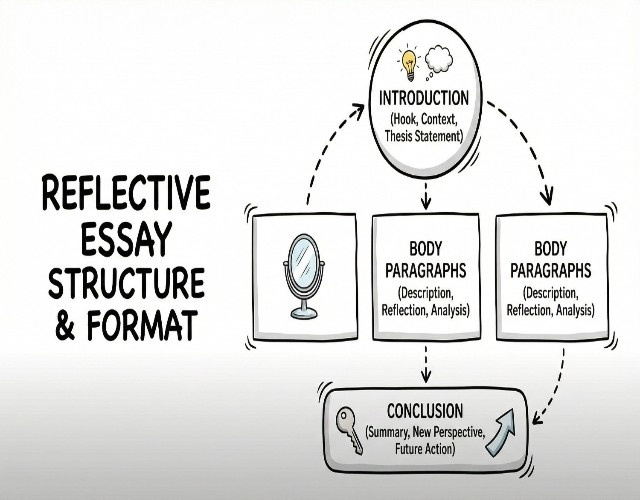
Introduction (10 to 15% of Essay)
Your introduction should accomplish three things quickly:
Hook with a vivid moment
Open with a scene, question, or striking detail that draws readers in.Provide context
Briefly set up when/where/why this experience happened.State your thesis
What's the main insight this experience taught you?
Example introduction:
"I'll never forget the silence after I said, 'I quit.' My debate coach stared at me, waiting for an explanation, but I had none, just exhaustion and the certainty that I'd made the right choice for the wrong activity. Walking away from debate, something I'd built my identity around for four years, taught me that sometimes quitting is the bravest thing you can do. That moment forced me to separate who I was from what I did, revealing that self-worth can't be earned through achievements alone."
Length: 100 to 150 words
H3: Body Paragraphs (70 to 80% of Essay)
Each body paragraph should move your story forward while deepening the reflection.
Paragraph structure:
1. Topic sentence: Previews this section's focus
2. Describe what happened: Specific details, dialogue, sensory information
3. Explain what you thought/felt: Internal experience during the event
4. Analyze what you learned: The deeper meaning or lesson
5. Link to thesis: Connect back to your main insight
Example body paragraph:
[Topic sentence] The moment I realized I was done with debate came during the state finals.
[Description] I sat in the prep room, listening to my teammates strategize, and felt nothing, not excitement, not nerves, just emptiness. I'd spent four years convincing myself I loved this, but in that moment, I finally admitted the truth: I was performing passion, not feeling it.
[Reflection] The admission terrified me. If I wasn't "the debate kid," who was I? My entire college application narrative hinged on this identity.
[Analysis] But pretending was exhausting in a way competition never had been. I realized I'd been afraid to disappoint people who'd invested in my success, my coach, my parents, my teammates. Walking away would mean facing their disappointment and, worse, my own sense of failure. Yet staying felt like betraying myself.
[Link] That tension, between external expectations and internal truth, was the real lesson. Sometimes the hardest growth comes from choosing authenticity over achievement.
Number of body paragraphs: 3 to 5, depending on complexity and length requirements.
H3: Conclusion (10 to 15% of Essay)
Your conclusion should feel like a resolution, not repetition.
What to include:
- Restate your main insight (in fresh language)
- Summarize key learning moments (briefly)
- Project forward: How will this affect your future?
Example conclusion:
"Quitting debate didn't make me a quitter; it made me someone brave enough to change course when something no longer serves me. The identity crisis that followed was painful but necessary, forcing me to discover interests I'd suppressed and relationships I'd neglected. Now, when I'm tempted to persist in something just because I've invested time and energy, I remember that state finals prep room and the relief I felt when I finally admitted the truth. Growth isn't always about pushing through. Sometimes it's about letting go."
Length: 75 to 125 words
Reflective Essay Examples (Annotated)
Here are real examples showing strong reflective writing in action.
Example 1: Clinical Experience (Nursing)
Thesis: My first patient death taught me that nursing isn't about saving everyone; it's about being present when you can't.
Sample body paragraph:
I'd been a nursing student for six months when Mr. John died during my shift. His cancer was terminal, we all knew that, but I'd convinced myself he'd hold on longer. When the monitors started alarming, I froze. My preceptor moved efficiently, silencing alarms, adjusting his position, speaking softly to his daughter. I just stood there, useless. Afterward, I apologized for freezing. She said, "You didn't freeze. You witnessed." That distinction changed everything. I'd been so focused on clinical skills, IVs, medications, and assessments that I'd missed the point. Being present isn't passive; it's active compassion. Mr. John didn't need me to save him; nobody could. He needed someone to see his humanity in that moment. My job wasn't to prevent death, it was to honor it. That shift taught me that nursing excellence isn't measured in saved lives alone, but in dignified deaths, comforted families, and the courage to stay present when everything in you wants to flee.
Example 2: Academic Challenge
Thesis: Failing organic chemistry taught me that intelligence isn't fixed, it's built through struggle and strategic help-seeking.
Sample body paragraph:
When I got my midterm back, a 47%, I felt my pre med dreams evaporate. I'd never failed anything. Failure meant I wasn't smart enough, wasn't cut out for medicine, wasn't who I thought I was. For a week, I avoided office hours, skipped study groups, and told nobody. I was drowning and too proud to ask for a life raft. Then my roommate asked a simple question: "What's your plan?" I didn't have one. That's when it hit me, I'd been treating intelligence like a trait you either have or don't, rather than a skill you develop. "Smart" students weren't avoiding help; they were aggressively seeking it. I'd mistaken silence for competence and help-seeking for weakness. The next day, I showed up to office hours with my disaster of an exam and said, "I don't understand any of this." My professor didn't judge me; she taught me. By finals, I'd attended every tutoring session, joined two study groups, and learned that asking for help isn't admitting defeat; it's admitting you're serious about succeeding. I finished with a B+. More importantly, I finished with a completely different definition of intelligence.
Example 3: Cultural Experience
Thesis: My host family in Japan taught me that hospitality isn't about perfection; it's about making space for imperfect connections.
Sample body paragraph:
During my first dinner with my host family in Osaka, I made every possible mistake. I forgot to say "itadakimasu" before eating. I held my chopsticks wrong. I accidentally pointed at people. My Japanese was terrible, and I kept apologizing, "sumimasen, sumimasen", until my host mother laughed and said in broken English, "Stop, sorry! We learn together!" Her response stunned me. I'd arrived in Japan terrified of being rude, of not knowing enough, of embarrassing myself and them. I thought good guests were perfect guests. But she was telling me the opposite, that stumbling through cross cultural communication was the point, not a problem. When I tried to be perfect, I was distant. When I relaxed and made mistakes, we connected. She taught me her terrible English curse words; I taught her teenage American slang. We laughed more than we conversed clearly. By the end of that dinner, I realized I'd been so focused on not messing up that I'd missed the entire purpose of hospitality, creating connection, not showcasing competence. Real hospitality makes space for your guest's imperfection. It says, "Be yourself, even if yourself is awkward and confused."
| Do you like the above examples? Need ideas? Check out our reflective essay topics page with 240+ ideas organized by category, personal growth, academics, career, relationships, and more |
Tips for Strong Reflective Writing
Beyond structure, these strategies improve reflection quality
1. Use Specific Details
Weak: "I was nervous during my presentation." Specific details make your reflection believable and vivid. |
2. Include Dialogue When Relevant
Direct quotes bring scenes to life and show rather than tell. Example: My mentor said, "Nobody figures it out on the first try. The question is whether you'll try a second time." That reframing changed everything. |
3. Explore Multiple Perspectives
Don't just examine your experience, consider how others might have seen it differently. Example: "I thought I was being helpful by taking charge of the project. My teammate later told me I'd been steamrolling over everyone's ideas. That gap between my intention and their experience forced me to reconsider what 'leadership' actually means." |
4. Use Reflective Language
These phrases signal you're analyzing, not just describing:
|
4. Connect to Learning or Theory (When Appropriate)
For academic reflections, linking personal experience to coursework strengthens your essay. Example: "Experiencing language barriers in Madrid gave me a new appreciation for Vygotsky's theory of language and thought. I realized how much of my identity was tied to linguistic expression. When I couldn't articulate complex ideas in Spanish, I felt cognitively diminished." |
5. Show Ongoing Learning
Strong reflections acknowledge that learning is a process, not a destination. Example: "I haven't perfected patience, but I'm now aware when I'm slipping into old patterns. That awareness itself is growth." |
Downloadable Reflective Essay Resources
Reflective Essay Filled In Template (PDF)
Reflection Question Generator (PDF)
Self Assessment Reflective Essay Checklist (PDF)
Reflective Writing Vocabulary List (PDF)
Annotated Reflective Essay Example Essays Collection (PDF)
Still stuck on how to organize your experience? Get reflective essay help from our professional essay writing service experts who specialize in transforming personal experiences into academic reflections.
Common Reflective Essay Mistakes (And How to Fix Them)
Even strong writers make these errors. Here's how to avoid them.
Mistake #1: Too Much Story, Not Enough Reflection
What it looks like:
Five paragraphs describing your volunteer trip in detail, one paragraph saying "I learned teamwork is important."
Why it's wrong:
You're writing a narrative essay, not a reflective one. Description should serve analysis, not replace it.
Fix:
Follow the 40 to 60 rule. Describe briefly, analyze deeply. Every scene should prompt reflection.
Mistake #2: Vague, Generic Insights
What it looks like:
"This experience taught me to never give up and always try my best."
Why it's wrong:
These lessons are obvious and universal; they could apply to any experience. There's no personal specificity.
Fix:
Dig deeper. What specifically did you learn about HOW to persist? When is giving up actually wise? What assumption about effort was challenged?
Mistake #3: No Clear Change or Growth
What it looks like:
You describe an experience, but end up the same person you started.
Why it's wrong:
Reflection requires transformation. If nothing changed, it's not reflective material.
Fix:
Identify your "before and after." What did you believe before? What do you believe now? What will you do differently?
Mistake #4: Hiding Your Real Feelings
What it looks like:
"It was a good learning experience, and I'm glad it happened."
Why it's wrong:
This is a sanitized reflection, safe, surface level, and unconvincing.
Fix:
Be honest about negative emotions. "I was angry. I felt betrayed. I wanted to quit." Real feelings make real reflection.
Mistake #5: No Connection to Broader Meaning
What it looks like:
You reflect on a specific experience but never zoom out to the larger significance.
Why it's wrong:
Personal reflection becomes academic when you connect individual experience to universal themes.
Fix:
Ask "What does this reveal about me/others/life?" Connect your story to themes like identity, growth, resilience, communication, belonging, etc.
Mistake #6: Writing What You Think They Want to Hear
What it looks like:
"This service trip taught me how privileged I am and how grateful I should be."
Why it's wrong:
If it sounds like what every student writes, it probably is. Readers can spot manufactured epiphanies.
Fix:
Write the truth, even if it's complicated or messy. "I felt uncomfortable with the 'white savior' dynamic and wasn't sure how to help without condescending" is more honest and interesting than generic gratitude.
GET YOUR REFLECTIVE ESSAY DONE
Our writers help you craft powerful reflective essays that showcase your growth.
- Custom written from scratch for every order
- Matched with a writer in your subject area
- Delivered on time, every time
- Full confidentiality guaranteed
100% human written. Satisfaction guaranteed.
Order NowBottom Line
A reflective essay is your chance to show that you don't just have experiences, you learn from them. The best reflections are honest about mistakes, specific about change, and analytical about meaning.
Whether you're reflecting on clinical practice, a personal challenge, or a cultural encounter, the formula is the same: describe briefly, reflect deeply, analyze thoroughly. Use the template above, study the examples, avoid common mistakes, and trust that your genuine insights matter more than trying to sound impressive.
Your experiences have taught you something. A strong reflective essay reveals what that something is.
Good luck, and remember, the messy, honest reflections are always better than the polished, generic ones.