What Causes Homesickness in College Students?
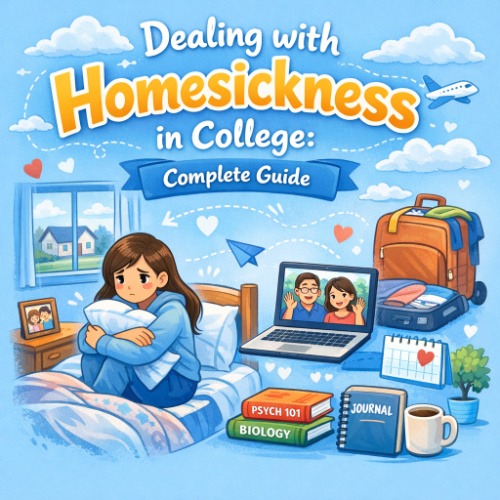
Homesickness in college stems from separation from familiar support systems including family, friends, and romantic partners, loss of comfortable routines and predictable environment, adjustment to independent living without parental structure, identity uncertainty navigating new social dynamics and academic expectations, and grief over ending high school chapter while embracing unknown college future. First-generation students, international students, and those attending college far from home experience particularly intense homesickness with 82% reporting significant adjustment challenges.
Common Homesickness Triggers
Transition-related triggers:
- First few weeks of freshman year (highest intensity period)
- Return to campus after breaks (readjustment after home visits)
- Holidays, birthdays, or family celebrations missed
- Hearing news from home (siblings' milestones, family events)
- Seeing social media posts of friends together at home
- Stressful academic periods (midterms, finals) increasing vulnerability
- Illness or injury when wanting parental care
Environmental triggers:
- Roommate conflicts or loneliness in dorm
- Challenging coursework or academic struggles
- Rejection from clubs, organizations, or social groups
- Romantic relationship difficulties
- Financial stress and money concerns
- Weather differences (moving from sunny to cold climates)
- Cultural differences for international or out-of-state students
Psychological factors:
- Previous separation anxiety or attachment concerns
- Perfectionism creating pressure to immediately succeed
- Comparing yourself to seemingly well-adjusted peers
- Fear of missing out on home life (FOMO)
- Difficulty building new friendships
- Lack of purpose or clear goals
Who Experiences Homesickness Most Intensely?
Research shows certain groups face elevated homesickness risk:
High-risk populations:
- First-generation college students (82% report significant homesickness)
- International students adjusting to culture and language
- Students attending college far from home (500+ miles)
- Those leaving close-knit families or tight friend groups
- Students with previous separation anxiety or mental health concerns
- Athletes or students in demanding programs with limited social time
- Rural students transitioning to large urban campuses
- Students from collectivist cultures (emphasis on family)
Understanding your risk factors helps normalize your experience and identify appropriate coping strategies rather than feeling isolated in your struggle.
When managing homesickness alongside demanding coursework during adjustment period, consider using a professional essay writing service for routine assignments during particularly difficult weeks, allowing focus on building social connections, establishing routines, and engaging in campus activities that directly reduce homesickness and promote successful adjustment.
What Are Effective Coping Strategies for Homesickness?
Effective coping strategies include establishing consistent routines creating structure and predictability, joining 2-3 campus organizations or clubs building community and purpose, maintaining moderate contact with home (2-3 times weekly avoiding excessive daily calling), decorating dorm space with familiar comforting items, engaging in physical activity releasing endorphins and reducing anxiety, practicing self-compassion recognizing adjustment takes time, and seeking professional counseling when homesickness persists beyond 8 weeks or interferes with daily functioning.
1. Build New Support Networks Proactively
Social connection is the most powerful antidote to homesickness, with research showing students who join 2-3 organizations within first month experience 65% less intense homesickness.
Immediate action steps:
- Attend freshman orientation events (force yourself even if uncomfortable)
- Join 2-3 clubs aligned with interests (sports, hobbies, cultural groups)
- Participate in floor activities organized by resident advisors
- Study in common areas or library rather than isolating in dorm
- Introduce yourself to classmates and suggest study groups
- Attend campus events (concerts, speakers, festivals) regularly
- Volunteer for campus or community service projects
- Visit campus recreation center or fitness classes
Conversation starters for new connections:
- "What's your major? What made you choose it?"
- "Where are you from? What's your hometown like?"
- "Have you found any good places to eat around here?"
- "Want to grab lunch between classes sometime?"
- "Are you going to [campus event]? Want to go together?"
Students who actively pursue friendships in first 3-4 weeks report 78% reduction in homesickness intensity by October compared to those who wait for friendships to happen naturally.
2. Establish Comforting Routines and Rituals
Creating predictable routines reduces anxiety and builds sense of control during transitional period.
Daily routine elements:
- Consistent wake-up and sleep schedule (even weekends)
- Regular meal times maintaining healthy eating patterns
- Designated study hours in same location daily
- Physical activity at consistent times (morning run, evening gym)
- Evening wind-down routine (reading, journaling, meditation)
- Weekly check-in with family on specific day/time
Create new college traditions:
- Weekly Sunday brunch with friends at favorite dining hall
- Thursday night game nights or movie nights with floor mates
- Saturday morning farmers market visits or coffee shop study sessions
- Monthly care package exchange with friends from home
- Seasonal campus traditions (homecoming, spring fest participation)
Routines provide structure replacing familiar home patterns while creating new positive associations with college environment.
3. Make Your Space Feel Like Home
Your dorm room significantly impacts comfort levels. Personalizing space helps create sanctuary reducing homesickness triggers.
Dorm decorating strategies:
- Photos of family, friends, pets (not so many it prevents moving forward)
- Favorite blanket, pillow, or stuffed animal from home
- String lights creating warm ambiance rather than harsh overhead lighting
- Posters or artwork reflecting your interests and personality
- Plants adding life and care responsibility
- Comfortable seating (bean bag, cushions) for visitors
- Pleasant scents (candles if allowed, essential oil diffusers)
- Your favorite books, hobby supplies, or instruments
Balance bringing familiar items with acquiring new items representing your college identity and friendships. Don't recreate entire bedroom preventing engagement with new environment.
4. Maintain Healthy Home Contact Balance
Staying connected with home provides comfort, but excessive contact prevents campus adjustment and prolongs homesickness.
Healthy contact patterns:
- 2-3 scheduled calls or video chats weekly (not daily)
- Text updates about highlights (not minute-by-minute narration)
- Share positive experiences and new friendships (not only complaints)
- Limit duration of calls to 30-45 minutes
- Schedule calls at consistent times preventing constant availability
- Avoid calling parents immediately after difficult moments (process first)
Excessive contact warning signs:
- Calling home multiple times daily
- Crying on phone regularly without improving
- Sharing every minor frustration or disappointment
- Parents making decisions for you rather than supporting independence
- Spending free time on phone rather than engaging on campus
- Feeling worse rather than better after home contact
If home contact increases distress rather than providing comfort, reduce frequency and explore campus support resources.
5. Practice Self-Compassion and Patience
Adjustment takes time. Being kind to yourself during transition prevents shame and self-criticism that intensify homesickness.
Self-compassion strategies:
- Acknowledge feelings without judgment: "I'm feeling homesick, and that's okay"
- Remind yourself 70% of students experience this
- Recognize progress even when small (made one friend, attended one event)
- Avoid comparing yourself to seemingly happy peers (everyone struggles)
- Give yourself permission to feel sad sometimes
- Celebrate small victories (got through difficult day, tried new activity)
- Remember, adjustment is process, not instant transformation
Reframe negative self-talk:
Negative: "Everyone else has friends and I'm alone. Something is wrong with me." |
Negative: "I can't handle college. I should just go home." |
Negative: "I'm so homesick. I'll never feel at home here." |
Students practicing self-compassion recover from homesickness 40% faster than those engaging in harsh self-criticism, according to research from UC Berkeley's Greater Good Science Center.
How Do You Know When Homesickness Requires Professional Help?
Homesickness requires professional help when symptoms persist beyond 8-10 weeks without improvement, interfere with daily functioning including class attendance or academic performance (missing classes, failing assignments), include severe depression or anxiety symptoms (panic attacks, persistent crying, hopelessness), involve self-harm thoughts or behaviors, lead to unhealthy coping mechanisms (substance abuse, disordered eating, excessive sleeping), or cause complete social withdrawal avoiding all campus activities and relationships.
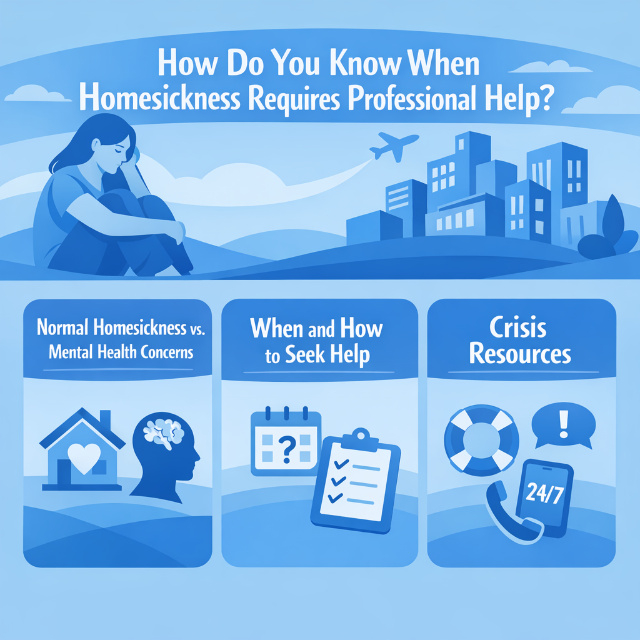
Normal Homesickness vs. Mental Health Concerns
Normal homesickness (self-management appropriate):
- Sadness or longing that comes and goes
- Difficulty concentrating occasionally
- Missing home during specific triggers (holidays, stressful times)
- Gradual improvement over first 6-8 weeks
- Able to attend classes and complete coursework
- Still engaging socially even if difficult
- Symptoms manageable with coping strategies
- Looking forward to some aspects of college life
Concerning symptoms (professional help needed):
- Constant pervasive sadness lasting most of the day
- Complete inability to concentrate affecting grades
- Missing classes regularly due to homesickness
- No improvement or worsening after 8 weeks
- Severe anxiety or panic attacks
- Thoughts of self-harm or suicide
- Complete social isolation (not leaving room)
- Physical symptoms (weight loss, insomnia, chronic illness)
- Substance use to cope with feelings
- Overwhelming desire to leave school permanently
When and How to Seek Help
Campus resources available:
- Counseling center (typically 6-12 free sessions annually)
- Student health center for physical symptoms
- Resident advisor or residence life staff
- Academic advisor or dean of students
- Peer support groups for homesickness or adjustment
- Religious or spiritual counselors
- International student office (for international students)
- First-generation student support programs
How to access counseling:
- Call counseling center directly (no referral needed)
- Walk-in hours for crisis situations (same-day appointments)
- Schedule initial intake appointment (30-60 minutes)
- Be honest about severity and duration of symptoms
- Ask about group therapy options for adjustment issues
- Inquire about workshops on stress management or coping skills
What to expect in counseling:
- Safe, confidential space to discuss feelings
- Validation that homesickness is normal
- Practical coping strategies beyond what you've tried
- Exploration of underlying anxiety or depression
- Possible referral for medication if clinical depression diagnosed
- Ongoing support throughout adjustment period
Research shows students who attend 4-6 counseling sessions for adjustment issues report 73% improvement in homesickness symptoms and 89% improved overall mental health, demonstrating effectiveness of professional support.
Crisis Resources
If experiencing immediate crisis (self-harm thoughts, severe panic, suicidal ideation):
- Call 988 (Suicide & Crisis Lifeline) 24/7
- Text "HELLO" to 741741 (Crisis Text Line)
- Call campus police/security for immediate assistance
- Go to nearest emergency room
- Contact counseling center crisis line (most offer 24/7 support)
Don't wait for symptoms to become severe. Early intervention prevents escalation and promotes faster recovery.
How Can You Support a Friend Experiencing Homesickness?
Support a friend experiencing homesickness by listening without judgment or dismissing their feelings, inviting them to activities and events even if they initially decline (gentle persistence matters), offering to accompany them to counseling or support groups, checking in regularly via text or visits, avoiding platitudes like "just get over it" or "everyone feels that way," helping them access campus resources when overwhelmed, and encouraging professional help if symptoms worsen or persist beyond 8 weeks.
Effective Support Strategies
Do these helpful actions:
- Listen actively without trying to immediately solve problems
- Validate feelings: "I hear you. That sounds really hard."
- Share your own adjustment struggles (normalizes experience)
- Invite them to specific activities with you: "Want to get dinner at 6?"
- Follow up after difficult moments: "How are you feeling today?"
- Offer practical help (accompany to counseling, help with classwork)
- Celebrate small victories (attended event, made new friend)
- Include them in group activities without pressuring participation
- Send encouraging texts checking in regularly
- Suggest campus resources gently without being pushy
Avoid these unhelpful responses:
- "Just get over it" (dismissive and invalidating)
- "Everyone feels homesick" (minimizes individual struggle)
- "You should be grateful to be in college" (induces guilt)
- "Why don't you just go home?" (suggests giving up)
- "You're being dramatic" (shames emotional response)
- Constant problem-solving without listening
- Forcing them to attend social events
- Telling parents without permission
- Sharing struggles publicly or gossiping
- Abandoning them when support feels difficult
Specific invitation strategies:
- "I'm going to [event]. Want to come with me?"
- "Let's grab coffee after class. My treat."
- "Movie night in my room tonight. You're welcome anytime."
- "Study group at library at 3pm. Join us?"
- "I need someone to go to [place] with. Come with me?"
When to encourage professional help:
- Symptoms persisting beyond 6-8 weeks without improvement
- Increasing severity (worse over time, not better)
- Missing classes or academic performance declining
- Mention of self-harm thoughts or severe depression
- Complete social isolation despite your efforts
- Substance use or unhealthy coping mechanisms
Approach help-seeking conversations compassionately: "I care about you and I've noticed you're struggling. Have you considered talking to someone at counseling center? I'd be happy to go with you to make that appointment."
Does Homesickness Ever Completely Go Away?
Homesickness typically diminishes significantly within 8-12 weeks as students build friendships, establish routines, and develop campus identity, with 85% reporting substantial improvement by winter break. Complete resolution varies, some students experience occasional waves of nostalgia throughout college, particularly during stressful periods or holidays, while others fully adjust with minimal continued homesickness. The intensity decreases dramatically even when occasional feelings persist, and most students develop healthy balance maintaining home connections while thriving independently on campus.
The Adjustment Timeline
Weeks 1-3: Initial shock and excitement
- Honeymoon phase with novelty and adventure
- Initial homesickness hits as reality of separation sets in
- Most intense emotional period
- High anxiety and uncertainty
Weeks 4-8: Peak homesickness
- Novelty wears off revealing daily challenges
- Social groups forming, potentially feeling left out
- Academic demands increasing stress
- Missing major home events or traditions
- Highest counseling center utilization period
Weeks 9-12: Gradual improvement
- Friendships solidifying providing support
- Campus routines becoming comfortable
- Identity as college student developing
- Competence and confidence increasing
- Homesickness intensity decreasing significantly
After winter break: Readjustment
- Brief homesickness spike returning to campus
- Quicker recovery than initial adjustment (days vs. weeks)
- Spring semester easier as foundation established
- Continued gradual improvement
Sophomore year onward:
- Occasional homesickness during specific triggers
- Manageable brief episodes rather than persistent state
- Strong campus identity and belonging established
- Home visits feel like visiting rather than escaping
Factors Affecting Adjustment Speed
Faster adjustment (4-6 weeks):
- Proactive social engagement from day one
- Previous successful independence experiences
- Strong campus support systems accessed early
- Healthy coping skills and emotional regulation
- Moderate home contact (2-3 times weekly)
Slower adjustment (10-16 weeks):
- Social isolation or difficulty making friends
- Excessive home contact preventing campus investment
- Underlying anxiety or depression
- Negative roommate situations
- Academic struggles without support-seeking
- International students navigating culture shock
| Remember: adjustment is non-linear. Having difficult days after several good weeks doesn't indicate failure; it reflects the normal ups and downs of significant life transitions. |
How Can Parents and Family Help From a Distance?
Parents and family help from a distance by maintaining consistent but not excessive contact (2-3 calls weekly), listening supportively without solving every problem, encouraging campus engagement rather than coming home frequently, sending care packages with practical items and comfort food, trusting student to navigate challenges building resilience, avoiding guilt trips about distance or infrequent communication, and empowering decision-making rather than directing choices, while knowing when to encourage professional help if symptoms suggest clinical depression or anxiety.
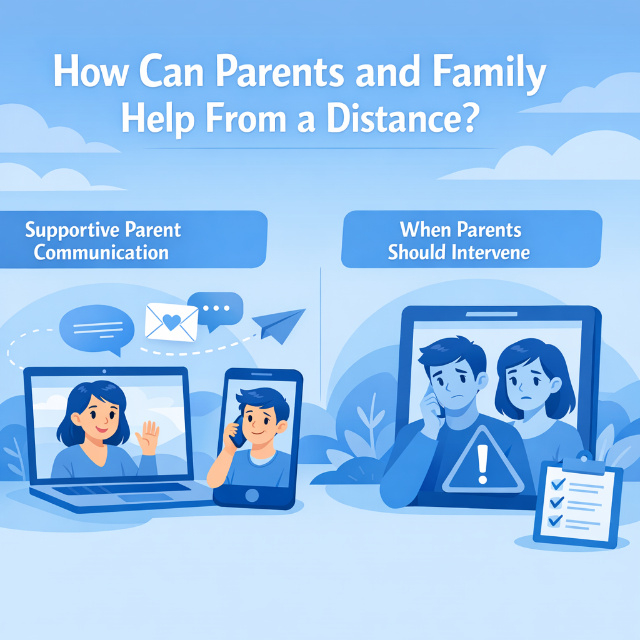
Supportive Parent Communication
Helpful parental responses:
- "Tell me about the good parts of your week too."
- "What have you tried to feel better? How can I support those efforts?"
- "I'm glad you're sharing this with me. It sounds difficult."
- "Remember when you adjusted to [previous challenge]? You got through that too."
- "Have you thought about talking to someone at counseling center?"
- "I miss you too, and I'm proud of you for staying and working through this."
- "What's one small thing you could do today to feel a bit better?"
Unhelpful parental responses:
- "Just come home if you're that unhappy" (undermines commitment)
- "You're going to a great school. Stop complaining." (invalidating)
- "We're paying a lot for this. You need to make it work." (guilt-inducing)
- "Why can't you just make friends like everyone else?" (shaming)
- "I knew you weren't ready for college." (confidence-destroying)
- Immediately solving every problem (prevents independence)
- Excessive daily check-ins (prevents adjustment)
Care package ideas:
- Favorite snacks or comfort food from home
- New snacks to try together with roommate (encourages connection)
- Practical items (laundry detergent, toiletries, school supplies)
- Handwritten note or card (more meaningful than texts)
- Small gift cards to coffee shop or campus restaurant
- Photos from home or funny family updates
- Self-care items (face masks, tea, cozy socks)
- Motivational books or journals
Send care packages occasionally (monthly, not weekly) as gestures of love without creating dependence on home for emotional regulation.
When Parents Should Intervene
Appropriate parental intervention:
- Student explicitly requests help accessing resources
- Severe symptoms suggesting clinical depression or anxiety
- Suicidal thoughts or self-harm behaviors
- Significant academic failure risking dismissal
- Safety concerns (severe roommate conflict, harassment)
- Physical health emergencies
- Financial emergencies requiring family support
Trust student to handle:
- Normal roommate disagreements
- Academic challenges or lower-than-expected grades
- Social disappointments or friendship conflicts
- General adjustment struggles and homesickness
- Time management and organization issues
- Minor health concerns (colds, stress)
The goal is supporting independence while maintaining safety net, not rescuing from every difficulty preventing growth and resilience development.
Key Takeaways
Successfully navigate homesickness through these evidence-based strategies:
Homesickness affects 66-75% of first-year students and is completely normal response to major life transition, not weakness or inability to handle college. Peak intensity occurs weeks 4-8, with 85% of students reporting substantial improvement by winter break as friendships develop, routines establish, and campus identity forms.
Build social connections proactively by joining 2-3 campus organizations within first month, attending floor activities and campus events, studying in common areas, and actively introducing yourself to classmates. Students who pursue friendships early experience 65% less intense homesickness than those who wait passively for connections to happen naturally.
Maintain healthy home contact balance with 2-3 scheduled calls weekly rather than daily contact, sharing positive experiences alongside challenges, and limiting call duration to 30-45 minutes. Excessive contact prevents campus adjustment and prolongs homesickness, while moderate connection provides comfort without dependence.
Seek professional help when needed if homesickness persists beyond 8-10 weeks without improvement, interferes with daily functioning, includes severe depression or anxiety symptoms, or leads to unhealthy coping mechanisms. Campus counseling centers provide free confidential support with research showing 73% improvement after 4-6 sessions.
Practice self-compassion and patience recognizing adjustment takes time and non-linear progress with difficult days even after improvement. Reframe negative self-talk, celebrate small victories, avoid comparing yourself to seemingly well-adjusted peers, and remember 70% of students share your experience even if not visibly apparent.
Homesickness is temporary adjustment challenge, not permanent condition or personal failure. The intensity that feels overwhelming at week 3 dramatically decreases by week 12 as competence, confidence, and campus community develop through consistent engagement and healthy coping strategies.
When managing homesickness alongside demanding academic workload during difficult adjustment weeks, consider using a trusted essay writing service for routine coursework, allowing focus on building friendships, establishing supportive routines, and engaging in campus activities that directly reduce homesickness and promote successful college transition determining long-term academic and social success.