Why Is Critical Thinking More Important in the AI Era?
AI makes poor critical thinking more consequential while simultaneously making it easier to avoid developing these skills. Understanding this paradox is crucial for academic success.
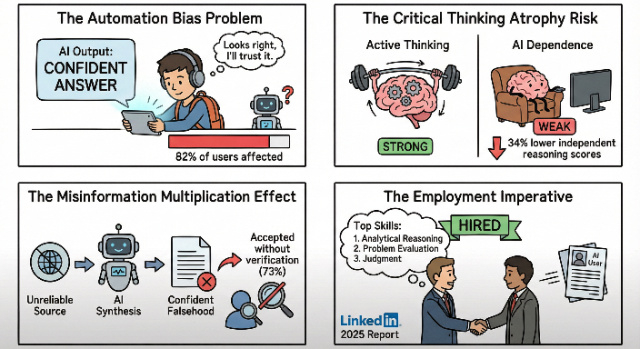
The Automation Bias Problem
Automation bias—the tendency to trust computer-generated outputs over contradictory human judgment—affects 82% of users according to recent behavioral research. When AI produces confident, well-formatted answers, students accept them uncritically even when outputs contain errors, logical flaws, or outdated information.
This bias intensifies because AI responses look authoritative. Unlike Wikipedia's questionable reputation or random blogs students naturally question, AI tools like ChatGPT present information with apparent certainty. Students forget that AI generates probable text patterns, not verified truth.
The Critical Thinking Atrophy Risk
Using AI for tasks requiring analysis and evaluation prevents developing those exact capabilities. Research from MIT's Learning Lab shows students relying heavily on AI for problem-solving score 34% lower on independent reasoning assessments than peers who use AI selectively.
Think of critical thinking like physical fitness. Using AI for all analytical work is like taking an elevator everywhere—convenient short-term but weakening over time. The key is strategic use that builds rather than replaces your cognitive capabilities.
The Misinformation Multiplication Effect
AI doesn't just generate isolated errors—it can multiply misinformation by confidently synthesizing false information from unreliable sources.
A 2025 study found that AI-generated summaries contained verifiable errors in 41% of cases when source material included misinformation, and users accepted these errors 73% of the time without verification.
Students who can't critically evaluate AI outputs become amplifiers of misinformation, citing fabricated statistics, nonexistent research, and confidently stated falsehoods in their academic work.
The Employment Imperative
Employers increasingly prioritize critical thinking above technical knowledge. LinkedIn's 2025 Global Talent Trends report identifies analytical reasoning, problem evaluation, and judgment as the top three skills sought in new hires—precisely the skills AI can't replicate but can help you avoid developing if used passively.
Students working with trusted essay writing services should ensure these services emphasize critical analysis and original reasoning rather than AI-generated content, as this reflects the professional standards employers expect.
What Critical Thinking Skills Must Students Develop for AI?
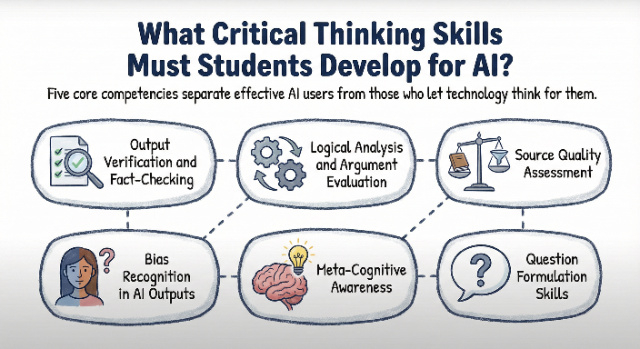
Five core competencies separate effective AI users from those who let technology think for them.
1. Output Verification and Fact-Checking
Never accept AI outputs without verification, especially factual claims, statistics, or citations. AI confidently generates realistic-sounding information that doesn't exist—fake research papers, fabricated statistics, nonexistent historical events.
Verification process: Cross-reference key claims through independent sources, verify citations actually exist and say what's claimed, check if statistics align with authoritative data sources, and confirm dates and contexts are accurate. Budget 20% of time saved by AI for verification work.
According to research from Oxford's Future of Humanity Institute, students who systematically verify AI outputs maintain 91% accuracy in their work compared to 64% for those accepting AI outputs uncritically.
2. Logical Analysis and Argument Evaluation
AI generates superficially convincing arguments containing logical fallacies, false equivalences, and reasoning errors. Students must recognize these flaws independently.
Common AI reasoning errors include: correlation presented as causation without supporting evidence, false balance treating fringe and mainstream views as equally valid, circular reasoning where conclusions restate premises, hasty generalizations from insufficient examples, and appeal to authority without verifying expert credibility.
Practice evaluating argument structure separately from content quality. A well-written paragraph can contain terrible reasoning.
Ask: Does the conclusion logically follow from premises? Are there hidden assumptions? What evidence would contradict this claim?
3. Source Quality Assessment
AI aggregates information without evaluating source reliability. It might cite academic journals alongside conspiracy websites, giving both equal weight. Students must independently assess source credibility.
Evaluation framework: Check author credentials and affiliations through independent verification, assess publication venue reputation and peer review standards, examine funding sources for conflicts of interest, verify publication date for fields with rapid development, and cross-reference through other authoritative sources.
A 2024 analysis found that AI-generated research summaries included citations to predatory journals in 28% of cases, which students then cited in their papers without recognizing the credibility issues.
4. Bias Recognition in AI Outputs
AI systems inherit biases from training data, producing outputs that reflect and amplify societal biases. Students must recognize when AI responses favor particular perspectives, exclude important viewpoints, or present culturally specific assumptions as universal truths.
Red flags for bias: Presenting controversial topics as settled without acknowledging debate, omitting perspectives from affected communities, using loaded language that signals particular ideological positions, and generalizing from Western/English-language contexts to all situations.
Always ask: Whose perspective is centered? Whose is missing? What assumptions underlie this analysis? Would people affected by this issue agree with this characterization?
5. Meta-Cognitive Awareness
The most crucial skill is knowing when to trust AI versus when to think independently. This requires honest self-assessment about your own knowledge gaps and AI limitations.
Use AI for: Brainstorming initial ideas, formatting and organization assistance, summarizing long texts you'll verify independently, identifying topics requiring deeper research, and generating alternative perspectives to consider.
Think independently for: Final verification of all facts and citations, evaluating argument quality and logical coherence, making judgment calls about source credibility, assessing ethical implications, and synthesizing information into original insights.
Research shows students with strong meta-cognitive awareness use AI 45% more efficiently and produce 38% higher quality work than those lacking this self-awareness.
6. Question Formulation Skills
The quality of AI outputs depends entirely on question quality. Students must develop precise, well-structured prompting skills that elicit useful responses rather than accepting whatever AI generates from vague queries.
Effective prompting includes: Specifying desired output format and length, providing relevant context AI needs, requesting specific analysis types, explicitly noting what to include or exclude, and asking for reasoning explanation rather than just conclusions.
Students working with reliable essay writing services benefit when they can articulate clear, specific requirements rather than vague requests, demonstrating the broader value of question formulation skills.
How Can Students Practice Critical Thinking with AI Tools?
Developing critical thinking requires deliberate practice, not just awareness. These strategies build analytical skills while using AI productively.
The Verification Challenge Method
For every AI-generated paragraph you use, identify three factual claims and verify each through independent sources. This practice makes verification habitual while teaching you to spot common AI errors.
Track your error discovery rate—most students find AI mistakes in 30-40% of outputs when checking systematically.
The Comparison Analysis Exercise
Generate responses from multiple AI tools (ChatGPT, Claude, Gemini) for the same question. Analyze differences, inconsistencies, and contradictions. This reveals AI's probabilistic nature rather than truth-seeking function, building healthy skepticism about any single output.
The "Explain to a Freshman" Test
After using AI to understand a concept, explain it to someone unfamiliar with the topic without referencing AI output. If you can't explain it clearly, you didn't understand it—you just consumed formatted text. This forces genuine comprehension rather than passive acceptance.
The Counter-Argument Generation
For any AI-generated argument, deliberately create the strongest opposing position. Use this exercise to identify weaknesses in the original argument and develop more nuanced understanding. Strong critical thinkers engage with ideas they initially resist.
The Source Citation Verification Protocol
Every citation AI provides must be independently verified. Check that papers exist, authors are correctly attributed, publication details are accurate, and the source actually supports the claimed point. Create a personal tracking sheet—most students find 25-35% of AI-generated citations have some error.
The Logical Fallacy Hunt
Review AI outputs specifically searching for reasoning errors. Create a checklist of common fallacies and systematically check each output. This trains pattern recognition for faulty reasoning, a skill transferring beyond AI to evaluating all arguments.
The "Why" Chain Exercise
For any AI conclusion, ask "why" five times, demanding reasoning at each level. AI often can't provide deep causal explanations, revealing where its "understanding" is superficial. This exposes limitations while strengthening your analytical depth.
The Collaborative Critical Review
Share AI outputs with study groups and collectively critique them. Different students notice different issues, and group discussion builds analytical skills faster than solo work. This also normalizes critical AI evaluation rather than treating it as antagonistic to technology use.
Students using fast essay writing services can apply these verification and analysis techniques to professional writing, ensuring final submissions meet academic critical thinking standards.
What Are the Limits of AI That Require Human Critical Thinking?
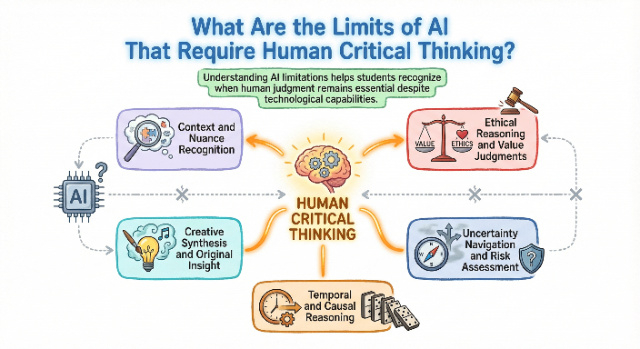
Understanding AI limitations helps students recognize when human judgment remains essential despite technological capabilities.
Context and Nuance Recognition
AI struggles with context-dependent meaning, cultural nuances, and implied information. It misses sarcasm, fails to recognize when "technically correct" answers miss the point, and doesn't understand unspoken social context affecting interpretation.
Example: Ask AI about appropriate professional communication and it provides generic advice without understanding that norms vary dramatically across industries, cultures, and organizational hierarchies. Human critical thinking applies contextual awareness AI lacks.
Ethical Reasoning and Value Judgments
AI can describe ethical frameworks but can't make genuine ethical judgments requiring value hierarchies. Questions like "Should I prioritize efficiency or equity?" or "When does honesty become harmful?" require human moral reasoning AI simulates without possessing.
Students must independently evaluate ethical implications of AI suggestions, particularly regarding academic integrity, research ethics, and professional conduct. AI might suggest efficient shortcuts that violate academic honesty policies or overlook ethical considerations in research design.
Creative Synthesis and Original Insight
While AI combines existing information in novel ways, it doesn't generate genuinely original insights requiring intuitive leaps, cross-domain synthesis, or creative problem-solving. It remixes training data but doesn't think outside that box.
True critical thinking produces insights AI can't generate because they require connecting disparate knowledge domains, recognizing patterns across different contexts, or challenging fundamental assumptions AI was trained to accept.
Uncertainty Navigation and Risk Assessment
AI provides confident answers even for uncertain questions. It doesn't effectively communicate probability, acknowledge conflicting evidence, or express appropriate uncertainty about limitations. Human critical thinking involves comfortable uncertainty, recognizing knowledge gaps, and proportional confidence.
Students must independently assess claim certainty, recognize when issues remain unsettled, and communicate uncertainty honestly rather than adopting AI's false confidence.
Temporal and Causal Reasoning
AI struggles with temporal logic, causation, and counterfactual reasoning. It can't reliably answer "what would have happened if" questions, often confuses correlation with causation, and misses temporal sequences affecting interpretation.
Critical thinkers must independently evaluate causal claims, consider alternative explanations, and recognize when temporal factors matter for accurate understanding.
Conclusion: Critical Thinking as Your Competitive Advantage
The AI revolution makes critical thinking more valuable, not less. Here are the essential takeaways:
- AI shifts critical thinking from information access to evaluation: Your competitive advantage lies in judgment, not knowledge recall
- Automation bias is real: Consciously question AI outputs rather than accepting them based on confident presentation
- Verification must be systematic: Check facts, citations, and logical reasoning in all AI-generated content you use
- Meta-cognitive awareness determines success: Knowing when to trust AI versus thinking independently separates effective users from passive consumers
- Human reasoning remains essential: For context, ethics, creativity, and uncertainty navigation that AI can't replicate
Start building these skills today through deliberate practice. Verify one claim per AI response. Identify one logical fallacy per day. Explain one concept without referencing sources. These small habits compound into robust critical thinking capabilities.
The future doesn't belong to those who can use AI or those who avoid it—it belongs to those who can think critically alongside it. Students who develop strong analytical skills while leveraging AI strategically will outperform both AI-dependent peers who can't evaluate outputs and AI-avoidant students who miss efficiency gains.
Critical thinking isn't about being anti-technology. It's about being pro-accuracy, pro-reasoning, and pro-understanding. Use AI as a powerful tool while maintaining the critical judgment that makes you the expert directing technology rather than the passive consumer accepting whatever it generates.
Ready to elevate your academic work while developing critical thinking skills? Partner with a trusted essay writing service that prioritizes analytical rigor and original reasoning.
Your academic success, professional prospects, and ability to navigate an increasingly complex information environment all depend on critical thinking skills that complement but don't depend on AI capabilities. Develop them now, practice them consistently, and watch them become your most valuable competitive advantage in an AI-augmented world.