-19439.jpg)
What Are Professional Skills and Why Do They Matter?
Professional skills (often called "soft skills" or "transferable skills") include communication, teamwork, leadership, problem-solving, time management, adaptability, and critical thinking, competencies applicable across industries and roles, unlike field-specific technical knowledge. These skills determine how effectively you collaborate, lead projects, manage responsibilities, and navigate workplace challenges, regardless of your specific job function.
Professional Skills vs. Technical Skills
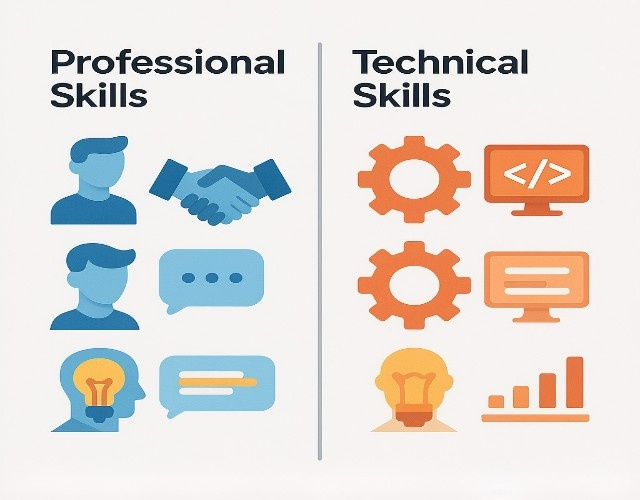
| Aspect | Technical Skills (Hard Skills) | Professional Skills (Soft Skills) |
|---|---|---|
| Nature | Specific, measurable, teachable abilities | Interpersonal and cognitive abilities |
| Examples | Programming languages, software proficiency, and data analysis | Communication, leadership, teamwork, and emotional intelligence |
| Field Applications | Laboratory techniques, engineering design, statistical methods | Problem-solving, adaptability, creativity, and work ethic |
| How They’re Learned | Coursework, certifications, and formal training programs | Diverse experiences and deliberate practice |
| Evaluation | Easier to verify through tests or demonstrations | Harder to quantify, proven through behavior and references |
Both matter, but professional skills often determine career success more than technical knowledge alone. Technical skills get you interviews; professional skills get you hired and promoted.
Why Employers Prioritize Professional Skills
Employers can teach specific software or procedures. They struggle to teach communication, work ethic, or the ability to collaborate effectively. Professional skills indicate how successfully you'll integrate into teams and grow within organizations.
Employment research consistently shows:
- Approximately 75-85% of job success depends on professional skills versus technical knowledge.
- Most terminations result from professional skill deficits (poor communication, inability to work with teams) rather than technical incompetence.
- Leadership potential and advancement depend more heavily on professional capabilities than technical expertise.
- Employees with strong professional skills adapt more easily to new roles, technologies, and organizational changes
Technical expertise without professional skills creates specialized employees who struggle to advance to leadership or work across functions. Professional skills enable long-term career growth and flexibility.
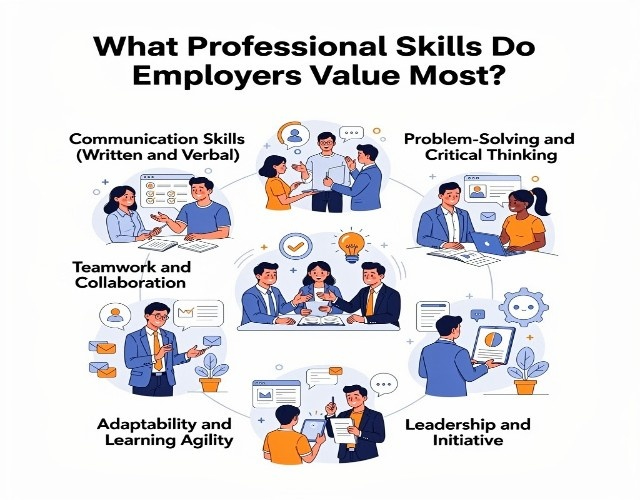
What Professional Skills Do Employers Value Most?
The five most valued professional skills across industries are effective communication (written and verbal), teamwork and collaboration, problem-solving and critical thinking, adaptability and learning agility, and leadership and initiative. While specific industries emphasize different technical skills, these core professional competencies consistently rank as top priorities for employers hiring college graduates.
1. Communication Skills (Written and Verbal)
Strong communicators convey ideas clearly, listen actively, tailor their messaging for different audiences, and collaborate effectively across various communication channels.
Written communication:
- Professional emails following workplace conventions.
- Clear reports, documentation, and proposals.
- Ability to synthesize complex information into accessible summaries.
- Error-free writing with appropriate tone and formatting
Verbal communication:
- Confident presentation and public speaking.
- Active listening and asking clarifying questions.
- Articulating ideas clearly in meetings and discussions.
- Professional phone and video conference presence.
Communication deficits create workplace friction, misunderstandings, and inefficiency. Strong communicators accelerate projects, reduce conflicts, and facilitate collaboration.
2. Teamwork and Collaboration
Modern workplaces require coordinating across functions, working with diverse colleagues, and contributing to collective goals beyond individual tasks.
Teamwork capabilities:
- Collaborating effectively with different personality types.
- Contributing ideas while respecting others' perspectives.
- Giving and receiving constructive feedback professionally.
- Managing disagreements productively.
- Supporting team members and celebrating collective success
Employees who work well in teams multiply organizational effectiveness. Those who struggle to collaborate create bottlenecks and reduce overall productivity regardless of individual abilities.
3. Problem-Solving and Critical Thinking
Employers value employees who analyze situations, identify solutions, and make sound decisions rather than simply executing prescribed tasks.
Problem-solving skills:
- Breaking complex problems into manageable components.
- Researching and evaluating potential solutions.
- Making decisions with incomplete information.
- Learning from failures and adjusting approaches.
- Thinking creatively about challenges.
Entry-level employees who demonstrate strong problem-solving advance faster because they require less supervision and contribute beyond their defined roles.
4. Adaptability and Learning Agility
Rapid technological and organizational change requires employees who learn quickly, embrace new approaches, and remain productive during transitions.
Adaptability indicators:
- Comfort with ambiguity and changing priorities.
- Willingness to learn new tools, processes, and responsibilities.
- Resilience when facing setbacks or challenges.
- Flexibility in work styles and approaches.
- Positive attitude during organizational changes.
Adaptable employees handle evolving responsibilities as companies grow and pivot, while rigid employees struggle when their specialized knowledge becomes obsolete.
5. Leadership and Initiative
Leadership extends beyond formal management roles; it means taking ownership, identifying opportunities, and motivating others toward goals.
Leadership capabilities:
- Taking initiative without waiting for direction.
- Identifying problems and proposing solutions proactively.
- Motivating and influencing peers positively.
- Managing projects and coordinating team efforts.
- Taking accountability for outcomes and learning from mistakes
Employees demonstrating leadership potential advance to positions of greater responsibility and compensation. Initiative signals the engagement and ownership employers value highly.
How Can You Develop Professional Skills During College?
Develop professional skills through strategic course selection emphasizing group work and presentations, pursuing leadership positions in campus organizations, seeking employment requiring customer service or responsibility, completing internships in professional environments, and deliberately practicing through workshops, volunteer work, and extracurricular activities. The most effective approach combines multiple development avenues rather than relying solely on coursework or one type of experience.
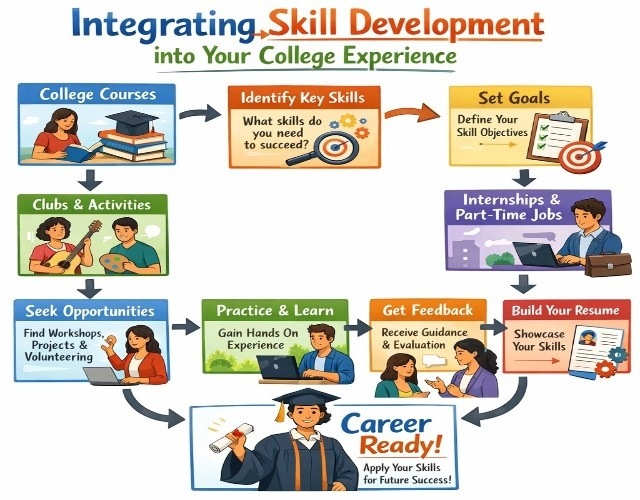
Strategy 1: Strategic Course Selection
Not all courses develop professional skills equally. Strategically include classes requiring presentations, group projects, writing assignments, and real-world problem-solving.
Courses that build professional skills:
- Writing-intensive courses (any discipline), including subjects often covered in the best digital marketing course programs.
- Public speaking or communication classes.
- Courses with substantial group project components.
- Capstone projects requiring real client work.
- Case study analysis and problem-solving courses.
- Leadership or organizational behavior classes.
How to maximize coursework for skill development:
- Volunteer for presentation opportunities rather than avoiding them.
- Seek challenging group projects instead of easy solo assignments.
- Request feedback on communication and collaboration from professors.
- Take electives outside your major requiring different thinking approaches.
- Pursue research assistantships requiring professional interactions
Students who strategically select challenging courses with professional skill components graduate more prepared for workplace demands than those who avoid anything uncomfortable.
Strategy 2: Campus Organizations and Leadership Roles
Student organizations provide low-stakes environments for developing and practicing leadership, teamwork, and project management skills.
High-value campus involvement:
- Executive board positions (president, treasurer, event coordinator).
- Committee leadership roles requiring coordination and planning.
- Club founding or significant growth initiatives.
- Cross-organizational collaborations and campus-wide events.
- Mentorship or peer advising programs.
Skills developed through organizations:
- Event planning and project management.
- Budget management and resource allocation.
- Team coordination and conflict resolution.
- Public speaking at meetings and events.
- Marketing and membership recruitment.
- Professional communication with advisors and external contacts.
The key is taking actual responsibility, not passive membership. Leading one organization develops more skills than attending meetings for five different clubs.
Strategy 3: Employment and Internships
Part-time jobs and internships provide authentic professional environments where you practice skills under real workplace pressures with actual consequences.
Jobs that develop professional skills:
- Customer service roles (retail, food service, hospitality).
- Office or administrative positions.
- Tutoring or teaching assistantships.
- Research assistants working with faculty.
- Campus employment (orientation leaders, tour guides).
- Any position requiring regular professional communication.
What to seek in work experiences:
- Responsibility beyond simple task completion.
- Interaction with diverse people (customers, colleagues, supervisors).
- Opportunities to solve problems or improve processes.
- Positions requiring communication and collaboration.
- Environments providing feedback on your performance.
Even "basic" jobs develop valuable skills when approached intentionally. Frame retail work as customer service and problem-solving. View administrative work as communication and organization development.
Strategy 4: Deliberate Practice Opportunities
Seek specific opportunities targeting skills you need to develop.
Targeted skill development:
- Toastmasters or speaking clubs for presentation skills.
- Writing center consultations for professional writing improvement.
- Mock interview programs for communication practice.
- Volunteer leadership roles in community organizations.
- Professional development workshops through career centers.
- Online courses on specific skills (project management, conflict resolution).
Identify your weakest professional skills, then deliberately seek experiences developing those specific capabilities.
Strategy 5: Reflection and Documentation
Skill development requires conscious reflection on experiences and systematic documentation for future applications.
Reflection practices:
- Journal about challenging situations and what you learned.
- Request specific feedback from supervisors and mentors.
- Identify concrete examples demonstrating each skill.
- Analyze what worked versus what you'd improve.
- Connect experiences to professional development.
Documentation systems:
- Maintain portfolio of written work, presentations, and projects.
- Track accomplishments and quantify impacts when possible.
- Collect letters of recommendation while experiences are fresh.
- Build "skill stories" for interviews (situation, action, result).
- Update resume quarterly with new experiences and capabilities.
Students who document skill development throughout college have compelling interview responses and application materials. Those who wait until job searches begin struggle to recall specific examples.
When you're translating these skill development experiences into compelling personal statements for competitive graduate programs or fellowship applications where demonstrating professional readiness determines selection, a trusted essay writing service can help you articulate how your diverse experiences have built the specific capabilities these programs require, framing scattered activities as deliberate professional development.
How Do You Balance Skill Development with Academic Performance?
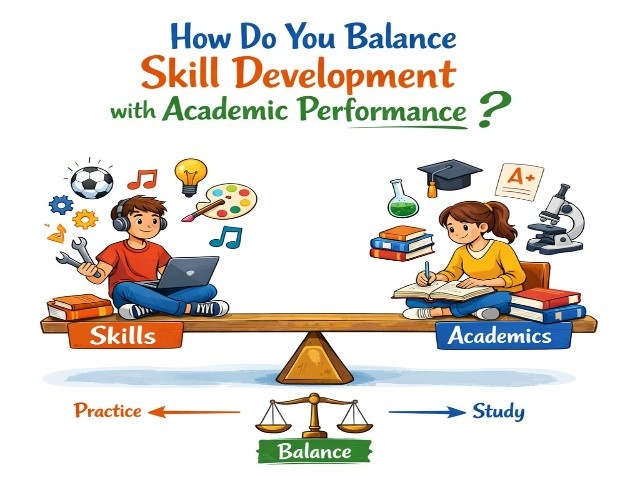
Balance skill-building with academics by integrating professional development into coursework choices, limiting extracurricular commitments to 2-3 meaningful activities with genuine leadership rather than superficial involvement in many, and pursuing part-time work or internships during summers and lighter semesters rather than overloading during intensive academic periods.
The key is strategic prioritization, recognizing that professional skills enhance rather than detract from career outcomes; they're not optional extras but essential components of employability.;
1. The Integration Approach
The most efficient strategy integrates skill development into academic work rather than treating them as competing priorities.
Integration strategies:
- Choose electives offering both academic credit and skill development (writing courses, research projects, presentations).
- Pursue research assistantships that count toward major requirements while building professional capabilities.
- Select internships providing academic credit when available.
- Frame group projects and presentations as deliberate professional development opportunities.
- Use academic papers to practice professional writing standards.
Students using integration strategies develop professional skills without sacrificing academic performance or overwhelming themselves with commitments.
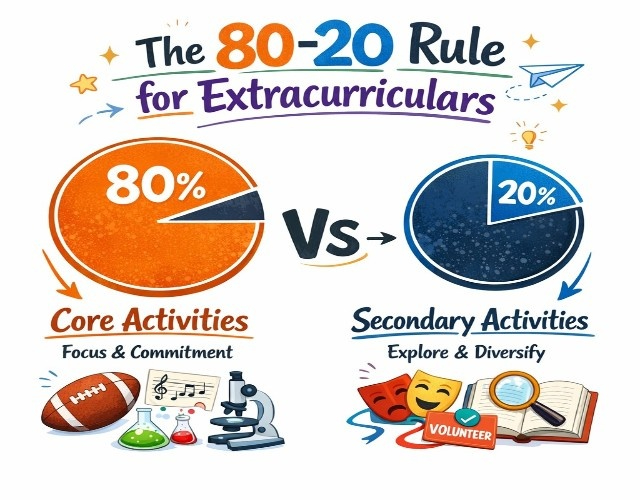
2. The 80-20 Rule for Extracurriculars
Invest deeply in 2-3 organizations where you can develop meaningful skills and demonstrate leadership rather than surface-level participation in many activities.
Quality over quantity benefits:
- Deeper skill development through sustained involvement.
- Stronger recommendation letters from advisors who know you well.
- More impressive accomplishments to discuss in interviews.
- Less time commitment overall (2-3 meetings weekly vs. 6-7).
- Actual leadership responsibility versus passive attendance.
Leadership in one organization with a measurable impact impresses employers more than membership in five with no distinguishing contributions.
3. Strategic Timing Across Semesters
Distribute intensive skill-building activities across your college career rather than attempting everything simultaneously.
Sample distribution:
- Freshman year: Focus on academics, explore 3-4 organizations casually, build a foundation.
- Sophomore year: Commit to 2-3 organizations, pursue first internship, develop specific skills.
- Junior year: Take leadership roles, complete a major internship, maximize skill development.
- Senior year: Leverage developed skills for capstone projects, job search, and final applications
This progression prevents burnout while systematically building capabilities. Attempting everything freshman year creates unsustainable stress.
Saying No Strategically
Protecting time for high-value activities requires declining low-value opportunities.
Decision framework for opportunities:
- Does this develop the specific skills I need?
- Will this create meaningful accomplishments for applications?
- Does this align with my career goals?
- Will this provide strong relationships or recommendations?
- Can I commit the necessary time without sacrificing academics?
If answers are mostly no, decline politely. Your time has value; invest it where returns are highest.
How Do You Demonstrate Professional Skills to Employers?
Demonstrate professional skills through specific examples in interviews using the STAR method (Situation, Task, Action, Result), concrete accomplishments on resumes quantifying impacts, strong recommendation letters from supervisors who've observed your skills directly, professional portfolios showing actual work products, and polished application materials themselves serving as communication skill evidence.
Generic claims about possessing skills without supporting evidence fail to convince employers; specific stories and demonstrations prove capabilities.
The STAR Method for Interview Responses
Structure responses to behavioral interview questions (Tell me about a time when...) using the Situation, Task, Action, Result framework.
STAR structure:
| Situation: Brief context setting the scene (1-2 sentences) |
| Task: Challenge or responsibility you faced (1 sentence) |
| Action: Specific steps you took, emphasizing your role (3-4 sentences) |
| Result: Measurable outcome and what you learned (1-2 sentences) |
Weak response:
"I have great teamwork skills because I've worked on many group projects and always contribute to team success."
Strong STAR response:
"During my marketing course, our 5-person team struggled with conflicting ideas for our campaign strategy (Situation). As project coordinator, I needed to unite the team around one approach before our client presentation (Task).
I facilitated a structured decision-making session where each member presented their ideas, we evaluated pros and cons collaboratively, and then voted on our direction. I documented our agreed strategy and created weekly check-ins, ensuring everyone remained aligned (Action).
We delivered our campaign on time, received the highest grade in our class, and the client implemented 3 of our recommendations (Result). This taught me that structured facilitation often works better than trying to force consensus."
Specific stories with measurable outcomes prove your capabilities far more effectively than abstract claims.
Resume Accomplishments vs. Responsibilities
Resumes should emphasize what you achieved and skills demonstrated rather than listing job duties.
Responsibility-focused (weak)
"Responsible for customer service and handling complaints."
Accomplishment-focused (strong):
"Resolved 50+ customer concerns weekly, maintaining 4.7/5.0 satisfaction rating and reducing complaint escalation 35% through proactive problem-solving."
The second demonstrates communication, problem-solving, and measurable impact, professional skills employers value.
Portfolio and Work Samples
For fields where applicable, create portfolios showcasing actual work demonstrating professional capabilities.
Portfolio components:
- Writing samples (reports, analyses, articles).
- Presentation slide decks.
- Project documentation and outcomes.
- Design work or creative projects.
- Data analyses or research findings.
- Marketing campaigns or communications materials.
Recommendation Letters as Skill Validation
Letters from professors, employers, or mentors provide third-party validation of your professional skills that self-reported claims cannot.
Strong recommendations specifically address:
- Concrete examples of skills demonstrated.
- Comparison to peer performance levels.
- Growth and development over time.
- Specific situations showcasing capabilities.
- Prediction of future success based on observed skills.
Request recommendations from people who've directly observed your professional skill development and can provide specific examples. Generic letters from impressive-sounding people who barely know you add minimal value.
When you're preparing comprehensive application packages for competitive graduate programs, prestigious fellowships, or selective professional opportunities where every element, personal statement, resume, and recommendations must cohesively demonstrate professional readiness, a reliable essay writing service can help you develop strategically aligned materials that present your skill development as a deliberate, impressive trajectory rather than scattered, disconnected experiences.
REMEMBER! Portfolios provide tangible evidence of skills claims. Telling employers you have strong communication skills is less convincing than showing published articles or professional reports.
Conclusion
Building professional skills during college requires a deliberate strategy combining coursework selections emphasizing collaboration and communication, leadership roles in campus organizations, employment experiences requiring responsibility and interaction, and consistent reflection documenting skill development for future applications.
Key strategies for systematic skill development:
- Prioritize the five most valued professional skills, communication, teamwork, problem-solving, adaptability, and leadership, through diverse experiences rather than academic coursework alone.
- Integrate skill-building into academic requirements by choosing courses with presentations and group work, pursuing research assistantships, and framing all activities as professional development opportunities.
- Commit deeply to 2-3 organizations where you can achieve leadership roles and measurable impact rather than superficial participation in many activities.
- Balance skill development with academic performance by distributing intensive activities across semesters and saying no to low-value commitments.
- Document skills through specific STAR method examples, quantified resume accomplishments, portfolio work samples, and recommendation letters providing third-party validation
Begin assessing your current professional skill levels through career center assessments or honest self-reflection on strengths and development areas. Students who intentionally build professional capabilities alongside academic knowledge graduate significantly more prepared for workplace demands and career success.
The effort invested in developing th;ese skills during college produces returns throughout your entire career, communication, leadership, and problem-solving abilities remain valuable regardless of industry changes or role transitions.
Your degree proves domain knowledge; professional skills prove you can perform effectively in workplace contexts. Employers increasingly prioritize these capabilities over academic credentials alone, making systematic skill development essential for competitive career outcomes.
When you're articulating your professional skill development journey in personal statements for graduate programs, fellowship applications, or competitive opportunities where demonstrating readiness for professional-level work determines selection, a professional essay writing service can help you craft compelling narratives showing how you've deliberately built the capabilities these programs require, transforming scattered experiences into impressive evidence of professional maturity.
Download our free Professional Skills Development Tracker with self-assessment rubrics, experience documentation worksheets, and STAR method example builders for systematic capability building.