
Example #1: Elementary Book Report (Who Was Martin Luther King, Jr.?)
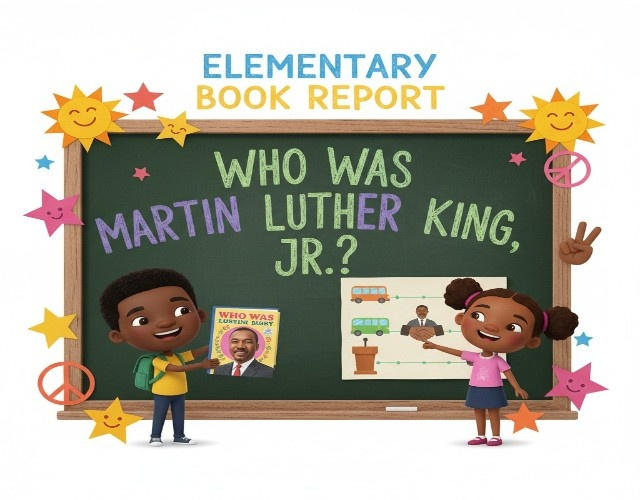
Who Was Martin Luther King, Jr.? Grade Level: 3rd to 5th | Length: 312 words
Non-Fiction Example: Who Was Martin Luther King, Jr.?
[ABBREVIATED ELEMENTARY EXAMPLE]
Introduction: Who Was Martin Luther King, Jr.? by Bonnie Bader tells the story of an important civil rights leader. Dr. King fought for equal rights for Black people in America.
Summary: The book describes Dr. King's childhood in Atlanta, Georgia. He grew up when Black people couldn't go to the same schools or restaurants as white people. This made him sad and angry.
Dr. King became a minister like his father. He led peaceful protests to change unfair laws. His most famous moment was the "I Have a Dream" speech in Washington, D.C. Sadly, Dr. King was killed in 1968, but his work helped change America.
What I Learned: Dr. King taught that you should fight for what's right without using violence. He showed that peaceful protests can change unfair laws. The book teaches readers to treat everyone equally no matter what they look like.
My Opinion: I think Dr. King was very brave. It must have been scary to stand up to people who didn't want things to change. This book taught me about an important person in American history.
What Makes It Work:
- Chronological organization: Follows life story logically.
- Age appropriate content: Explains complex history simply.
- Clear learning: States lessons explicitly.
- Personal reflection: Shows understanding of significance.
Expert Writers for Every Book Genre and Subject
We'll write a custom report for your book
- Any grade level, any book
- Delivered on time guaranteed
- Stress-free help at any stage
- Unlimited revisions included
Real writers who read the books. Zero AI.
Order NowExample #2: Book Report Examples for Middle School (The Giver)

The Giver: Grade Level: 6th to 8th | Length: 687 words
Freedom vs. Safety in The Giver
What would you give up to live in a perfect world? In Lois Lowry's novel The Giver, published in 1993, the community has eliminated pain, war, and suffering by removing all choices from people's lives. Through Jonas's journey from innocent child to enlightened rebel, Lowry argues that freedom and individuality matter more than safety and sameness, even when freedom brings pain.
The Giver takes place in a futuristic society where everything is controlled. People don't choose their jobs, spouses, or even how many children to have. The community has eliminated colors, emotions, and memories of the past. When twelve-year-old Jonas receives his life assignment as the next Receiver of Memory, he begins training with an old man called The Giver. The Giver transfers memories of the past to Jonas, memories of war, starvation, and pain, but also memories of love, color, music, and joy.
As Jonas gains these memories, he realizes his perfect community has sacrificed humanity for safety. When he learns that "release" means killing people, including babies and the elderly, Jonas escapes with a baby named Gabriel to save him and to return memories to the community.
The novel's main conflict occurs inside Jonas's mind as he struggles between the comfort of ignorance and the burden of knowledge. At the beginning, Jonas accepts his community's rules without question. He even uses the community's language, like "apologizing for imprecise language," when he accidentally says the wrong word. After receiving memories, Jonas begins to see the flaws in his society. He realizes that without pain, people can't truly experience joy. Without choices, people aren't really living, they're just existing. His statement "I want to wake up and decide things" shows his transformation from obedient citizen to independent thinker.
The main theme of the novel is that freedom requires sacrifice. The community gave up freedom to eliminate suffering, but Lowry shows this trade isn't worth it. When Jonas asks The Giver why people gave up colors and emotions, The Giver explains they chose sameness to prevent jealousy and conflict. But Jonas sees that sameness also prevents love, creativity, and individuality. The memory of the family celebrating Christmas shows Jonas what his community lost: genuine connection and joy. His decision to leave the community, knowing he'll face danger and hardship, proves he values freedom more than safety.
Another important theme is the danger of ignorance. The community's citizens don't know what they're missing because they have no memories of anything different. They accept "release" as normal because they don't know it means death. Jonas's mother works in the Department of Justice, punishing people for breaking rules, but she can't really understand justice because she's never experienced true injustice. Lowry suggests that knowledge, even painful knowledge, is essential for making ethical decisions.
The ending leaves readers uncertain about Jonas's fate. Some interpret the lights and music Jonas sees as heaven, meaning he and Gabriel died in the snow. Others believe they reached a real community where people live freely. This ambiguity supports Lowry's message that freedom means uncertainty; we can't know what will happen, and that's okay. Jonas chose the unknown over the predictable, which is exactly what the book encourages readers to do.
The Giver remains relevant today because it questions how much control we should give up for security. Like Jonas's community, modern society often prioritizes safety over freedom through surveillance, regulations, and social pressure to conform. Lowry warns that when we let others make all our decisions, we lose what makes us human. The novel reminds us that a life without choices, emotions, and even pain isn't really life at all.
What Makes This Work:
- Strong thesis statement: Clearly argues Lowry's position on freedom vs. safety.
- Efficient plot summary: Covers the story in one paragraph without unnecessary detail.
- Character analysis with evidence: Uses specific quotes to show Jonas's transformation.
- Multiple themes explored: Discusses both freedom/sacrifice and knowledge/ignorance.
- Textual evidence integrated: Quotes support every analytical claim.
- Modern relevance: Connects the book to current issues readers care about.
- Proper structure: Introduction, summary, character analysis, themes, and conclusion flow logically.
| Note: Teachers often provide a book report format example to show students how to combine summaries, analysis, and personal reflections. |
Example #3: Book Report Examples for High School (The Great Gatsby)

The Great Gatsby Grade Level: 9th to 12th | Length: 1,094 words
The Corruption of the American Dream in The Great Gatsby
The Great Gatsby, F. Scott Fitzgerald's 1925 masterpiece, exposes the dark underbelly of 1920s American prosperity. Through the tragic fall of Jay Gatsby, a self-made millionaire obsessed with recapturing his lost love, Fitzgerald argues that the American Dream, the belief that anyone can achieve success through hard work, has been corrupted by materialism and moral decay. The novel suggests that in a society obsessed with wealth and status, the dream of self-improvement becomes a nightmare of empty excess and unfulfilled longing.
Set in the summer of 1922 on Long Island, the novel follows narrator Nick Carraway as he becomes entangled in the world of his mysterious neighbor, Jay Gatsby. Gatsby throws elaborate parties every weekend, hoping to attract the attention of Daisy Buchanan, Nick's cousin and Gatsby's former lover, who lives across the bay.
Five years earlier, Gatsby and Daisy fell in love, but he was too poor for her wealthy family. After Gatsby left to fight in World War I, Daisy married Tom Buchanan, a brutish man from old money. Now wealthy through mysterious business dealings, Gatsby believes he can win Daisy back. Nick arranges their reunion, and Gatsby and Daisy begin an affair.
The situation escalates when Tom discovers the affair and confronts Gatsby. In the chaos that follows, Daisy accidentally kills Tom's mistress while driving Gatsby's car. Gatsby takes the blame to protect Daisy, and the mistress's husband shoots Gatsby in revenge. The novel ends with only Nick and Gatsby's father attending his funeral; none of his party guests care enough to come.
Fitzgerald structures the novel to parallel Gatsby's rise and fall with the corruption of the American Dream itself. The first half establishes Gatsby as a romantic figure pursuing his dream against all odds. His mansion, his parties, and his wealth seem to prove that the American Dream works, that a poor boy from North Dakota can become someone important. However, the second half reveals the emptiness behind this success. Gatsby's wealth comes from bootlegging and crime, not honest work. His parties attract hundreds of people, but he has no real friends.
Most devastatingly, his dream of winning Daisy back is based on an impossible fantasy of recreating the past. When Gatsby insists, "Can't repeat the past? Why of course you can!" he reveals his fundamental delusion. The American Dream promises that the future can be better than the past, but Gatsby twists it backward, trying to reclaim what's already gone.
The green light at the end of Daisy's dock functions as the novel's central symbol for this corrupted dream. Gatsby reaches toward it, "trembling," believing it represents his future with Daisy. But Fitzgerald reveals that the green light actually represents the gap between fantasy and reality. The light seems close, but the water between Gatsby and Daisy proves uncrossable. The more Gatsby pursues his dream, the more it eludes him. This symbolizes how the American Dream itself becomes more distant the harder people chase it. Material success doesn't bring happiness or love; it only exposes the emptiness that wealth can't fill.
Daisy herself embodies the corruption at the heart of the American Dream. Gatsby builds his entire life around winning her back, seeing her as the ultimate prize that will validate his transformation from James Gatz to Jay Gatsby. But Daisy isn't the pure, perfect woman Gatsby imagines.
She's shallow, careless, and morally weak. When she kills Myrtle Wilson, she lets Gatsby take the blame without even calling to check on him. Tom accurately observes that he and Daisy are "careless people" who "smashed up things and creatures and then retreated back into their money." Gatsby's dream fails not because he isn't wealthy enough, but because the object of his dream, both Daisy specifically and wealth-based status generally, isn't worth pursuing. The American Dream promises that achieving success will bring fulfillment, but Gatsby discovers too late that material success is hollow.
The contrast between West Egg and East Egg illuminates class divisions that the American Dream supposedly overcomes. Gatsby lives in West Egg, home of the newly rich who have earned their money. Tom and Daisy live in East Egg, home of established families with inherited wealth. Despite Gatsby's mansion and fortune, he can never truly belong to Daisy's world.
Tom dismisses Gatsby as "Mr. Nobody from Nowhere," emphasizing that no amount of money can erase class distinctions. The American Dream claims that America has no permanent class system, that anyone can rise through merit. Fitzgerald reveals this as a lie. Old money looks down on new money, legitimate wealth looks down on criminal wealth, and even achieving enormous success doesn't guarantee acceptance or happiness.
Nick's evolution as narrator mirrors the reader's growing disillusionment with the American Dream. Initially impressed by Gatsby's optimism and the East Coast's glamour, Nick gradually recognizes the moral emptiness of this world. By the novel's end, he concludes that Tom and Daisy's crowd is "rotten," while Gatsby, despite his criminal activities and delusions, is "worth the whole damn bunch put together" because at least he was capable of hope and loyalty. Nick retreats to the Midwest, suggesting that the East Coast's wealth and sophistication corrupt rather than fulfill.
The novel's famous final lines capture Fitzgerald's tragic vision of the American Dream: "So we beat on, boats against the current, borne back ceaselessly into the past." This metaphor suggests that Americans perpetually chase an impossible dream, fighting against reality (the current) while being pulled backward despite our forward motion.
The American Dream promises that the future can be whatever we make it, but Fitzgerald argues we're trapped by the past, by class origins, by previous choices, by who we truly are beneath the personas we construct. Gatsby's tragedy becomes America's tragedy: the belief that we can recreate ourselves and achieve happiness through wealth proves to be a beautiful but ultimately destructive illusion.
The Great Gatsby endures because it diagnoses a problem still plaguing American society. Nearly a century later, we continue believing that wealth equals worth, that material success brings happiness, and that anyone can achieve their dreams through determination. Fitzgerald's novel reminds us that these beliefs, however appealing, ignore the reality of class divisions, moral compromises, and the emptiness of purely material pursuits. The American Dream isn't dead, but as Gatsby's story shows, chasing it without examining its true costs leads to tragedy.
What Makes This Work:
- Sophisticated thesis: Makes a clear argument about Fitzgerald's message.
- Efficient summary: Covers plot in one paragraph, leaving room for analysis.
- Symbol analysis: Examines the green light as a central metaphor.
- Character as theme vehicle: Shows how Daisy embodies the dream's corruption.
- Literary techniques: Discusses structure, symbolism, and narrative perspective.
- Multiple themes integrated: Weaves together class, materialism, and illusion.
- Historical context: Places the novel in 1920s America.
- Contemporary relevance: Explains why the book still matters today.
- Advanced analysis: Goes beyond plot to examine Fitzgerald's craft and meaning.
Example #4: College Book Report (Beloved)

Beloved: Grade Level: College | Length: 1,423 words
Reclaiming Identity Through Memory in Toni Morrison's Beloved
Toni Morrison's Beloved (1987) confronts the haunting legacy of slavery through the story of Sethe, an escaped slave who killed her infant daughter rather than let her be returned to slavery. Morrison's novel argues that African Americans cannot build healthy identities or communities without directly confronting the traumatic memories of slavery that American culture has attempted to suppress.
Through the ghost Beloved's literal return and demand for recognition, Morrison insists that buried trauma doesn't disappear; it haunts the present until acknowledged and integrated. The novel demonstrates that healing requires remembering, no matter how painful those memories may be.
The narrative unfolds primarily in 1873 Cincinnati, eighteen years after Sethe escaped from Sweet Home plantation in Kentucky. She lives at 124 Bluestone Road with her daughter, Denver, isolated from the Black community because of her infanticide. When Paul D, a fellow Sweet Home survivor, arrives, Sethe begins to open up about her past. Shortly after, a mysterious young woman named Beloved appears, and Sethe becomes convinced she is the reincarnation of her dead daughter.
Beloved grows increasingly demanding, consuming Sethe's attention and draining her vitality. Denver must break free from the house's isolation to get help from the community. Ultimately, thirty neighborhood women arrive to exorcise Beloved, allowing Sethe to begin healing. The novel ends ambiguously, Beloved vanishes, but the text insists "this is not a story to pass on," both warning against forgetting and acknowledging the trauma's weight.
Morrison structures the novel as a deliberate challenge to linear narrative, mirroring how trauma disrupts normal memory. The story moves backward and forward in time, circles around events before revealing them fully, and uses fragmented, sometimes unreliable perspectives. This form enacts the characters' experience of traumatic memory, memories that intrude suddenly, that resist coherent narrative, that remain incompletely understood even by those who lived them.
When Sethe finally explains why she killed her daughter, the explanation emerges gradually through layered flashbacks, approximating the difficulty of articulating unspeakable trauma. Morrison's non-linear structure forces readers to actively construct meaning from fragments, experiencing interpretively what the characters experience psychologically.
Beloved herself functions as the physical manifestation of repressed memory. She is not simply Sethe's dead daughter returned but represents all of slavery's unnamed victims, "the Sixty Million and more" to whom Morrison dedicates the novel. Beloved's body literally grows as she feeds on Sethe's memories, becoming "pregnant" with the past that Sethe must deliver. Her demands, "tell me your diamonds" and "how come you never told me anything?", express the necessity of bearing witness to trauma.
Beloved's increasing voracity demonstrates how unacknowledged trauma doesn't fade but grows more destructive. Only when the community intervenes can Sethe break Beloved's hold, suggesting that healing trauma requires both individual acknowledgment and communal support.
Morrison uses "rememory", her invented term for memories that exist as living forces, to explore how slavery's trauma persists across generations. Sethe explains that painful places leave "rememories" that anyone can encounter: "even though it's all over, done and done with, it's going to always be there waiting for you." This concept challenges linear time and individual memory, suggesting that traumatic history remains present and accessible, waiting to be encountered.
Denver experiences Sethe's memories as if they were her own despite not having lived them. This intergenerational transmission of trauma reflects psychological research on how descendants of trauma survivors can inherit emotional and psychological effects. Morrison presents this not as a metaphor but as a literal reality within the novel's world, demanding readers take seriously how history lives in the present.
The motif of milk, particularly the theft of Sethe's breast milk, represents the violation of Black motherhood under slavery. When schoolteacher's nephews hold Sethe down and nurse her while she's pregnant, they commit an act more devastating to her than the physical beating that scars her back. This violation attacks her ability to nurture her children, reducing her to an animal to be used.
Sethe's subsequent killing of Beloved can be understood as a reclamation of motherhood, a determination that her children will not be enslaved, even if that means death. Morrison complicates easy moral judgment by showing how slavery created impossible choices. Sethe's act was simultaneously the deepest love (protecting her child from slavery) and the deepest trauma (killing that child). The novel refuses to resolve this contradiction, insisting readers sit with the impossible position slavery forced on Black mothers.
Paul D's locked tobacco tin heart symbolizes the psychological defense mechanisms slavery required for survival. He has sealed away his emotions, his memories, his full humanity to endure Sweet Home and subsequent imprisonment. His relationship with Sethe begins to open the tin, but Beloved forces it fully open in ways he cannot control. His statement "Sethe, if I'm here with you, with Denver, you can go anywhere you want. Jump, if you want to, 'cause I'll catch you" promises the security necessary for Sethe to confront her memories.
However, when Paul D learns about Sethe's infanticide, he responds "You got two feet, Sethe, not four," comparing her to an animal. This betrayal demonstrates how trauma affects not just individuals but relationships and communities. Morrison shows that healing requires multiple people supporting each other through the process of remembering.
The novel's most radical claim concerns the relationship between individual and collective memory. While Beloved focuses on Sethe's personal trauma, Morrison insists this personal story represents a collective experience. The Middle Passage, slavery's brutality, and post-emancipation struggles affected millions, yet dominant American culture has attempted to forget or minimize this history. By making Beloved simultaneously Sethe's individual daughter and a representative of all lost slaves, Morrison connects personal and historical trauma. The novel suggests that until America collectively acknowledges and mourns slavery's victims, the trauma will continue haunting the present. Sethe's personal healing requires community intervention, just as American healing requires national recognition of historical crimes.
Morrison's treatment of the Black community demonstrates the complex social dynamics of post-slavery life. The community shuns Sethe not simply for her crime but because Baby Suggs's feast before Sethe's capture seemed like showing off. This pettiness appears cruel, but Morrison reveals how slavery damaged community bonds, creating mistrust and competition where solidarity should exist. The community's eventual intervention to save Sethe from Beloved represents a healing of these communal wounds alongside Sethe's personal healing. Ella, who leads the exorcism, does so because she recognizes Beloved as "something" that shouldn't be allowed to claim the living. This collective action suggests that communities, not just individuals, must actively resist trauma's destructive pull.
The novel's ending deliberately refuses closure, insisting "This is not a story to pass on." This statement functions as both a warning, don't forget this history, and acknowledgment, this pain is almost too great to bear. Sethe survives but remains wounded; Paul D promises to help her find her worth, but healing isn't guaranteed. Beloved "erupts" occasionally into others' dreams and visions, neither fully gone nor fully present. This ambiguous resolution reflects Morrison's understanding that trauma doesn't offer neat conclusions. The novel doesn't promise that remembering heals all wounds, only that not remembering guarantees continued haunting.
Morrison's achievement in Beloved lies in translating historical trauma into visceral present experience. While based on the true story of Margaret Garner, a slave who killed her child rather than return her to slavery, Morrison's novel is not historical fiction but an exploration of how history lives in bodies, minds, and communities. By making the ghost literal rather than metaphorical, Morrison forces readers to treat slavery's legacy as material reality rather than an abstract past. The novel insists that American culture's failure to fully reckon with slavery continues to generate trauma, that Beloved keeps returning because the work of acknowledgment and healing remains incomplete.
Contemporary relevance manifests in ongoing struggles around how America teaches and discusses slavery. Debates over critical race theory, the 1619 Project, and historical monuments demonstrate continued resistance to fully confronting this history. Morrison's novel remains urgent because it models what genuine reckoning requires: listening to painful testimonies, acknowledging ongoing effects, providing communal support for healing, and refusing to minimize or forget.
Beloved doesn't offer easy answers but insists on the necessity of the questions. In its final lines, Morrison writes "Certainly no clamor for a kiss", acknowledging that forgotten victims don't demand attention, yet insisting through the novel's very existence that they deserve remembrance. The novel becomes itself an act of witness, creating space for memories that culture would rather suppress.
What Makes This Work:
- Complex thesis: Argues Morrison's position on memory, trauma, and healing.
- Scholarly depth: Engages with psychological concepts of trauma and memory.
- Symbol analysis: Examines multiple symbols (milk, heart, Beloved herself).
- Literary technique: Discusses narrative structure and its thematic purpose.
- Historical context: Places the novel in post slavery American culture.
- Theoretical framework: Uses trauma theory to analyze the text.
- Textual evidence: Every claim is supported by specific passages.
- Contemporary relevance: Connects to current debates about historical memory.
- Sophisticated language: Academic tone appropriate for college level.
- Original argument: Goes beyond obvious interpretations to make fresh claims.
Not sure how to organize your ideas? Our book report outline breaks down each section step by step.
Order Your Book Report from Your Phone in Under 2 Minutes
Fast, mobile-friendly ordering, help is literally at your fingertips
- Tap to Start Order Mobile-optimized forms that take seconds to complete
- Chat with Support Real-time assistance via text, chat, or call
- Track Your Progress Get instant notifications as your report is written
- Receive on Any Device. Access your completed report anywhere, anytime
Studying at the library? On the bus? Order professional book report help wherever you are!
Order NowExample #5: Non Fiction Book Report Example (Educated by Tara Westover)

Educated: Grade Level: High School/College | Length: 891 words
Self-Invention Through Education in Tara Westover's Educated
Tara Westover's memoir Educated (2018) chronicles her journey from growing up in a survivalist family in rural Idaho with no formal schooling to earning a PhD from Cambridge University. Through her narrative of self-education against overwhelming obstacles, Westover explores the tension between family loyalty and individual growth, arguing that true education requires not just acquiring knowledge but developing the courage to question received truths and construct one's own identity. The memoir ultimately suggests that education's deepest value lies in its power to free people from limiting narratives about who they must be.
Westover grows up as the youngest of seven children in a family dominated by her father Gene's paranoid religious beliefs and conspiracy theories. He refuses to send his children to school, distrusts doctors and hospitals, and prepares obsessively for the "Days of Abomination" he believes are coming.
The family works in his junkyard, where Tara and her siblings experience serious injuries without medical treatment. Her older brother Shawn becomes increasingly violent and abusive, but the family refuses to acknowledge his behavior. At sixteen, Tara decides to educate herself to escape, teaching herself enough math and grammar to take the ACT. She attends Brigham Young University, then wins a fellowship to Cambridge.
However, education distances her from her family. When she finally confronts them about Shawn's abuse, they refuse to believe her and demand she recant. The memoir ends with Tara estranged from most of her family but having earned her doctorate and found her own identity.
The title Educated functions on multiple levels beyond formal schooling. Westover's education includes learning calculus and European history, but more fundamentally involves learning to trust her own perception of reality.
Throughout her childhood, her father's extreme interpretations shape how she understands events. When the family survives a car accident, her father caused by refusing to let anyone wear seatbelts, and Gene attributes their survival to divine intervention rather than luck, converting potential evidence against his worldview into confirmation of it. Tara's education involves learning to question these narratives.
At BYU, when a professor teaches about the Holocaust, Tara raises her hand to ask what it was; her father had never mentioned it. This moment of admitting ignorance becomes more courageous than any answer she could have given, representing her willingness to acknowledge gaps in her knowledge rather than pretend understanding.
The central conflict concerns loyalty versus selfhood. Westover loves her family and struggles throughout the memoir with guilt over leaving them. Her parents' refusal to acknowledge Shawn's violence forces an impossible choice: she can maintain family relationships by accepting their false narrative, or she can trust her own memory and lose them.
This dilemma extends beyond her specific situation to illuminate how education more broadly requires breaking from authority. Learning to think independently means risking disagreement with parents, communities, and traditions. Westover frames this not as rejecting her family but as claiming the right to define herself. Her statement "I am not the child my father raised, but he is the father who raised her" acknowledges the complexity, she was shaped by her upbringing, but is not bound by it.
The recurring motif of memory emphasizes how identity depends on narrative control. Throughout the memoir, Westover questions her own memories, wondering if she's remembering events accurately or distorting them. Her parents actively work to revise her memories, insisting events she experienced didn't happen or happened differently. This gaslighting attempts to maintain its narrative authority over her identity.
Westover's PhD research focuses on intellectual history and how ideas develop and change over time, work that parallels her personal investigation into how her own ideas and identity formed. By writing the memoir itself, she claims permanent authority over her story, documenting her version before it can be rewritten.
Westover complicates simple narratives about education as unambiguous good. She pays steep prices for her education: estrangement from family, survivor's guilt about siblings still trapped in dangerous situations, and loss of the community and identity she knew. When she returns to Idaho after years at Cambridge, she realizes she no longer fits anywhere, too educated for her family, too marked by her origins for complete comfort in academic circles.
The memoir refuses to present her doctorate as pure triumph, acknowledging the profound loneliness of being "between worlds." This honesty about education's costs makes her ultimate choice more powerful; she considers the price worth paying, but doesn't pretend the price isn't real.
The memoir's structure reflects Westover's evolution in understanding her past. Early chapters present events through her childhood perspective, accepting her father's explanations. Gradually, adult Tara's voice intrudes with doubts and questions. By the final chapters, she openly analyzes her father's probable bipolar disorder and her mother's enabling. This narrative technique enacts the educational process itself, moving from accepting given interpretations to developing critical distance and independent analysis. The structure shows rather than tells how education transformed her consciousness.
Educated resonates beyond individual memoir because it examines broader questions about knowledge, authority, and identity. Who controls what counts as truth? Can families survive fundamental disagreements about reality? What do we owe to families and communities that shaped us but also constrain us?
Westover's story speaks to anyone who has had to choose between belonging and authenticity, between loyalty and growth. Her courage lies not in academic achievement but in the harder work of constructing a self, claiming the right to her own story, and living with the consequences. In this sense, she embodies education's deepest purpose, not filling the mind with information, but freeing the person to become who they choose to be.
What Makes This Work:
- Clear argument: Thesis about education as self invention, not just knowledge.
- Genre awareness: Treats memoir as crafted narrative, not just recounted events.
- Multiple themes: Explores memory, loyalty, identity, and authority.
- Text analysis: Examines title meaning, structure, and narrative technique.
- Biographical context: Balances Westover's story with analytical distance.
- Contemporary relevance: Connects to broader questions about truth and identity.
- Balanced perspective: Acknowledges education's costs alongside benefits.
- Sophisticated reading: Goes beyond plot summary to analyze craft and meaning.
Remember! Looking at creative book report examples can inspire students to present their summaries and analyses in unique and engaging ways.
Example #6: Fiction Example: The Outsiders
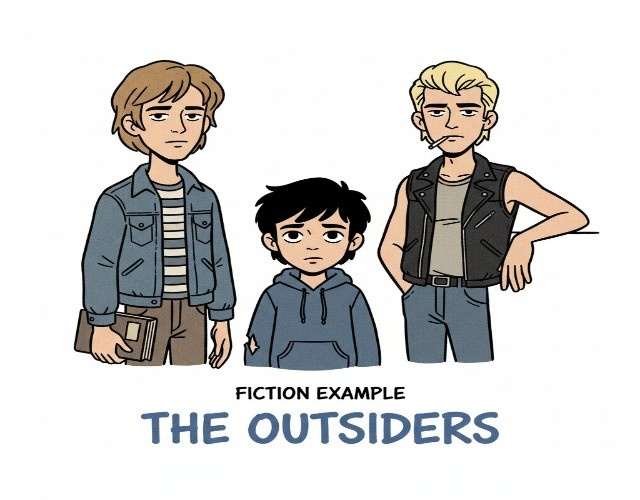
The Outsiders: Grade Level: Middle School/College | Length: 460 words
Fiction Example: The Outsiders
[COMPLETE MIDDLE SCHOOL REPORT]
Introduction: In S.E. Hinton's novel The Outsiders, published in 1967, teenagers Ponyboy Curtis and his friends navigate violent gang rivalries in 1960s Oklahoma. Through Ponyboy's first-person narration, Hinton explores how socioeconomic divisions create conflict while demonstrating that individuals transcend their social groups' stereotypes. The novel suggests that understanding others' humanity can bridge even the deepest social divides.
Plot Summary: Fourteen-year-old Ponyboy belongs to the Greasers, a working-class gang constantly fighting the wealthy Socs. After Ponyboy and Johnny are attacked by Socs, Johnny kills Bob in self-defense. The boys flee to an abandoned church where they hide for several days.
When the church catches fire with children inside, Johnny and Ponyboy rescue them, but Johnny is severely injured. He dies from his injuries after telling Ponyboy to "stay gold", to maintain his innocence and goodness. The tragedy leads both gangs to realize the futility of their violence. Ponyboy eventually processes his trauma by writing his story, which becomes the novel itself.
Character Analysis: Ponyboy is sensitive and intelligent, differing from typical Greaser stereotypes. He loves reading and movies, demonstrating that social class doesn't determine personality or interests. His development from naive observer to someone who understands both sides' humanity shows his maturation.
Johnny Cade is the gang's vulnerable member, abused at home and searching for belonging. His sacrifice to save children demonstrates heroism exists regardless of social class. His death proves the most devastating because he represents innocent victimhood of gang violence.
Darry Curtis, Ponyboy's oldest brother, initially seems harsh but actually sacrifices his future to keep his family together after their parents die. He represents responsible adulthood and the pressures poverty creates.
Theme Discussion: The novel's primary theme examines how socioeconomic division creates conflict. Greasers and Socs fight because they view each other as completely different. However, Cherry Valance's observation that "things are rough all over" reveals that both groups face struggles, poverty versus pressure to maintain wealth and status.
Johnny's final words, "stay gold," reference Robert Frost's poem about innocence's impermanence. This theme suggests that maintaining goodness and hope despite life's hardships defines true courage. Ponyboy's ability to see beauty and write despite tragedy embodies this theme.
The novel also explores chosen family versus biological family. The Greasers create brotherhood, filling gaps left by dysfunctional homes. This demonstrates that meaningful connections transcend blood relationships, forming through shared experience and mutual support.
Conclusion: Hinton effectively uses gang conflict as metaphor for broader class divisions in American society. By humanizing both Greasers and Socs, she challenges readers to look beyond social categories, recognizing individual humanity. The novel's continued relevance stems from its timeless message that empathy and understanding can overcome prejudice. Ponyboy's journey from simple us-versus-them thinking to nuanced understanding of human complexity makes the novel resonate with readers experiencing their own coming-of-age realizations.
What Makes It Work:
- Strong thesis: Clear interpretive claim about class division and empathy.
- Balanced structure: 20% summary, 80% analysis.
- Specific evidence: Character actions and dialogue support claims.
- Theme depth: Examines multiple interconnected themes.
- Sophisticated analysis: Explains WHY characters behave as they do.
- Synthesis conclusion: Connects ideas to broader significance.
- Appropriate length: 500 to 600 words for middle school.
Reading an example of book report can help students understand how to summarize the story, analyze characters, and share their personal reflections. If organizing your thoughts feels overwhelming, our book report outline can guide you through every part of the assignment.
Example #7:Literary Example: 1984

1984: Grade Level: College Level | Length: 250 words
Literary Analysis: 1984
[EXCERPT - Theoretical Framework and Advanced Analysis]
Introduction: George Orwell's 1984 presents totalitarianism's ultimate manifestation through the Party's complete control over reality itself. Applying Michel Foucault's concept of panoptic surveillance and Judith Butler's theories of performative identity, this analysis examines how Oceania maintains power not merely through violence but through psychological mechanisms that make subjects police themselves. Orwell's dystopia reveals how totalitarian regimes succeed by colonizing not just physical space but language, memory, and consciousness itself.
Theoretical Framework: Foucault's Discipline and Punish argues that modern power operates through surveillance, creating self-disciplining subjects. The Party's telescreens literalize this panoptic control; citizens never know when they're watched, so they must always perform loyalty. Winston's instinctive suppression of thoughtcrime before the telescreen demonstrates internalized surveillance's success.
However, Orwell extends beyond Foucault by showing how totalitarianism colonizes private consciousness. The Party doesn't merely surveil behavior but attempts to eliminate the capacity for dissent through Newspeak's linguistic constraints and continuous present's temporal dissolution. This suggests surveillance alone insufficient for total control, language and memory must also be controlled.
Newspeak and Linguistic Control: The Party's systematic destruction of language reveals Orwell's understanding that thought depends on linguistic capacity. By eliminating words for concepts like "freedom," the Party aims to make freedom literally unthinkable. This anticipates contemporary linguistic theory (Sapir-Whorf hypothesis) suggesting language shapes cognition.
The appendix's past-tense discussion of Newspeak implies the Party's eventual failure, offering subtle hope absent from the main narrative. This formal choice suggests language's resilience, even totalitarian control cannot permanently constrain human meaning-making capacity.
What Makes It Work:
- Theoretical framework: Applies scholarly concepts appropriately.
- Original argument: Advances interpretation beyond surface reading.
- Evidence integration: Seamlessly incorporates quotes and paraphrases.
- Formal awareness: Analyzes structural elements (appendix).
- Scholarly conversation: Engages with critical tradition.
- Advanced synthesis: Connects multiple theoretical lenses.
If you want help structuring your book report, analyzing themes clearly, or polishing your writing, a trusted essay writing service can provide expert guidance and ensure your report meets academic standards.
Downloadable Book Report Sample PDFs
Elementary Book Report Sample Pack
3 complete reports (grades 3 to 5)
Middle School Book Report Sample Pack
3 complete reports (grades 6 to 8)
High School Book Report Sample Pack
4 complete reports (grades 9 to 12)
College Book Report Sample Pack
3 advanced analysis reports
Annotated Book Report Samples Bundle
All reports with expert commentary showing what works
Conclusion
Learning book report writing accelerates through studying effective examples. Study 3 to 5 samples matching your level before writing. For complete fundamentals, explore our book report guide. Apply these techniques systematically to write comprehensive, analytical reports at any education level.
See How We've Helped 10,000+ Students Ace Their Book Reports
Real students, real results, real grade improvements
- Read Success Stories. Students share how we helped them achieve A+ grades
- Check Our Reviews 4.9/5 stars from verified customers
- See Sample Reports. View examples of our A+ quality work
- Join Success Community, Become our next success story
From struggling with C's to celebrating A's, see the transformation our service creates for students like you.
Order Now