Imagine finishing a captivating novel and wanting to share your experience with others, what happened, who the characters were, and what the story meant. Book reports provide structured frameworks for communicating your understanding of texts, from simple summaries of childhood favorites to sophisticated analyses of complex literature.
Book report writing is an academic staple appearing in nearly every grade from elementary through college. Despite their ubiquity, many students struggle with reports, uncertain what to include, how much detail to provide, or how to balance summary with analysis.
Understanding the purpose, structure, and techniques of effective book reports transforms them from dreaded assignments into manageable, even enjoyable, opportunities to engage deeply with literature.
This comprehensive guide covers everything you need to master book report writing at any level. You'll understand what makes book reports unique from other academic writing, learn essential components of effective reports, discover strategies for reading and analyzing books efficiently, explore different types of reports for various genres, and access resources including outlines, templates, and examples.
We'll cover understanding the fundamentals and purposes of book reports, essential components every report must include, a step-by-step process from reading to final draft, different types of reports for various genres and purposes, organizing and structuring reports effectively, and resources, including outlines, templates, and writing guides.
Whether you're writing your first elementary school book report or crafting a sophisticated college-level literary analysis, you'll find practical strategies, clear examples, and helpful resources.
For detailed structural guidance, explore our comprehensive book report outline guide with templates for all education levels. For step-by-step writing instructions, visit our complete book report writing guide covering the entire process from reading through revision.
Understanding Book Reports
| Aspect | Explanation |
|---|---|
| Objective vs. Subjective Focus | Book reports emphasize objective description of plot, characters, and themes, rather than personal opinions. Unlike reviews, they do not argue whether the book is “good” or “bad.” |
| Summary + Analysis Balance | Strong reports combine plot summary with analysis. Too much summary becomes a retelling; too much analysis lacks textual grounding. Effective reports link key events to their deeper meaning. |
| Demonstrating Comprehension | The core purpose is to prove understanding of the text—main ideas, character development, plot structure, and thematic patterns. This sets book reports apart from persuasive or research-based writing. |
| Structured Format | Book reports follow a consistent structure: introduction, summary, character analysis, themes, and conclusion. Knowing the format makes them easier to write effectively. |
Book reports appear across all education levels but adapt to developmental stages. Elementary reports focus on basic comprehension, who, what, when, and where, with simple summaries and character descriptions.
A strong book report doesn’t just retell the story; it comments on the author’s writing style, tone, pacing, and message.
Middle school reports add why and how questions, introducing basic literary analysis. High school reports demand sophisticated interpretation of symbolism, themes, and the author's craft. College reports require critical evaluation, positioning books within literary traditions and theoretical frameworks.
The skills developed through report writing transfer broadly. Summarizing complex information concisely, identifying main ideas versus supporting details, analyzing cause and effect relationships, recognizing patterns and themes, and organizing information logically all serve students throughout education and professional life.
Core Components
Every effective book report, regardless of education level or specific requirements, includes five essential components that structure your analysis and demonstrate comprehension.
Introduction with Thesis: The opening establishes the book's basic information (title, author, publication details) and presents your thesis statement—the main point or interpretation you'll develop throughout the report. Strong introductions hook readers with interesting observations about the book while efficiently providing necessary context.
Elementary introductions might simply state: "Charlotte's Web by E.B. White is about friendship between a pig and a spider." High school introductions develop more sophisticated theses: "In Charlotte's Web, E.B. White explores how true friendship transcends physical differences and mortality, ultimately suggesting that love's impact endures beyond death."
Plot Summary: This section recounts the story's main events in chronological order, covering the beginning (exposition and initial conflict), middle (rising action and complications), and end (climax and resolution). Effective summaries identify major plot points without excessive detail; you're providing an overview, not retelling every scene.
The challenge lies in determining the appropriate detail level. Include events essential to understanding the story and character development. Omit minor subplots and supporting scenes that don't advance the main conflicts. Generally, a plot summary should comprise 20-25% of total report length—enough to orient readers unfamiliar with the book but not so much that the summary overwhelms analysis.
For guidance on creating effective summaries, see our book report outline guide with templates showing appropriate summary length for different education levels.
Character Analysis: Examine the main characters, protagonists, and antagonists, describing physical traits, personality characteristics, motivations, and development throughout the story. Strong character analysis goes beyond description to interpretation, explaining why characters behave as they do and what their actions reveal about themes.
Describe both static characters (unchanging throughout the story) and dynamic characters (experiencing significant change or growth). For dynamic characters, identify what causes transformation, events, relationships, and realizations, and what this development reveals about the story's meaning.
Secondary characters deserve attention when they significantly impact the plot or illuminate themes. Explain their roles, relationships to main characters, and contributions to the story's development. Avoid lengthy descriptions of every minor character; focus on those essential to understanding the narrative.
Learn While You Get Help
Understand Book Reports Better Through Expert-Written Examples
Use professionally written book reports as learning tools to improve your own writing skills.
Theme Identification: Themes are the central ideas, messages, or insights the author explores through the story. Common themes include friendship, courage, coming of age, good versus evil, appearance versus reality, power of knowledge, nature of sacrifice, and countless others.
Identify 2-3 major themes and explain how the author develops them through plot events, character experiences, symbols, and narrative techniques. Support thematic claims with specific examples from the text, particular scenes, character actions, or dialogue demonstrating the theme's presence.
Distinguish between themes (universal ideas applicable beyond the specific story) and topics (specific subjects the story addresses). "War" is a topic; "War destroys innocence" or "War reveals human capacity for both cruelty and compassion" are themes.
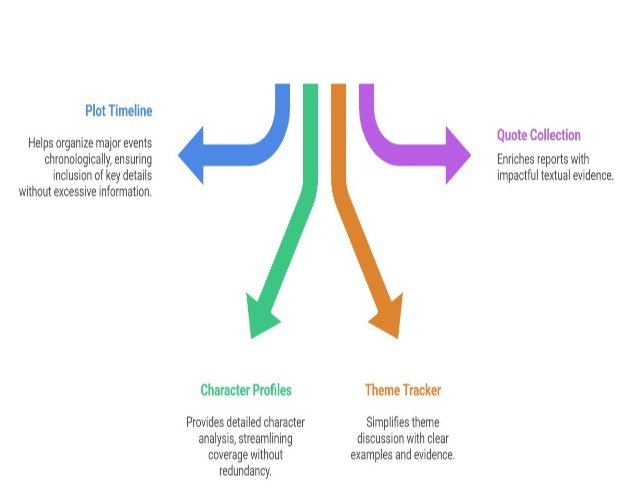
Use a 3-column note method: “Plot Events,” “Character Details,” and “Important Quotes.” This keeps your report organized and eliminates rereading.
Conclusion Synthesizing Insights: Effective conclusions go beyond simply restating the introduction. Synthesize insights from your analysis, explaining what readers should understand about the book's significance. Address the "so what?" question: why does this book matter? What makes it worth reading and discussing?
Consider the book's overall impact, effectiveness in achieving the author's purpose, relevance to contemporary readers, or contribution to its genre. Avoid introducing new plot details or analysis in conclusions; instead, reflect on the significance of insights developed throughout the report.
For step-by-step guidance on each component, explore our comprehensive book report writing guide with detailed instructions and examples for every section.
Types of Book Reports
Different assignments require different approaches. Understanding various report types helps you meet specific requirements and adapt your writing appropriately. Each type requires a different approach, and reviewing book report examples can help you understand the differences more clearly
Fiction Reports: The most common type, fiction reports analyze novels, short stories, and other imaginative narratives. They emphasize plot summary, character development, theme identification, and literary technique analysis. Fiction reports examine how authors use narrative elements, setting, conflict, point of view, and symbolism to create meaning.
Structure typically follows:
- Introduction with basic book information.
- Thesis.
- Plot summary organized chronologically or by major conflict.
- Character analysis of protagonists and key supporting figures, theme discussion with textual evidence.
- Conclusion assessing overall significance and effectiveness.
Non-Fiction Reports: Reports on non-fiction books (biography, history, science, self-help, memoir) focus on information, arguments, and evidence rather than plot and character. They summarize the author's main thesis or purpose, outline key supporting arguments or information, evaluate evidence quality and persuasiveness, and assess the book's contribution to its subject.
Non-fiction reports require different organizational approaches. Instead of a plot summary, you'll provide a thesis summary and argument structure. Instead of character analysis, you might analyze the author's credibility, methodology, or perspective. Themes become central arguments or patterns in the author's thinking.
Comparative Reports: Some assignments require comparing two or more books, examining similarities and differences in themes, characters, narrative techniques, or perspectives on shared subjects. Comparative reports demand a clear organizational strategy, discussing books separately, then comparing, or organizing by comparison points, discussing both books within each section.
Effective comparative reports establish a clear basis for comparison. Why compare these specific books? What insights emerge from juxtaposing them? Strong comparisons reveal a deeper understanding than analyzing either book alone, showing how different authors approach similar themes, how narrative techniques create different effects, or how perspectives complement or contradict each other.
Genre-Specific Reports: Certain genres require specialized approaches. Biography reports focus on the subject's life significance and the author's interpretation. Historical fiction reports balance plot analysis with historical accuracy evaluation. Science fiction or fantasy reports might examine world-building and imaginative elements alongside traditional narrative analysis.
Poetry collections require different treatment than novels, analyzing individual poems, examining recurring themes and techniques, and discussing the collection's overall arc or organization. Play reports might address performance elements, stage directions, dialogue, and dramatic structure, alongside traditional literary analysis.
Academic Purposes
Understanding why teachers assign book reports helps you approach them more effectively and appreciate their value beyond immediate grade requirements.
Developing Reading Comprehension: Reports require a thorough understanding of texts. You can't fake comprehension when you must summarize plot, analyze characters, and identify themes. This accountability encourages careful reading, teaching you to track main ideas, note important details, and recognize patterns.
The close reading required for effective reports develops skills applicable to all academic reading. Learning to distinguish main ideas from supporting details, recognize cause-and-effect relationships, track character or argument development, and synthesize information from lengthy texts serves students across all subjects requiring text comprehension.
Building Analytical Skills: Reports push beyond surface-level summary to deeper analysis. Why do characters behave as they do? How do plot events connect to themes? What techniques does the author use to create effects? These analytical questions develop critical thinking applicable far beyond literature classes.
Analytical skills transfer broadly. Learning to examine evidence, identify patterns, recognize relationships between elements, support claims with specific examples, and draw conclusions from observations serves students in science labs, history document analysis, mathematical problem-solving, and professional decision-making throughout careers.
Enhancing Writing Abilities: Book reports provide structured practice organizing complex information logically, expressing ideas clearly and concisely, supporting claims with textual evidence, and adapting writing to audience and purpose. These fundamental writing skills improve through repeated practice across multiple reports.
The organizational challenges of reports, balancing summary with analysis, structuring multiple body paragraphs coherently, and maintaining logical flow between sections—teach students to plan before writing, develop paragraphs around clear topic sentences, use transitions effectively, and create satisfying conclusions.
Teaching Literary Analysis: Reports introduce students to literary analysis techniques they'll use throughout their education. Identifying themes, analyzing character development, recognizing symbolism, understanding narrative perspective, and evaluating the author's craft all appear in more advanced literature courses. Book reports provide foundational practice with these concepts.
Simple 3-Step Process
Getting Book Report Help Has Never Been Easier
Submit details - Expert writes - Receive your A+ book report. It's that simple!
As students progress, report expectations grow more sophisticated, scaffolding increasingly complex analytical skills. Elementary focus on basic comprehension prepares for middle school theme identification, which prepares for high school symbolism analysis, which prepares for college theoretical interpretation.
Essential Reading Strategies
Pre-Reading Preparation
Effective book reports begin before you start reading. Strategic preparation makes reading more efficient and analysis more insightful.
Research the Author: Understanding the author's background, other works, and historical context enriches reading comprehension. What experiences influenced their writing? What themes appear across their work? What literary movement or tradition do they represent?
Brief author research, reading biographical overview and reviews of their other books, takes 15-20 minutes but significantly enhances understanding. You'll recognize autobiographical elements, understand historical or cultural references, and appreciate thematic patterns across the author's work.
Preview the Book: Before diving into Chapter One, examine the book strategically. Read cover and jacket copy, noting promised themes or conflicts. Scan chapter titles revealing structure and major subjects. Read opening pages establishing tone, style, and initial conflict. Check closing pages (without spoiling plot), noting resolution style.
This preview creates a mental framework for organizing information as you read. You'll recognize when promised themes emerge, understand how early elements connect to later developments, and track the author's structural choices.
Clarify Assignment Requirements: Before reading, understand exactly what your report must include. Required length, specific components (character analysis, theme discussion, personal response), formatting requirements, and due date all influence how you approach reading and note-taking.
If unclear about requirements, ask your teacher before reading rather than after. Understanding whether you need a plot summary or thematic analysis, whether you should focus on specific characters or elements, and what analytical depth is expected prevents wasted effort and missed requirements.
Set Reading Schedule: Divide the book into manageable sections based on your due date. Reading 30-50 pages daily prevents last-minute cramming and allows time for reflection and note-taking. Rushed reading leads to poor comprehension and inadequate analysis.
Calculate backwards from your due date, allowing time for reading, note organization, outline creation, drafting, and revision. If your report is due in two weeks and the book is 300 pages, plan to finish reading in 8-9 days, allowing 4-5 days for writing and revision.
Active Reading Techniques
Reading for book reports differs from reading for pleasure. Active reading techniques maximize comprehension and simplify later writing.
Annotate as You Read: Keep pen and sticky notes handy, marking important passages, noting questions or observations, and flagging significant quotes. Annotations create a roadmap for later analysis, helping you locate key passages quickly when writing.
Mark character introductions, major plot developments, thematic statements, effective descriptive passages, confusing sections requiring re-reading, and quotes you might use in your report. Brief marginal notes, "turning point," "theme of friendship," "character change", help you remember significance when reviewing later.
Take Chapter Notes: After each chapter or major section, write a brief summary (2-3 sentences) capturing the main events and developments. This creates an outline you'll use when writing a plot summary, ensures you remember early events when finishing the book, and identifies patterns or themes as they develop.
Chapter notes also help you track character development across the narrative, recognize foreshadowing or setup for later events, and maintain engagement with lengthy books read over multiple days or weeks.
Track Character Development: Create a character chart noting names, relationships, personality traits, motivations, and significant actions. Update as you read, tracking how characters change, what causes transformation, and what these changes reveal about themes.
Character tracking prevents confusion with large casts and helps you remember supporting characters often forgotten by the book's end. It also reveals patterns in how multiple characters respond to similar challenges, how relationships evolve, and how character decisions drive plot development.
Identify Themes Early: Watch for recurring ideas, symbols, or questions the author explores repeatedly. Early theme identification helps you notice supporting evidence throughout the book, understand why certain scenes or conversations appear, and connect seemingly unrelated plot elements through thematic threads.
Common theme indicators include repeated symbols or images, philosophical questions or statements by characters, contrasts or parallels the author emphasizes, title connections, and the narrator's commentary on events or characters.
For comprehensive reading and analysis strategies, visit our complete book report writing guide with detailed note-taking templates and tracking systems.
Note-Taking Systems
Organized notes transform reading comprehension into effective reports. Several systems work well depending on personal preference and assignment requirements.
Structuring Your Report
Introduction Strategies
Effective introductions accomplish multiple goals: providing essential book information, engaging readers' interest, establishing your focus or thesis, and previewing your report's organization.
Opening Hook: Begin with an attention-getting statement rather than simply stating the title. Possible hooks include a surprising fact about the book or author, a relevant quotation from the text, a provocative question the book addresses, a bold statement about the book's significance, or a connection to universal themes or contemporary issues.
- Weak opening: "This report is about To Kill a Mockingbird by Harper Lee."
- Strong opening: "In the segregated South of the 1930s, one lawyer's moral courage challenged an entire community's prejudice—and taught his children lessons about justice that resonate today."
Essential Information: Every introduction must include title (underlined or italicized), author's full name, publication year (for context, especially with older books), genre (fiction, non-fiction, biography, fantasy, etc.), and brief context (time period, setting, or situation).
Present this information efficiently without a list-like structure. Integrate it naturally: "Harper Lee's 1960 novel To Kill a Mockingbird examines racial injustice through the eyes of Scout Finch, a young girl in Depression-era Alabama."
Thesis Statement: Your thesis presents the main point or interpretation you'll develop throughout the report. It goes beyond plot summary to an analytical claim about the book's meaning, significance, or effectiveness.
Elementary thesis: "Charlotte's Web teaches that friendship is important." More sophisticated thesis: "Through Charlotte's selfless acts to save Wilbur, E.B. White suggests that true friendship transcends self-interest and even death, creating legacies that endure."
Effective theses are specific (focused on a particular aspect, not vague generality), arguable (interpretive claim, not obvious fact), and supportable (you can prove it with examples from the book).
Preview of Structure: Briefly indicate what your report will cover, helping readers understand organizational logic. "This report will examine the novel's plot, analyze the main characters' development, and discuss its central themes of prejudice and moral courage."
For detailed introduction strategies and templates, see our comprehensive book report outline guide with examples for all education levels.
Body Paragraph Organization
The body contains your report's substance, plot summary, character analysis, and theme discussion. Clear organization prevents confusion and demonstrates thorough comprehension.
Plot Summary Section: Organize chronologically, covering beginning (exposition, initial situation, inciting incident), middle (rising action, complications, character development), and end (climax, falling action, resolution). Focus on major events essential to understanding the story.
Use one paragraph for each major section or 2-3 paragraphs for longer books with complex plots. Begin each paragraph with a topic sentence indicating which plot section you're covering: "The story begins when..." "Complications arise when..." "The climax occurs when..."
Maintain appropriate balance. Plot summary should comprise approximately 20-25% of the total report length. A more extensive summary leaves insufficient space for analysis; a less summary fails to demonstrate comprehension.
Each body paragraph should explore a single idea—such as character growth, theme development, or conflict—not everything at once.
Character Analysis Section: Dedicate separate paragraphs to different characters or group minor characters together. Begin with protagonists and antagonists, then address significant supporting characters.
Each character paragraph should describe physical and personality traits, explain motivations and goals, analyze character development (how they change and why), discuss relationships with other characters, and connect the character to themes.
Analyze, don't just describe. Explain why characters behave as they do, what their actions reveal about themes, and how they contribute to the story's meaning. "Scout's innocence allows her to question adult prejudices without understanding their depth," analyzes. "Scout is young and innocent" merely describes.
Theme Discussion Section: Address 2-3 major themes in separate paragraphs. Each paragraph should clearly state the theme, provide specific examples demonstrating its presence (plot events, character actions, dialogue, symbols), explain how the author develops the theme, and connect the theme to the book's overall significance.
Support thematic claims with textual evidence. Don't simply assert "The book explores friendship"; explain how specific scenes, character relationships, and plot developments demonstrate friendship's importance and reveal the author's perspective on it.
Transitions Between Sections: Use transitional sentences connecting sections smoothly. "After establishing these plot developments, we can examine how characters respond to challenges," links plot summary to character analysis. "These character transformations reflect the novel's central themes," connects character analysis to theme discussion.
100% Original Work Guaranteed
Every Book Report is Custom-Written Just for You—Never Resold
Complete originality with free plagiarism reports included. Your academic integrity is our priority.
Conclusion Approaches
Conclusions synthesize insights without simply restating the introduction. They answer the "so what?" question—why does this analysis matter?
Synthesis of Analysis: Bring together insights from plot, character, and theme discussions, showing how they interconnect. How do plot events demonstrate themes? How does character development embody the author's message? What patterns emerge from your analysis?
Effective synthesis goes beyond listing points to explaining relationships between them. "Scout's journey from innocence to awareness mirrors the community's painful reckoning with prejudice, suggesting that moral growth requires confronting uncomfortable truths."
Assessment of Significance: Evaluate the book's overall impact, effectiveness, or importance. Does it achieve the author's purpose? What makes it memorable or meaningful? Why should readers care about this story?
Avoid empty praise ("This is a great book") or vague criticism ("I didn't like it"). Instead, explain specifically what works or doesn't: "Lee's choice to narrate through Scout's child perspective makes abstract issues of justice concrete and emotionally powerful, helping readers understand prejudice's human cost."
Broader Connections: Connect the book to larger contexts—other works by the same author, the literary genre or tradition, contemporary social issues, or universal human experiences. These connections demonstrate a sophisticated understanding beyond the individual text.
"Like other coming-of-age novels, Mockingbird charts the painful loss of innocence, but Lee's racial justice focus gives this universal experience particular urgency and moral weight."
The conclusion should highlight the book’s message or impact—not just restate the plot. Explain why the book matters.
Final Reflection: End with a memorable statement or observation, leaving readers with something to consider. Avoid introducing new information; instead, offer insight that resonates beyond the immediate report.
"Ultimately, To Kill a Mockingbird reminds us that moral courage often appears in quiet acts of decency—standing alone against injustice even when victory seems impossible."
For complete structural guidance with templates and examples, explore our book report outline resource with customizable frameworks for different report types.
Common Book Report Mistakes & How to Fix Them
Too Much Plot Summary: Many reports become mere plot recaps, dedicating 80% of space to summary with minimal analysis. Remember: readers need enough plot context to follow your analysis, but don't need every detail retold. Limit summary to 20-25% of total length.
Fix: After drafting, highlight the plot summary versus the analysis. If summary dominates, cut unnecessary details and expand analytical sections examining characters, themes, and significance.
Vague Theme Statements: Weak reports identify themes without explaining or supporting them: "The book is about friendship." Strong reports define themes precisely and support with specific evidence: "The novel suggests friendship transcends physical differences, as Charlotte's devotion to Wilbur despite their species differences demonstrates unconditional acceptance."
Fix: For each theme mentioned, provide at least one specific example from the book demonstrating it and explain what this example reveals about the author's perspective.
Character Description Without Analysis: Simply describing characters' appearances and actions without analyzing motivations, changes, or significance produces superficial reports missing analytical depth.
Fix: Ask "why?" and "so what?" for every character point. Why does this character behave this way? What does this reveal about them or the themes? How does their development contribute to the story's meaning?
Missing Thesis Statement: Reports without clear thesis statements lack focus and direction. Readers (and graders) should understand your main point or interpretation from the introduction.
Fix: After drafting, identify your main argument about the book in one sentence. If you can't, you don't have a thesis. Develop an interpretive claim about the book's meaning, significance, or effectiveness and state it clearly in the introduction.
Personal Opinion Replacing Analysis: Book reports should analyze objectively rather than offering personal likes and dislikes. "I loved this book" or "This was boring" aren't analytical observations.
Fix: Focus on the book's content, themes, and techniques rather than your feelings about it. If including personal response (some assignments require this), ground it in specific elements: "The protagonist's development felt authentic because..." rather than "I really liked the main character."
Inconsistent Verb Tense: Mixing past and present tenses confuses readers. Literary analysis traditionally uses the present tense when discussing books: "Scout learns about injustice," not "Scout learned about injustice."
Fix: Use the present tense consistently when discussing the book's content: plot events, character actions, and theme development. Use the past tense only when discussing historical context or the author's life.
Insufficient Textual Evidence: Analytical claims without supporting examples from the text are unconvincing. Every interpretation needs specific evidence.
Fix: For each analytical point, provide at least one specific example, scene, quote, or character action from the book demonstrating your interpretation. Show readers where your insights come from.Resources and Tools
Downloadable Templates:
Checklists:
Sample Reports:
For step-by-step writing instructions from reading through the final draft, explore our complete book report writing guide with strategies for every stage of the process.
Conclusion
Mastering book report writing develops essential academic skills serving students throughout education and beyond. The ability to read critically, identify main ideas, analyze evidence, organize complex information, and express insights clearly transfers to all subjects requiring comprehension, analysis, and communication.
Book reports may feel formulaic initially, but they provide structured practice with skills you'll use throughout life—understanding texts deeply, thinking analytically about ideas and arguments, supporting claims with evidence, and communicating insights clearly to others. Each report strengthens these foundational abilities.
Approach reports strategically: read actively with a note-taking system, organize information before drafting using outlines, balance summary with analysis, remembering reports demonstrate both comprehension and interpretation, support analytical claims with specific textual evidence, and revise focusing on clarity, organization, and depth.
Success in book report writing comes through practice and a systematic approach. Use the strategies, templates, and resources provided here to streamline your process and improve your results. With proper preparation, organized note-taking, clear structure, and thoughtful analysis, you can transform book reports from dreaded assignments into manageable opportunities to engage deeply with literature.
Begin your next report with confidence using our detailed book report outline guide, providing templates and structures for all education levels, and our comprehensive book report writing guide, walking you through every step from reading through final revision. With these resources and consistent practice, your book report skills will strengthen significantly. If you need more help, browse our book report examples to see what a strong report looks like.
Learn to Write Better Book Reports While Getting Expert Help
Use professionally written examples to improve your own skills
- Order Your Custom Report. Get an expertly written book report for your specific book
- Study Our Techniques. See exactly how professionals analyze and structure reports
- Apply What You Learn. Use insights to improve your own writing abilities
- Build Lasting Skills. Develop confidence for future assignments
It's not just about this assignment—it's about becoming a better writer for life.
Get Started Now