Introduction
Many students start writing book reports without clear plans, hoping structure will emerge as they write. This approach typically produces disorganized reports that jump between topics, omit essential elements, or dedicate excessive space to summary while skimping on analysis.
Effective writers outline before drafting, organizing information logically and ensuring comprehensive coverage. Outlines transform chaotic notes from reading into structured frameworks guiding efficient writing. The process clarifies thinking—identifying your main argument, determining what evidence supports it, and recognizing logical organization.
This guide provides everything you need to create effective book report outlines at any education level. You'll learn essential components every outline must include, strategies for organizing information logically, templates for different education levels and report types, methods for balancing summary with analysis, and techniques for using outlines to streamline drafting.
Whether you're outlining your first elementary school report or a sophisticated college literary analysis, you'll find practical frameworks and clear examples. Outlines aren't one-size-fits-all; they adapt to assignment requirements, book complexity, and analytical depth needed.
After creating your outline here, use our complete book report writing guide for step-by-step instructions transforming outlines into polished final drafts. This comprehensive guide provides templates, strategies, and book report examples for creating outlines at every education level.
Essential Outline Components
| Section | Key Points |
|---|---|
| Introduction | Hook, book info, thesis, preview body |
| Plot Summary | Major events only, chronological, brief phrases, ~20–25% of outline, link to analysis |
| Character Analysis | Main/supporting characters, traits, motivations, development, relationships, theme connections |
| Theme Discussion | Identify 2–3 themes, support with evidence, track development, note significance |
| Conclusion | Synthesize insights, overall assessment, broader connections, final reflection |
Introduction Section
Every book report outline begins with introduction planning covering essential elements readers need immediately.
Hook Strategy: Note your attention-getting opening approach—surprising fact about the book or author, relevant quotation from the text, provocative question the book addresses, bold statement about significance, or connection to universal themes. Don't write complete sentences; just identify your hook type and key point.
Example outline entry: "Hook: Charlotte's Web quote about friendship transcending differences"
Book Information Checklist: List essential details you'll include: full title (with proper formatting noted), author's complete name, publication year (especially important for older books), genre classification, and brief setting or context (time period, location, situation).
Example: "Info: To Kill a Mockingbird / Harper Lee / 1960 / Southern Gothic fiction / Depression-era Alabama"
Thesis Statement Draft: Articulate your main interpretive claim about the book—the central point your entire report will develop. Strong thesis statements are specific (focused on particular aspect, not vague generality), arguable (interpretive claim, not obvious fact), and supportable (provable with textual examples).
Elementary thesis example: "Charlotte's Web shows that real friends help each other." High school thesis: "Through Charlotte's selfless sacrifice, White suggests friendship's truest form transcends self-interest and even death, creating lasting impact beyond individual lives."
Preview Note: Briefly indicate what body sections will cover, establishing organizational logic: "Will cover plot summary (chronological), character analysis (Charlotte, Wilbur, Fern), themes (friendship, mortality, cycle of life)."
Plot Summary Section
Outlining plot summary prevents common mistakes—excessive detail overwhelming analysis, omitting crucial events, and disorganized chronology confusing readers.
Major Events Only: List 8-12 key plot points essential for understanding the story. Focus on events that establish conflict, reveal character, advance plot significantly, or demonstrate themes. Omit minor details, subplots that don't impact main story, and descriptive passages without plot significance.
Organize chronologically using brief phrases: "Beginning: Wilbur born as runt, saved by Fern / Sold to Zuckerman farm, lonely / Meets Charlotte the spider"
Beginning-Middle-End Structure: Divide plot summary into three sections ensuring balanced coverage.
Beginning (Exposition): Initial situation, main characters introduced, setting established, inciting incident triggering main conflict
Middle (Rising Action): Complications arise, conflicts intensify, character relationships develop, obstacles challenge protagonists
End (Resolution): Climax (turning point or peak tension), falling action (conflicts resolve), resolution (final outcome, character situations at story's end)
Length Guidelines: Plot summary should comprise approximately 20-25% of total report outline space. If your outline dedicates three pages to plot and one to analysis, rebalance. More outline space for summary typically produces reports heavy on recap, light on interpretation.
Connection to Analysis: Note how key plot events demonstrate themes or reveal character. Brief analytical observations in your plot outline prevent pure summary: "Charlotte's death (shows friendship's legacy beyond individual life—theme connection)"
For guidance on transforming your outline into complete written book report, see our comprehensive writing guide on how to write a book report with paragraph development strategies.
Character Analysis Section
Character analysis outlines organize observations about protagonists, antagonists, and significant supporting characters systematically.
Main Characters: Create subsections for each major character including name and role (protagonist, antagonist, supporting), physical description (brief, relevant traits), personality characteristics (3-5 key traits with evidence), motivations and goals (what they want, why), and character development (how they change, what causes transformation).
Example outline: "Charlotte (protagonist spider): Physical—gray, wise-looking / Personality—intelligent, selfless, creative, patient / Motivation—save Wilbur from slaughter / Development—accepts mortality, creates lasting legacy through words and eggs"
Supporting Characters: Group minor characters or give each brief entry noting role in story, relationship to main characters, and contribution to plot or themes.
"Templeton (rat): Selfish foil to Charlotte's generosity, provides reluctant help, demonstrates self-interest contrasting with friendship theme"
Character Relationships: Map key relationships and dynamics: "Charlotte-Wilbur: mentor-student, savior-saved, demonstrates unconditional friendship / Wilbur-Fern: child-pet bond, shows human-animal connection / Charlotte-Templeton: illustrates different moral codes"
Analysis Notes: For each character, note analytical points you'll develop: "Charlotte WHY analysis: Selflessness stems from maternal instinct? Natural spider behavior creating meaning? Author's message about legacy?"
Theme Connections: Link characters to themes they embody or explore: "Wilbur represents innocence, vulnerability, need for protection / Charlotte embodies wisdom, sacrifice, creative problem-solving / Together demonstrate friendship crossing differences"
Book Report Due Tomorrow?
Don't Panic! We Can Help You Submit On Time
Fast turnaround without compromising quality. Available 24/7 for your deadline emergencies.
Theme Discussion Section
Thematic analysis outlines identify central ideas and organize supporting evidence from the text.
Theme Identification: List 2-3 major themes using specific statements, not vague topics. "Friendship" is topic; "True friendship requires selfless sacrifice" is theme. "Death" is topic; "Accepting mortality gives life meaning" is theme.
Example themes list: 1. Friendship transcends differences and death / 2. Words have power to change perception and reality / 3. Life's cycle includes birth, growth, death, renewal"
Evidence Collection: Under each theme, list specific supporting examples including plot events demonstrating theme, character actions or dialogue, symbols or motifs, and author's direct statements.
Theme 1 evidence outline: "Friendship theme: Charlotte's web messages (words saving life) / Charlotte's death but eggs continue her legacy / Species difference (spider-pig) doesn't prevent bond / Fern's early protection of Wilbur / Templeton as contrast (self-interest vs friendship)"
Development Tracking: Note how themes develop throughout the story: "Friendship theme progression: Begins with Fern-Wilbur (simple protection) ? Charlotte-Wilbur (active sacrifice) ? Wilbur-Charlotte's children (legacy continuing) = Shows friendship evolving from need-based to selfless to generational"
Significance Notes: Jot down why each theme matters—what insight or message does it convey? "Significance: Charlotte's Web suggests friendship's value lies not in duration or similarity but in mutual care and lasting impact—challenges readers to consider quality over quantity in relationships"
Conclusion Section
Outline your conclusion to ensure it synthesizes insights rather than merely repeating introduction.
Key Points Synthesis: List main insights from each analytical section you'll bring together: "Plot shows progression from vulnerability to security / Charlotte character demonstrates selfless friendship ideal / Wilbur character shows growth from dependent to caring / Themes reveal author's message about friendship, mortality, legacy"
Overall Assessment: Note your evaluation of the book's effectiveness, significance, or impact: "Assessment: Successfully makes complex themes (death, friendship's limits) accessible to young readers through animal characters / Ending balances sadness with hope"
Broader Connections: Identify connections you'll make to other works, genres, or real-world relevance: "Connection: Like other children's classics (Velveteen Rabbit, Bridge to Terabithia), uses animal characters to explore difficult topics safely / Relevant to readers learning about loss, friendship's value"
Final Thought: Note your closing statement or reflection: "Final: White reminds readers that small acts of kindness create ripples extending far beyond immediate moment—Charlotte's words literally save life and create legacy"
For strategies transforming outline points into polished conclusion paragraphs, visit our complete writing guide with conclusion development techniques.
Outline Templates by Education Level
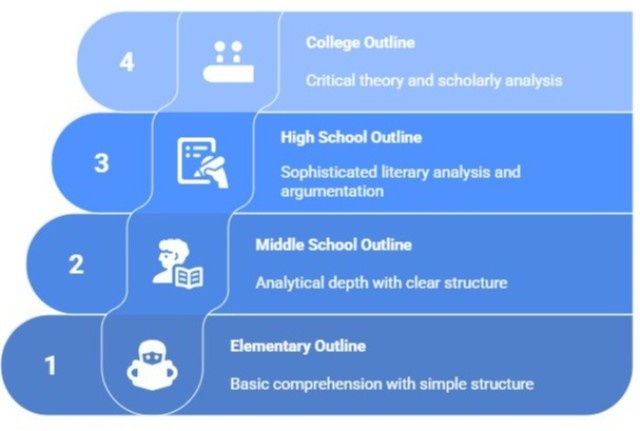
Elementary Level Template (Grades 3-5)
Elementary outlines emphasize basic comprehension with simple organizational structure.
I. Introduction - Book title: _____________ - Author: _____________ - Main character: _____________ - Setting (where/when): _____________ - Basic idea of story: _____________
II. Beginning of Story - How story starts: _____________ - Main character's situation: _____________ - Problem that happens: _____________
III. Middle of Story - What main character does: _____________ - Other important characters: _____________ - Biggest challenges: _____________
IV. End of Story - How problem gets solved: _____________ - What happens to main character: _____________ - How story ends: _____________
V. My Opinion - What I liked best: _____________ - Favorite character and why: _____________ - Would I recommend this book: _____________
Middle School Template (Grades 6-8)
Middle school outlines add analytical depth while maintaining clear structure.
I. Introduction
- Hook: Interesting opening fact or question
- Book information: Title, author, year, genre
- Brief plot summary: 2-3 sentences
- Thesis: Main point about book's meaning or significance
II. Plot Summary
- Beginning: Initial situation, main characters introduced, conflict established
- Middle: Major events (3-4 key points), complications, character challenges
- End: Climax, resolution, final outcome
III. Character Analysis
- Main character: Personality traits (3-4), goals and motivations, how they change
- Supporting character: Role in story, relationship to main character, importance to plot
IV. Theme Discussion
- Theme 1: Statement of theme, examples from book (2-3), what it shows about story's meaning
- Theme 2 (optional): Statement and examples
V. Conclusion
- Summary of main points
- Personal response
- Recommendation
Simple 3-Step Process
Getting Book Report Help Has Never Been Easier
Submit details - Expert writes - Receive your A+ book report. It's that simple!
High School Template (Grades 9-12)
High school outlines demand sophisticated literary analysis and argumentation.
I. Introduction (5-7 sentences)
- Hook: Engaging opening establishing context
- Background: Author, historical context, genre
- Brief plot overview: 2-3 sentences
- Thesis: Complex interpretive claim about meaning/significance
II. Plot Summary (20-25% of outline)
- Exposition: Setting, characters, initial situation
- Rising Action: Key events leading to climax (4-5 major points)
- Climax: Turning point or peak tension
- Falling Action/Resolution: Conflict resolution, character situations
III. Character Analysis
- Protagonist: Physical/personality traits, motivations and internal conflicts, character arc (static vs. dynamic), symbolic significance or thematic connection
- Antagonist: Role in creating conflict, relationship to protagonist, thematic purpose
- Key Supporting Characters: Functions in plot, thematic significance
IV. Literary Analysis
- Theme 1: Precise thematic statement, textual evidence (3-4 examples with page numbers), analysis of how theme develops, connection to thesis
- Theme 2: Same structure
- Literary Devices: Symbolism examples, narrative technique (POV, structure), author's style elements
V. Critical Evaluation
- Assessment of effectiveness
- Strengths and weaknesses
- Literary or cultural significance
- Comparison to similar works (optional)
VI. Conclusion
- Synthesis of analytical points
- Thesis restatement (varied wording)
- Broader significance
- Final insight
College Level Template
College outlines incorporate critical theory and scholarly analysis.
I. Introduction (Sophisticated opening)
- Context: Literary/historical/theoretical framework
- Author background and other works
- Publication context and reception
- Thesis: Complex argument with nuance
II. Summary (Minimal—assume reader familiarity)
- Brief plot/content overview (3-4 sentences)
- Focus on elements relevant to analysis
III. Analytical Section 1 (Thematic/Structural)
- Topic sentence: Main analytical point
- Textual evidence: Direct quotes with citations
- Analysis: Close reading, theoretical application
- Connection to thesis
IV. Analytical Section 2
- Different aspect or deeper development
- Same structure: claim, evidence, analysis, connection
V. Analytical Section 3
- Synthesis of previous sections or new dimension
- Advanced interpretation
VI. Critical Assessment
- Evaluation within literary tradition
- Theoretical implications
- Scholarly conversation positioning
- Limitations or counterarguments addressed
VII. Conclusion
- Synthesis of complex argument
- Implications beyond immediate text
- Contribution to understanding
- Areas for further study
Any Book, Any Genre
Expert Help for Fiction, Non-Fiction, Biography; Every Type of Book Report
Whether it's classic literature or modern non-fiction, we've got the expertise you need.
Creating Your Outline: Step-by-Step
Step 1: Gather Your Notes
Before outlining, compile all reading notes including chapter summaries, character observations, theme tracking, highlighted quotes with page numbers, and questions or confusion points needing clarification.
Organize notes by category—plot events together, character observations together, thematic patterns together. This organization reveals natural structure for your outline and report.
Review notes identifying patterns and connections: recurring symbols or motifs, character parallels or contrasts, cause-effect relationships, thematic threads, and the author's techniques or stylistic choices.
Step 2: Identify Your Thesis
Your thesis drives outline organization. Everything included should support or develop your central interpretive claim about the book.
Draft thesis statement before outlining in detail. Test it: Is it specific enough to guide analysis? Is it arguable, not just factual? Can you support it with textual evidence? Does it address assignment requirements?
If struggling with thesis, try completion exercises: "This book suggests that..." "The most important thing about [character] is..." "The author uses [element] to show..."
Thesis may evolve during outlining as you recognize patterns or connections. That's normal—outlining clarifies thinking. Revise thesis if needed to reflect refined understanding.
Step 3: Determine Organization
Choose organizational approach matching your thesis and the book's characteristics.
Chronological: Works for plot-driven narratives where events sequence matters. Follow story's timeline through beginning, middle, end.
Thematic: Works for books exploring multiple themes. Organize by theme rather than plot sequence, using plot examples to illustrate each theme.
Character-Centered: Works for character-driven stories. Organize sections around different characters' development rather than chronological plot.
Comparative: Works for reports comparing multiple books or perspectives. Organize by comparison points, addressing both/all books within each section.
Most reports use hybrid approaches—chronological plot summary followed by thematic analysis, or character-by-character analysis with thematic connections noted within each.
Step 4: Balance Summary and Analysis
Common outline weakness: excessive summary space, insufficient analysis planning.
Measure outline sections. If plot summary occupies 3 pages and analysis occupies 1 page, rebalance. Aim for plot summary comprising roughly 20-25% of outline space, with analytical sections dominating.
For each plot point, add analytical note: "Wilbur saved from slaughter (plot) ? introduces death theme, shows Fern's compassion (analysis)." This practice prevents writing purely summarizing reports.
Step 5: Include Specific Evidence
Strong outlines note specific supporting evidence with page numbers or chapter references enabling quick location when drafting.
For thematic claims, list concrete examples: "Friendship theme—Charlotte's web messages (Ch. 10-15), Charlotte's death scene (Ch. 21), Wilbur's grief and Charlotte's children (Ch. 22)."
For character analysis, note specific actions or dialogue: "Charlotte's intelligence—web word ideas, tricking Templeton, strategic thinking about Wilbur's fate."
Evidence notes transform outlining from abstract planning to concrete preparation, making drafting faster and more focused.
Step 6: Plan Transitions
Note how sections will connect. Smooth transitions prevent choppy, disconnected reports.
In outline margins, write transition ideas: "After plot summary, transition to character analysis: 'Understanding these plot developments allows us to examine how characters respond to challenges...'"
"After first theme, transition to second: 'This friendship theme connects closely to the book's exploration of mortality...'"
Planning transitions during outlining prevents awkward jumps between sections when drafting.
Outline Examples by Genre
Fiction Novel Outline Example
I. Introduction
- Hook: To Kill a Mockingbird's child narrator perspective creates unique moral education story
- Info: Harper Lee, 1960, Southern Gothic, Depression-era Alabama
- Brief plot: Scout Finch narrates father's defense of wrongly accused Black man, her coming-of-age journey
- Thesis: Lee uses Scout's innocent perspective to expose Southern prejudice's absurdity while showing how moral courage can challenge entire communities
II. Plot Summary (20%)
- Part 1: Scout's childhood adventures, Boo Radley mystery, school experiences
- Part 2: Tom Robinson trial preparation, community reactions, Atticus's defense
- Climax: Trial verdict despite clear innocence
- Resolution: Bob Ewell's attack, Boo's rescue, Scout's maturation
III. Character Analysis
- Scout: Tomboy narrator, innocence allows her to question prejudice, growth from simple moral view to complex understanding
- Atticus: Moral center, principled lawyer, teaches through example not lecture
- Boo Radley: Misunderstood recluse, represents prejudice's harm, ultimate protector
- Tom Robinson: Innocent victim, dignity despite injustice
IV. Themes
- Prejudice and injustice: Tom's trial, class prejudice, gender expectations
- Moral education: Scout learning from Atticus, experiences teaching empathy
- Courage: Atticus's moral stand, Mrs. Dubose's physical courage, connecting types
- Loss of innocence: Scout's journey from simple right/wrong to moral complexity
V. Conclusion
- Synthesis of Scout's growth reflecting community's moral reckoning
- Assessment of child narrator effectiveness
- Connection to enduring racial justice issues
- Final reflection on quiet courage
Middle School Book Reports Made Easy
Age-Appropriate Help That Matches Your Grade Level Perfectly
From elementary to college, we provide book report assistance tailored to your exact education level.
Non-Fiction Outline Example
I. Introduction
- Hook: Question about book's relevance or surprising claim
- Info: Title, author, publication year, subject/genre
- Brief overview: Main thesis or purpose
- Your thesis: Assessment of book's argument/significance
II. Author's Background
- Credentials and expertise
- Perspective or bias
- Other works on subject
III. Main Argument Summary
- Author's central thesis
- Primary supporting arguments (3-4 major points)
- Evidence types used (research, anecdotes, statistics)
IV. Analysis of Evidence
- Strength of research/sources
- Logical reasoning quality
- Counterargument handling
- Bias or gaps in evidence
V. Significance Assessment
- Contribution to field
- Practical applications
- Limitations or weaknesses
- Comparison to other works on topic
VI. Conclusion
- Synthesis of evaluation
- Overall assessment of effectiveness
- Relevance to contemporary issues
- Recommendation context
Common Outlining Mistakes
| Mistake | Problem | Fix |
|---|---|---|
| Too Vague | Lacks guidance; unclear points | Specify characters, traits, evidence |
| Too Detailed | Full sentences/paragraphs; defeats outline purpose | Use brief phrases/bullets only |
| Unbalanced Sections | Over-summary, minimal analysis | Keep summary ~20–25%; focus on analysis |
| Missing Thesis | No clear focus | Draft thesis first; support it in outline |
| No Evidence Notes | Analytical points unsupported | Add specific examples with references |
| Rigid Following | Inflexible; prevents improvements | Treat outline as flexible guide |
Too Vague: Outline entries like "Discuss characters" or "Talk about themes" provide insufficient guidance. Specify which characters, which traits, what evidence.
Fix: "Charlotte: selfless (web messages), creative (word choices), maternal (egg protection)—demonstrates ideal friendship"
Too Detailed: Writing complete sentences or full paragraphs defeats outlining's purpose. Save actual writing for drafting stage.
Fix: Use brief phrases and bullet points: "Charlotte saves Wilbur through web words" not "In the middle of the story, Charlotte comes up with a plan to save Wilbur's life by spinning words into her web that make people think Wilbur is special."
Unbalanced Sections: Outlines with extensive plot summary but minimal analysis planning produce summary-heavy reports lacking depth.
Fix: Measure outline section lengths. Aim for summary comprising roughly 20-25% with analytical sections dominating.
Missing Thesis: Outlines without clear thesis statements lack focus. You're organizing information but toward what end?
Fix: Draft thesis before detailing outline. Every section should support or develop your central claim.
No Evidence Notes: Outlines listing analytical points without noting supporting evidence lead to vague claims in actual reports.
Fix: For each analytical point, list specific examples with page numbers: "Theme: friendship—Ch. 13 (Charlotte's first web), Ch. 21 (death scene), Ch. 22 (legacy)"
Rigid Following: Treating outlines as unchangeable contracts prevents adaptation when better organization emerges during writing.
Fix: View outlines as flexible guides. If better structure becomes apparent while drafting, adjust. Outlines serve you; you don't serve outlines.
Conclusion
Effective book report outlines transform overwhelming assignments into manageable, structured tasks. The time invested in careful outlining pays dividends through faster drafting, better organization, more thorough analysis, and stronger final reports demonstrating comprehensive understanding.
Approach outlining systematically: gather and organize reading notes, identify clear thesis guiding analysis, choose organizational structure matching your thesis and the book, balance summary with analysis (20-25% summary, remainder analysis), include specific evidence with page numbers, and plan transitions between sections.
Use templates provided here as starting points, adapting them to assignment requirements, book characteristics, and analytical sophistication needed. Outlines serve you as flexible tools, not rigid constraints—adjust during writing as better organization or insights emerge.
Strong outlines create foundations for strong reports. With clear structure, focused thesis, organized evidence, and planned analysis, you'll draft more confidently and efficiently, producing reports that demonstrate thorough comprehension and thoughtful interpretation.
Begin your next book report by creating detailed outline using strategies and templates here. Then transform your outline into polished final draft with our comprehensive book report writing guide providing step-by-step instructions for every writing stage.
With systematic outlining practice, you'll develop organizational skills serving you throughout education and career—the ability to structure complex information logically, plan before executing, balance different types of content appropriately, and communicate ideas clearly and efficiently.
A+ Quality Book Reports—Guaranteed or Your Money Back
Original, well-researched reports that exceed teacher expectations
- Place Your Order Risk-Free 100% money-back guarantee if you're not satisfied
- Expert Research & Writing Thorough analysis with proper citations and formatting
- Free Plagiarism Report Every report comes with originality verification
- Unlimited Free Revisions We perfect it until it meets every requirement
Your success is guaranteed. If your book report doesn't meet standards, we'll rewrite it free or refund 100%.
Order with Confidence