
What Are Universal Test-Taking Strategies for All Exam Types?
Certain strategies improve performance regardless of exam format or subject. Master these foundational techniques before learning format-specific approaches.
1. Read All Instructions Carefully
Students lose points by misunderstanding instructions, answering five questions when only three are required, using the wrong formats, or missing special directions. Spend 2-3 minutes reading all instructions before starting. This prevents wasted work and ensures you're answering what's actually asked.
A 2024 study found that 8-12% of lost exam points stem from misreading instruction rather than content knowledge gaps.
These are the easiest points to secure; simply read carefully before rushing into questions.
2. Do an Initial Scan
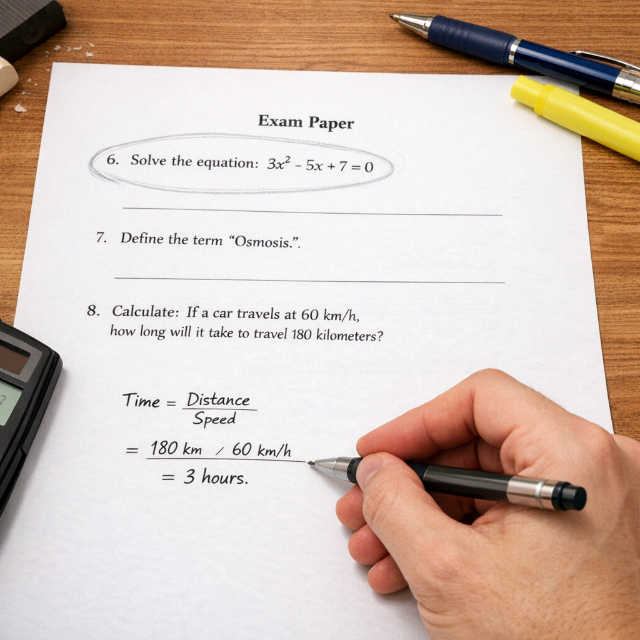
Spend the first 2-3 minutes scanning the entire exam to understand the length, question types, point values, and difficulty distribution. This reconnaissance shapes your strategy before committing to any particular approach.
Identify high-value questions deserving extra time. Note which questions appear easiest for confidence-building starts. Estimate rough time allocation based on point values. This planning prevents discovering you have 10 minutes for a 30-point essay you haven't started.
3. Answer Easy Questions First
Begin with questions you can answer confidently and quickly. This builds momentum, secures guaranteed points early, and reduces anxiety. Students who tackle difficult questions first often panic, waste time, and underperform on easier questions they know.
Mark difficult questions and return to them after completing easier ones. Your subconscious often works on difficult problems while you answer other questions, so second attempts frequently go better than first.
Research shows that students who answer easy questions first score 8-15% higher than those who proceed sequentially.
4. Manage Time Strategically
| Question Type | Marks | Time to Spend | Strategy Focus |
|---|---|---|---|
| Very short / MCQs | 1–2 | 1–2 min each | Answer fast, don’t overthink |
| Short answers | 3–5 | 5–8 min | Clear, direct points |
| Medium questions | 8–12 | 12–18 min | Structure + examples |
| Long essay | 20–30 | 25–40 min | Plan ? write ? review |
| Review buffer | — | 10–15% total time | Fix mistakes, check skips |
Allocate time proportional to point values, not question count. A 40-point essay deserves more time than ten 1-point multiple-choice questions worth 10 points total. Calculate rough minutes per point, then stick to your allocation.
Set checkpoints: "I should be through Section 1 by 10:30am" or "Half done by the 45-minute mark." When checkpoints slip, adjust strategy immediately rather than hoping to catch up later. Students who use time management strategies finish exams 25% more often than those without plans.
5. Budget Time for Review
Reserve the final 10-15% of exam time for review. This catches careless errors, allows reconsideration of uncertain answers with a fresh perspective, and provides buffer time if earlier sections take longer than planned.
Students who build in review time score 5-8% higher than those who work until the last second. Many lost points come from preventable mistakes that 60 seconds of review would catch, such as wrong units, calculation errors, and misread questions.
For students whose test-taking strategies are weak despite adequate content preparation, many use an essay writing service for specific assignments, freeing up time to practice test-taking techniques through additional practice exams and strategy drills.
What Strategies Work Best for Multiple Choice Questions?
Multiple choice exams reward systematic approaches that maximize accuracy while managing time efficiently. These techniques significantly improve scores.
1. Read Questions Before Answer Choices
Process the question stem completely before looking at options. Try formulating an answer in your head, then look for it among the choices. This prevents confusion from well-designed distractors that seem correct before you've thought through the question independently.
When you've mentally answered first, correct choices jump out rather than all options seeming plausible. This approach reduces time per question by 20-30% while improving accuracy.
2. Eliminate Obviously Wrong Answers
Cross out clearly incorrect options immediately to narrow your decision space. Even if you can't identify the right answer, eliminating two wrong answers gives you 50% odds on an educated guess versus 20-25% on random guessing.
Research shows that students who systematically eliminate wrong answers score 12% higher on questions they don't fully know than students who guess randomly.
Strategic elimination is the most valuable skill for uncertain questions.
3. Watch for Absolute Language
Answers containing "always," "never," "all," "none," "impossible," or "certainly" are frequently incorrect because few things in academics are absolute. Correct answers typically use qualified language like "usually," "often," "typically," or "may."
This isn't a guaranteed rule, but it is useful when choosing between similar options. Extreme answers are wrong 60-70% of the time across most standardized tests.
4. Use "All of the Above" and "None of the Above" Strategically
When "all of the above" appears and you know two options are correct, it's likely the answer; you don't need to verify the third. When "none of the above" appears and you're confident one option is correct, eliminate it immediately.
These special answers follow predictable patterns. "All of the above" is correct 40-50% of the time it appears, much higher than the 20-25% baseline you'd expect from random distribution.
5. Don't Change Answers Without Reason
Your first instinct is correct 55% of the time when changing answers without new information or reasoning. Students who change answers on gut feeling score lower than those who stick with their initial choices.
Only change answers when you:
- caught a calculation error
- noticed you misread the question
- realized new information from later questions, or
- have specific reasoning why your new answer is better.
Vague uncertainty isn't a sufficient reason.
6. Answer Every Question
Unless there's an explicit guessing penalty, always answer every question. Blank answers guarantee zero points, while educated guesses give you probability of success. On a five-option multiple choice, random guessing yields 20% correct; elimination-based guessing yields 30-40% correct.
These probabilistic points add up. On a 100-question exam, 10 educated guesses might yield 3-4 additional correct answers, worth 3-4% of your grade for questions you didn't fully know.
For students wanting additional practice with multiple-choice strategy before high-stakes standardized tests, many use a professional essay writing service for course papers, freeing time for comprehensive test-prep practice, including timed multiple-choice drills.
What Strategies Improve Essay and Short Answer Performance?
Essay questions require different strategies than multiple-choice questions, focusing on organization, time management, and demonstrating breadth of knowledge.
1. Plan Before Writing
Spend 10-15% of allocated essay time planning your response with quick outlines or bullet points. Students who plan before writing produce more organized, complete essays, scoring 15-20% higher than those who start writing immediately.
Jot down: thesis/main argument, 3-4 key points, supporting evidence for each point, and conclusion. This roadmap prevents forgetting important points mid-writing and creates a logical flow.
2. Answer the Question Directly
Address exactly what's asked in your opening sentence. If the question asks you to "compare and contrast" two theories, your first sentence should state the comparison. If it asks you to "evaluate," your opening should present your evaluation.
Professors report that the most common essay failure is answering an adjacent question rather than the actual question. Read prompts twice, underline key action words (analyze, compare, evaluate, argue), and ensure every paragraph advances your direct response.
3. Use Topic Sentences
Begin each paragraph with a clear topic sentence stating that paragraph's main point. This organization makes your argument easy to follow and demonstrates structured thinking, qualities that professors reward even when gaps exist in the specific content.
Strong topic sentences also help you stay focused. If you notice a paragraph drifting from its topic sentence, you catch yourself before wasting time on tangents.
4. Provide Specific Evidence
Vague generalizations score poorly; specific examples, quotations, data, and citations score well. Don't write "Many factors contributed to the Civil War." Write "Tariff disputes like the 1828 Tariff of Abominations, along with slavery expansion debates following the Kansas-Nebraska Act, created sectional tensions."
Specificity demonstrates genuine knowledge versus memorized generalities.
Research shows essays with 3+ specific examples per major point score 25% higher than essays with generic support.
5. Budget Time Per Question
For multiple essay questions, divide time proportionally by point value. If you have 60 minutes for three essays worth 20, 20, and 10 points, allocate roughly 24, 24, and 12 minutes respectively.
Stick ruthlessly to time limits. A mediocre response to all questions outscores a perfect response to two questions and no response to the third. Partial credit on all questions beats zero credit on any question.
6. Write Legibly and Use Paragraphs
Professors score legible, well-formatted essays 8-12% higher than identical content in a messy presentation. Clear handwriting and visible paragraph breaks make grading easier, creating subtle positive bias.
Skip lines between paragraphs if handwriting. Use indentation or line breaks in typed responses. Make the physical presentation signal that your thinking is organized and professional.
For students who discover they struggle more with essay construction than with content knowledge, combining test-taking strategy practice with targeted support from a reliable essay writing service for course papers can help develop strong essay-writing skills transferable to exam performance.
How Do You Maintain Peak Performance Throughout Long Exams?
Cognitive performance degrades during extended exams unless you actively maintain it. These strategies keep your brain functioning optimally under sustained pressure.
1. Start with Confidence-Building Questions
Beginning with questions you know builds momentum and reduces anxiety, setting a positive tone for the entire exam. Anxiety impairs working memory and problem-solving, so minimizing it early maximizes performance throughout.
Students who answer 3-5 easy questions first report feeling calmer and thinking more clearly than those who immediately tackle difficult material. This psychological warm-up is particularly valuable for high-stakes exams where anxiety significantly impacts performance.
2. Take Strategic Micro-Breaks
For exams exceeding 90 minutes, take three 30-second breaks where you close your eyes, take deep breaths, and reset your attention. These micro-breaks restore focus and prevent cognitive fatigue that can cause errors in the exam's final third.
Research shows attention quality drops 25-40% in the last hour of multi-hour exams.
Students taking brief breaks maintain focus better and make fewer careless errors late in exams.
3. Manage Physical Needs
Use the bathroom before exams, bring water if allowed, and dress in layers for temperature flexibility. Physical discomfort drains cognitive resources you need for test performance.
Studies show even mild dehydration (2% body weight loss) reduces cognitive performance by 10-15%.
Hunger, cold, and full bladders similarly impair thinking. Eliminate these easily addressable distractors.
4. Handle Anxiety and Panic
If anxiety spikes during the exam, pause for 60 seconds of deep breathing. Five slow, deep breaths activate your parasympathetic nervous system, reducing anxiety's cognitive impairment.
Remind yourself that feeling anxious is normal and doesn't predict failure. Reframe physiological arousal as helpful alertness rather than debilitating fear. Students who practice anxiety management techniques score 8-12% higher than equally prepared peers who lack coping strategies.
5. Skip and Return
Never let one difficult question derail your entire exam. If you've spent 5+ minutes on a question without progress, mark it, move on, and return after completing other questions. Often, the answer emerges when you revisit with a fresh perspective and less time pressure.
Students who employ skip-and-return strategies score 10-15% higher than those who persist on difficult questions until solved. Your goal is to maximize total points, not to perfect every question sequentially.
6. Review Strategically
When reviewing, prioritize questions you weren't confident about rather than rechecking obvious answers. Trust yourself on questions that felt straightforward. Focus review time on uncertain answers where reconsideration might catch errors or spark better responses.
For calculation-heavy questions, verify your arithmetic. For reading comprehension, re-read the question, ensuring your answer actually addresses what's asked. For essays, check that you've addressed all parts of multi-part questions.
For students managing test anxiety that impairs performance despite adequate preparation, combining anxiety management practice with strategic use of a trusted essay writing service for course papers can reduce overall academic pressure, improving test-day mental state.
Conclusion: Strategic Test-Taking Maximizes Your Knowledge Demonstration
Test-taking strategies that actually improve scores focus on time management, strategic question ordering, systematic answer elimination, and maintaining cognitive performance throughout exams. Students using structured approaches score 12-18% higher than peers who are equally prepared but lack strategic methods. These techniques don't replace content knowledge but ensure you demonstrate what you know effectively under pressure.
Key Takeaways:
- Read the instructions carefully and scan the entire exam before starting
- Answer easy questions first to build momentum and secure guaranteed points
- Manage time proportional to point values with built-in review time
- For multiple choice: eliminate wrong answers, watch for absolute language, trust first instincts
- For essays: plan before writing, use specific evidence, budget time per question
- Maintain performance with confidence-building starts, micro-breaks, and anxiety management
Implement these strategies in your next exam. Practice them during homework and quizzes so they're automatic under pressure. Take timed practice tests using these techniques. Compare your scores to previous exams where you used different approaches. The performance improvement will demonstrate that test-taking skills are learnable and trainable rather than innate talents.
For students whose test-taking skills need development alongside content mastery, strategically using a fast essay writing service for specific papers creates time for comprehensive test preparation, including strategy practice, timed drills, and anxiety management, without sacrificing overall academic performance.
Transform your exam approach from hoping your knowledge is sufficient to strategically demonstrating everything you know to maximize every possible point.