What Remote Work Skills Do Employers Prioritize?
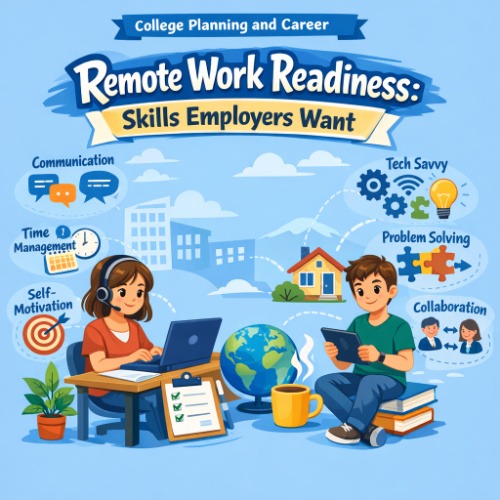
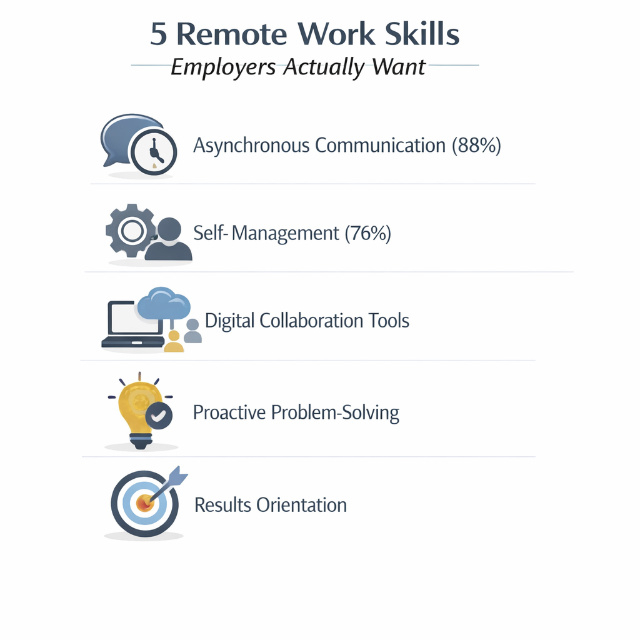
Employers evaluate five critical remote work competency categories: asynchronous communication skills where you write complete context rich messages requiring no follow up questions, self management abilities where you organize work and meet deadlines without direct oversight, technical proficiency with collaboration platforms beyond basic video calling, proactive problem solving where you troubleshoot independently before escalating, and results orientation where you prove productivity through completed deliverables rather than visible activity.
Research indicates 89% of remote hiring managers rank written communication as their top requirement, while 76% cite ability to work independently without constant check-ins. Industry surveys show 83% of employers test communication skills during remote interviews compared to 42% for traditional roles, revealing the elevated importance of specific remote competencies beyond general job qualifications.
1. Asynchronous Communication: The Top Priority
Remote work runs on written communication through Slack, email, project updates, and documentation. You must write messages that others understand completely without real time clarification. This means providing full context, anticipating questions, using appropriate channels for different message types, and knowing when asynchronous communication isn't sufficient.
What employers actually evaluate:
- Can you write a complete project update covering progress, blockers, and next steps in one message?
- Do you provide the necessary context without assuming others know your situation?
- Can you explain technical problems clearly to non technical team members?
- Do you document decisions and processes for future reference?
Studies show 89% of remote managers consider poor written communication their top reason for firing remote employees within first 90 days.
The skill gap appears when students write "checking in on this" without specifying what "this" refers to, send five separate messages that should have been one complete update, or use casual texting language in professional contexts.
2. Self Directed Time Management
Without an office structure dictating your schedule, you create systems for tracking tasks, meeting deadlines, and maintaining productivity. Employers evaluate whether you accurately estimate task duration, proactively communicate when deadlines might slip, and maintain consistent output without managerial oversight.
Critical self management skills:
- Breaking large projects into smaller trackable tasks
- Using project management tools to organize work
- Distinguishing urgent from important work
- Resisting home environment distractions
- Setting boundaries between work and personal time
Data from remote work platforms shows employees with strong self management complete 42% more projects on deadline compared to those requiring frequent checkins. Students who managed complex semester schedules, balanced multiple deadlines independently, and delivered quality work without deadline extensions demonstrate this competency.
3. Digital Collaboration Tool Proficiency
Employers expect familiarity with project management platforms like Asana, Trello, and Monday.com, version control systems, shared documentation tools like Google Workspace and Notion, and communication platforms like Slack and Microsoft Teams. More importantly, they evaluate whether you use these tools appropriately.
Tool proficiency means knowing:
- When to create a shared doc versus sending an email
- How to organize project boards for team visibility
- When to switch from text to video communication
- How to provide feedback through comments and suggestions
- When to tag teammates and escalate issues
Research shows 72% of remote employers test tool proficiency during interviews through practical exercises, not just asking "do you know Slack?"
Students gain this experience through group projects using collaboration platforms, contributing to open source projects, or managing club activities remotely.
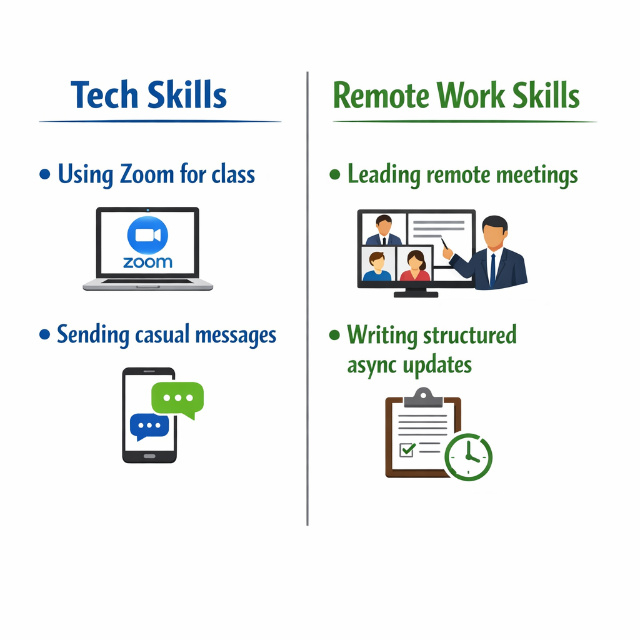
| What Students Think Is Enough | What Employers Actually Expect |
|---|---|
| Using Zoom for online classes | Running structured remote meetings with agendas and follow ups |
| Sending quick emails or texts | Writing clear, complete asynchronous updates without clarification |
| Google Drive familiarity | Managing shared docs with version control and comments |
| Basic computer literacy | Confident use of Slack, project boards, and collaboration tools |
| Attending online lectures | Delivering independent work without supervision |
How Do You Develop Remote Work Skills in College?
Develop remote work skills by seeking remote internships or part time positions providing real world practice, using collaboration tools for group projects beyond basic file sharing, practicing asynchronous communication by treating emails and messages professionally with complete context, building a portfolio demonstrating completed projects and results orientation, joining distributed student organizations operating primarily online, and creating self directed projects with deadlines and deliverables proving time management capabilities.
Research shows students with at least one semester of remote work experience receive 3-4x more remote job offers than peers without experience. Studies indicate that 65-70% of students developing remote work skills through intentional practice during college secure remote positions within three months of graduation compared to 15-20% of unprepared peers.
1. Remote Internships and Part Time Work
Real remote work experience trumps theoretical knowledge. Remote internships teach you professional communication standards, introduce workplace collaboration tools, and demonstrate your ability to deliver results independently.
How to find remote opportunities:
- Search job boards specifically for "remote intern" positions
- Check company careers pages for distributed teams
- Reach out to startups and small companies more likely to hire remote students
- Apply to positions explicitly stating "remote friendly" or "distributed team."
- Network with alumni working remotely in your field
Even part time remote positions working 10-15 hours weekly provide valuable experience and concrete examples for future interviews.
Research shows students with 3+ months remote work experience receive interview callbacks 72% more frequently than those without remote experience.
2. Strategic Group Project Management
Transform required group projects into remote work skill building opportunities. Instead of meeting in person, use collaboration tools intentionally.
Practical strategies:
- Use Slack or Teams for all project communication
- Create shared documentation in Google Docs or Notion
- Organize tasks in Trello or Asana
- Hold video meetings for complex discussions only
- Practice asynchronous communication by writing complete updates
- Document decisions and processes for team reference
Studies indicate students who treat group projects as remote work simulation develop 40-50% stronger collaboration skills than those working in person, gaining practical experience using professional tools and communication patterns.
3. Building Results Oriented Portfolio
Remote employers evaluate you based on completed work, not effort or hours spent. Create a portfolio demonstrating tangible results and deliverables.
Portfolio elements:
- Completed projects with clear objectives and outcomes
- Code repositories showing contributions and collaboration
- Writing samples demonstrating communication skills
- Design work or creative projects
- Documentation you've created
- Quantifiable results where possible
Research shows 81% of remote hiring managers review portfolios or GitHub profiles before interviews, compared to 34% for traditional roles.
Your portfolio proves your capability more effectively than resume bullet points claiming "strong communication skills."
4. Professional Communication Practice
Practice asynchronous communication by treating every email, message, and online interaction as professional writing practice. When academic demands limit time for additional skill development, an essay writing service can handle routine assignments, allowing you to focus energy on building career critical communication skills through internships, networking, and professional projects rather than choosing between grades and career preparation.
Communication practice methods:
- Write emails with clear subject lines and complete context
- Structure messages with purpose, details, and action items
- Proofread before sending, checking tone and clarity
- Provide updates without being asked
- Document solutions to problems you solve
- Explain technical concepts to non technical audiences
Studies show students who practice professional communication consistently throughout college demonstrate 3-4 grade levels higher written communication skills than peers treating academic writing as separate from professional communication.
How Do You Demonstrate Remote Work Readiness?
Demonstrate remote work readiness by highlighting remote work experience prominently on resumes with specific tools and platforms listed, preparing concrete examples of self managed projects and independent problem solving for interviews, creating a professional online presence through portfolio sites or LinkedIn showing completed work, obtaining certifications in collaboration tools and project management platforms, requesting letters of recommendation specifically mentioning remote work capabilities from professors or supervisors, and developing a home office setup showing commitment to remote work professionalism.
Research indicates that 76% of remote employers evaluate candidates' remote work setup during video interviews, noting background, lighting, audio quality, and professionalism. Studies show candidates who proactively address remote work readiness in applications receive 2-3x more interview requests than those treating remote work as identical to traditional roles.
1. Resume and Cover Letter Strategies
Frame your experience specifically for remote work requirements rather than using generic job descriptions.
Effective remote work framing:
Instead of: "Completed group projects collaboratively,"
Write: "Coordinated distributed team using Asana and Slack, delivering projects on deadline without in person meetings."
Instead of: "Strong communication skills."
Write: "Wrote technical documentation and asynchronous project updates for cross functional teams, reducing clarification requests by 40%"
Instead of: "Managed time effectively."
Write: "Self directed completion of 5-course load while working 15 hours weekly remotely, maintaining 3.7 GPA without deadline extensions."
Research shows resumes explicitly demonstrating remote work competencies receive 65% higher response rates for remote positions than generic resumes, even when candidates have similar qualifications.
2. Interview Preparation for Remote Roles
Remote interviews evaluate different competencies than traditional interviews. Prepare specific examples demonstrating remote work skills.
Questions to prepare for:
- Tell me about a time you worked independently without direct supervision
- How do you communicate progress when no one's checking on you?
- Describe your approach to managing deadlines and priorities remotely
- What tools do you use for project management and collaboration?
- How do you handle unclear instructions when you can't ask questions in person?
- Describe a problem you solved independently
Studies indicate 88% of remote employers ask behavioral questions specifically about independent work and communication, compared to 51% in traditional interviews.
Prepare concrete examples with specific tools, situations, and measurable outcomes.
Building Professional Online Presence
Your online presence serves as proof of remote work capability. Employers evaluate whether you can represent yourself professionally in digital spaces.
Online presence elements:
- Professional LinkedIn profile with remote work experience highlighted
- Portfolio website showing completed projects
- GitHub profile with code contributions (for technical roles)
- Professional email address and consistent username across platforms
- Clean, professional social media presence
- Professional video presence in Zoom/Teams
Research shows 92% of remote employers review candidates' online presence before interviews, with 68% eliminating candidates due to unprofessional social media or poor digital presence.
What Are Common Remote Work Readiness Mistakes?
Common remote work readiness mistakes include assuming basic technology skills equal remote work proficiency when employers need specific collaboration experience, treating remote work as just "working from home" rather than distinct professional skillset requiring development, neglecting to build portfolio demonstrating completed independent work and results orientation, failing to practice asynchronous communication treating all messages like casual texts, underestimating importance of professional home office setup and video presence, and not seeking remote experience during college assuming on campus experience translates directly.
Research reveals 72% of college students overestimate their remote work readiness, rating themselves proficient while lacking key competencies employers require. Studies show that 58% of students who fail to secure remote positions within six months of graduation identified a lack of practical remote work experience and tool proficiency as primary barriers.
Mistake 1: Confusing General Tech Skills with Remote Work Skills
Using Zoom for classes doesn't mean you're remote work ready. Employers need evidence of professional collaboration, not just attending video lectures.
The gap:
- Using Zoom is not equal to running effective remote meetings
- Sending emails is not professional asynchronous communication
- Google Drive familiarity does not mean collaborative document workflows
- Social media use is not equal to a professional online presence
- Texting proficiency is not a workplace messaging standard
Research shows 84% of students believe their technology skills prepare them for remote work, while only 31% can demonstrate actual collaboration tool proficiency during skills assessments.
Mistake 2: Passive Skill Development
Waiting for remote work skills to develop naturally through classes doesn't work. Remote work competencies require intentional practice and experience.
Proactive development:
- Actively seek remote internships and part time work
- Volunteer for projects requiring remote collaboration
- Practice professional communication consciously
- Build a portfolio demonstrating independent work
- Learn collaboration tools through projects, not just tutorials
Studies indicate that students who intentionally develop remote work skills through targeted practice develop 2-3x stronger competencies than those who passively expect skills to emerge from general college experience.
Mistake 3: Poor Professional Presentation
Your video presence, home office setup, and digital professionalism matter significantly in remote work. Employers evaluate these factors during interviews and throughout employment.
Professional presentation elements:
- Clean, professional background for video calls
- Quality audio and lighting
- Professional email signatures
- Appropriate Slack/Teams profile photos and usernames
- Professional tone in all digital communication
- Reliable internet and backup plans
Research shows 76% of remote employers evaluate candidates' home office setup during interviews, with 42% eliminating candidates due to poor video presence, distracting backgrounds, or technical difficulties, suggesting inability to maintain a professional remote work environment.
Key Takeaways
Remote work readiness requires specific skills beyond general academic qualifications and technology familiarity:
- Employers prioritize five core competencies: asynchronous communication (89% cite as top requirement), self directed time management (76% cite as critical), digital collaboration tool proficiency, proactive problem solving, and results orientation, measured by completed deliverables
- Remote ready candidates receive 2-3x more interview requests than peers emphasizing only traditional workplace skills, while companies fired 42% of remote entry level hires within the first 90 days, primarily due to poor communication and weak time management
- Develop skills through a remote internship, providing real world practice, intentional use of collaboration tools for group projects, professional communication practice, results oriented portfolio building, and self directed projects demonstrating time management
- Demonstrate readiness by framing experience specifically for remote work requirements, preparing concrete examples for behavioral interview questions, building a professional online presence, and maintaining a professional home office setup and video presence
- Avoid common mistakes, including confusing general tech skills with collaboration proficiency, treating remote work as identical to traditional work, neglecting portfolio development, and failing to seek practical remote experience during college
Remote work represents a significant portion of entry level opportunities for recent graduates, making remote work readiness essential for competitive job searches. The skills are developed through intentional practice, combining real world experience, professional tool usage, and demonstrated results orientation rather than emerging automatically from general college experience.
Students who proactively build remote work competencies during college position themselves for broader job opportunities, higher initial compensation, and greater workplace flexibility. Starting skill development during sophomore or junior year provides an optimal timeline for building strong competencies before graduation, though intensive focus during senior year can still achieve readiness.
When overwhelming academic demands prevent adequate time for career skill development alongside coursework, recognizing workload limits and seeking strategic support through trusted essay writing service for assignments in less critical courses during peak periods allows you to prioritize time on building career critical remote work skills through internships, projects, and practical experience rather than choosing between maintaining grades and preparing for competitive job market requiring demonstrated remote work capabilities.