What Time Management Strategies Work Best for Online Learning?
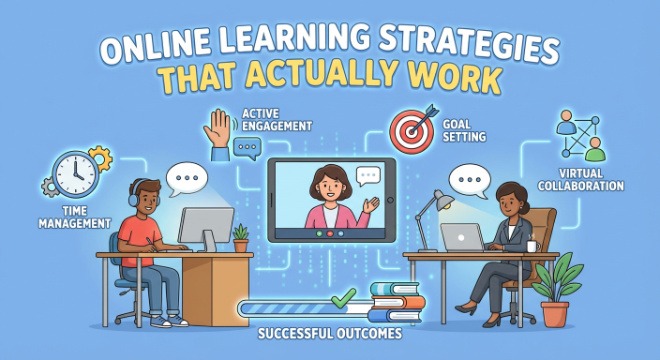
Online learning's flexibility becomes a liability without structured time management. Students who treat online courses as "work on it whenever" consistently underperform compared to those using systematic scheduling.
| Strategy | Key Idea/Approach |
|---|---|
| Time-Blocking | Assign fixed study periods for each task. |
| Pomodoro | Work in 25-minute focused intervals with breaks. |
| Backward Planning | Start from the deadline and set milestones. |
| Buffer Time | Submit assignments early to avoid issues. |
| Weekly Planning | Review tasks every week to stay organized. |
Time-Blocking for Online Courses
Schedule specific blocks for each course activity—lecture viewing, reading, assignments, and review sessions. Treat these blocks as non-negotiable appointments. Research from the National University's Online Learning Consortium shows students using time-blocking complete 89% of assignments on time compared to 61% for those without structured schedules.
Create a weekly template allocating 2-3 hours per credit hour. A three-credit course needs 6-9 hours weekly distributed across multiple sessions. Break this into manageable chunks: 90-minute lecture blocks, 60-minute reading sessions, and 120-minute assignment periods.
The Pomodoro Technique for Focus
Online learning's constant digital distractions require focused work periods. Use 25-minute focused sessions followed by 5-minute breaks. After four sessions, take a 15-30 minute break. This rhythm maintains concentration while preventing burnout.
Studies show students using Pomodoro retain 31% more information than those attempting marathon study sessions. The technique works because human attention naturally wanes after 25-30 minutes, making structured breaks more productive than fighting declining focus.
Backward Planning for Major Assignments
Start with the due date and work backward, creating intermediate milestones. For a research paper due in four weeks, schedule: week one for research and outline, week two for drafting introduction and main arguments, week three for completing draft and revisions, and week four for final edits and submission.
This prevents last-minute cramming and allows time for seeking help when needed. Students working with trusted essay writing services benefit from similar planning, providing writers adequate time for quality work rather than rushed completion.
Buffer Time for Technical Issues
Always submit work at least 24 hours before deadlines. Online platforms crash, files corrupt, and internet connections fail. A 2024 survey found 43% of online students experienced technical issues affecting submissions. Building buffer time prevents these predictable problems from becoming grade disasters.
Weekly Planning Sessions
Dedicate 30 minutes each Sunday reviewing upcoming week requirements across all courses. Check syllabi, discussion boards, and announcements. Create a consolidated weekly task list prioritizing by importance and urgency. This prevents missed deadlines and reduces decision fatigue throughout the week.
Plan your study time in advance and stick to a weekly schedule to avoid procrastination and stay on track in online learning.
How Can Students Stay Engaged During Online Lectures?
Passive video watching produces minimal learning. Active engagement strategies transform lecture consumption into genuine comprehension.
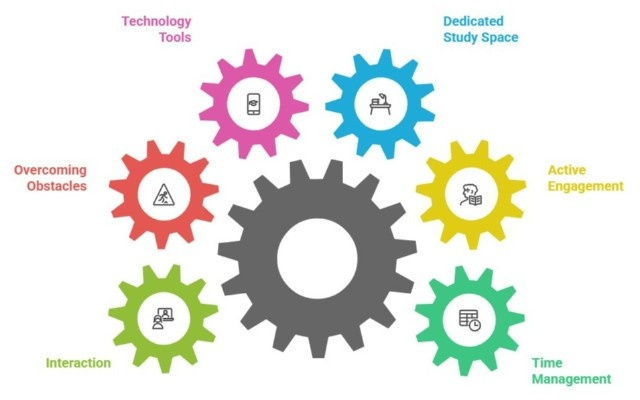
| Obstacle | Solution |
|---|---|
| Digital Distractions | Use website blockers; keep phone away; limit social media. |
| Lack of Study Space | Create a dedicated study area separate from relaxation zones. |
| Low Accountability | Join virtual study groups; use accountability apps; share goals. |
| Poor Communication | Email instructors early; attend office hours; ask questions. |
| Isolation | Engage in discussion boards; join study groups; attend live sessions. |
The Cornell Note-Taking System
Divide your digital or paper notes into three sections: a narrow left column for keywords, a larger right column for detailed notes, and a bottom section for summary. During lectures, take notes in the right column. Immediately after, write key terms in the left column and summarize main points at the bottom.
Research from Princeton shows students using structured note-taking systems retain 42% more information one week after lectures compared to those taking unstructured notes. The Cornell system forces active processing rather than passive transcription.
Speed Control and Pause-Rewind Strategy
Adjust playback speed based on content difficulty. Play straightforward review material at 1.25-1.5x speed to maintain engagement. Slow complex explanations to 0.75-1.0x for better comprehension. Pause frequently to process information, take notes, and formulate questions.
Students who actively control playback report 38% higher comprehension than those watching at standard speed without pausing. This active control maintains attention and accommodates individual learning pace.
Active Questioning Technique
Generate questions while watching lectures. What's the main argument? How does this connect to previous material? What examples support this claim? What would I add to this explanation? Write these questions in your notes and seek answers through course materials or discussion boards.
Studies show students who generate questions during learning remember 47% more material than passive listeners. Questions create mental engagement that passive observation doesn't trigger.
Immediate Summarization
After each lecture section or module, close your notes and write a 3-5 sentence summary from memory. This retrieval practice strengthens memory formation and immediately reveals comprehension gaps while material is fresh enough to review.
Social Learning Through Discussion
Actively participate in online discussions, not just to meet requirements but to process material through explanation. Teaching concepts to peers or asking thoughtful questions deepens understanding. Students participating meaningfully in discussions score 23% higher on exams according to research from the Online Learning Consortium.
Students who use a reliable essay writing service for complex assignments can apply these engagement techniques when reviewing completed work, using professional examples as learning tools rather than mere submission shortcuts.
Use short, focused study sessions with self-testing to stay engaged and remember more from online courses.
What Study Techniques Maximize Online Learning Retention?
Retention separates students who pass courses from those who develop lasting knowledge. These evidence-based techniques boost long-term retention dramatically.
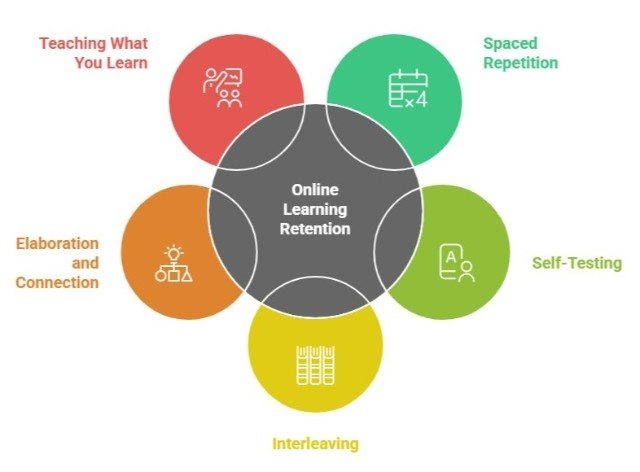
Spaced Repetition Over Cramming
Review material in expanding intervals: immediately after learning, one day later, three days later, one week later, two weeks later. This spacing leverages the psychological spacing effect, where distributed practice produces 40-50% better retention than massed practice.
Use flashcard apps like Anki or Quizlet that automate spacing algorithms, presenting material just before you'd forget it. This optimizes study time by focusing on material you're close to forgetting rather than repeatedly reviewing well-learned content.
Self-Testing as Primary Study Method
Practice retrieving information without notes before reviewing material. Take practice tests, do chapter review questions, or quiz yourself with flashcards. Retrieval practice produces 50% better long-term retention than additional study time according to cognitive psychology research.
Testing feels harder than reviewing notes, leading students to avoid it. But this difficulty signals effective learning. Easy studying produces false confidence while retrieval practice builds genuine mastery.
Interleaving Instead of Blocking
Mix topics within study sessions rather than studying one subject exclusively. Study statistics, then history, then biology, rather than three hours of statistics followed by three hours of history. Interleaving improves 43% better application of knowledge to new situations.
This seems counterintuitive because blocking feels more comfortable, but interleaving forces your brain to discriminate between concepts and choose appropriate methods—skills essential for exams mixing multiple topics.
Elaboration and Connection
Connect new information to existing knowledge. Ask "How does this relate to concepts I already know?" and "What are real-world applications?" Create analogies linking abstract concepts to concrete experiences.
Students who elaborate on material during studying achieve 35% higher test performance than those who simply review content without making connections. Elaboration creates retrieval cues that make information accessible when needed.
Teaching What You Learn
Explain concepts to others—study group members, friends, or even record yourself teaching to an imaginary audience. Teaching forces you to organize information coherently, identify gaps in understanding, and process material deeply.
The "protégé effect" shows students preparing to teach material score 28% higher on subsequent tests than those studying for personal use only. Teaching transforms passive knowledge into active understanding.
Prioritize active learning - summarize, self-test, and engage with content - to dramatically boost long-term retention in any online course.
How Can Students Overcome Common Online Learning Obstacles?
Even with strong strategies, online learning presents predictable challenges requiring specific solutions.
Managing Digital Distractions
Use website blockers like Freedom, Cold Turkey, or browser extensions blocking distracting sites during study blocks. Place phone in another room or use app timers restricting social media access during study hours.
Research shows students allowing social media access during studying require 26% longer to complete tasks and retain 22% less information. Distractions aren't harmless breaks—they fundamentally degrade learning quality.
Creating Dedicated Study Spaces
Designate a specific location for online learning, separate from relaxation areas. Your brain associates locations with activities—studying in bed weakens both sleep quality and study focus. Even small apartments can create study zones through spatial separation or specific chair/desk combinations used only for learning.
Students with dedicated study spaces report 31% higher productivity and 24% better focus than those studying in multi-purpose spaces.
Building Accountability Systems
Form study groups meeting virtually at regular times. Share goals publicly with classmates or friends. Use accountability apps tracking study time. External accountability compensates for online learning's lack of physical presence keeping students on track.
Students with accountability partners complete 79% of planned study sessions compared to 44% for those relying solely on self-motivation.
Communicating Proactively with Instructors
Email instructors when confused rather than waiting for assignment due dates. Attend virtual office hours. Ask questions in discussion boards. Online instructors can't see confused faces requiring clarification like physical classroom teachers can—you must advocate actively for needed support.
Students who email instructors at least twice monthly average 0.4 grade points higher than those communicating only when submitting work.
Combating Isolation
Join virtual study groups, participate actively in discussion boards, and attend optional synchronous sessions. Online learning's isolation contributes to dropout rates. Social connection, even virtual, improves persistence.
Students reporting strong peer connections in online courses show 46% higher completion rates than socially isolated students. Working with a fast essay writing service can provide additional academic support, but peer connections remain essential for motivation and engagement.
Conclusion: Your Online Learning Success Framework
Effective online learning isn't about intelligence or motivation alone—it's about deploying proven strategies systematically. The essential takeaways:
- Time-blocking creates structure replacing physical classroom schedules—treat online study blocks as non-negotiable appointments
- Active engagement beats passive viewing—use Cornell notes, generate questions, and control playback strategically
- Spaced repetition and self-testing produce 40-50% better retention than review-based studying
- Environmental and social factors matter—dedicated study spaces and accountability systems compensate for online isolation
- Proactive communication with instructors and peers prevents problems escalating from confusion to crisis
Start implementing one strategy weekly rather than attempting everything simultaneously. Master time-blocking first week, add Cornell notes second week, incorporate self-testing third week. Gradual adoption produces lasting habits.
Online learning success requires intentionality. The students who excel aren't necessarily smarter—they're more strategic, applying evidence-based techniques consistently. These strategies work across disciplines, course types, and learning styles because they address fundamental cognitive and behavioral principles.
Your online learning journey can be as effective as traditional education when you apply proper strategies. Use these techniques to transform online courses from convenient alternatives into powerful learning experiences building genuine knowledge and skills. Success is available to anyone willing to learn strategically rather than passively.