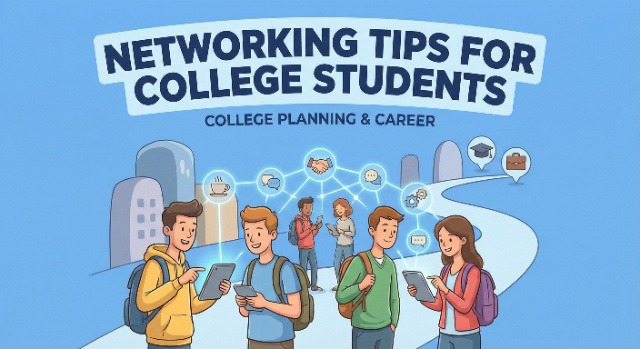
What Is Networking and Why Does It Matter for College Students?
Networking is the process of building and maintaining professional relationships that provide mutual benefit through information sharing, advice, referrals, and support throughout your career.
Unlike purely transactional interactions where you ask for jobs, genuine networking creates long-term connections where both parties gain value. You receive guidance and opportunities while offering fresh perspectives, enthusiasm, and future reciprocation as you advance.
Networking Approaches: Transactional vs. Relational
| Aspect | Transactional Networking | Relational Networking |
|---|---|---|
| Mindset | “What can you do for me?” | “How can we help each other over time?” |
| Focus | Immediate job leads, favors | Long-term relationship building |
| Outreach Style | Generic, mass messages | Personalized, research-based |
| Frequency of Contact | Only when you need something | Regular, value-adding touchpoints |
| Follow-Up | Often nonexistent or generic | Prompt, specific, and appreciative |
| Perception | Feels fake, self-serving | Feels authentic, mutually beneficial |
| Outcome | Short-term gains, burned bridges | Long-term connections, trust, referrals |
| Typical Result | Low response rate, few meaningful connections | 30–50+ meaningful connections by graduation |
Why Traditional Applications Aren't Enough
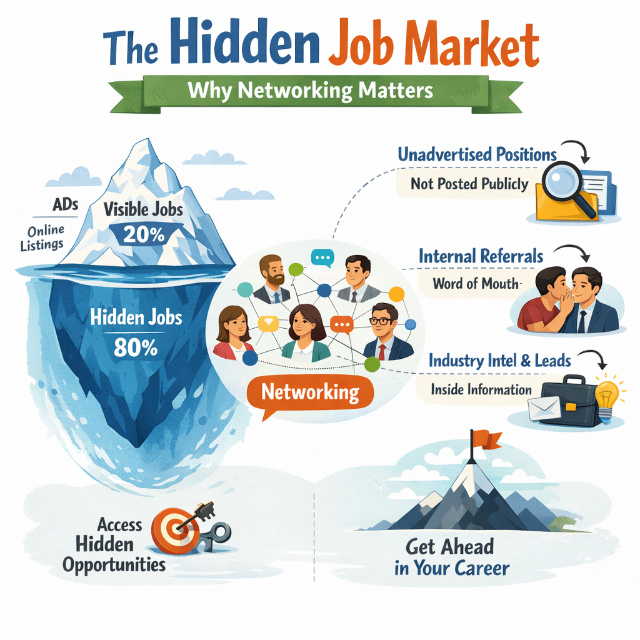
The majority of desirable positions never appear on public job boards. Companies fill roles through employee referrals, internal promotions, or direct outreach to candidates they've previously met. By the time positions post publicly, employers have often already identified preferred candidates through their networks.
The hidden job market:
- Approximately 60-85% of jobs fill through networking and referrals
- Many positions never get formally posted externally
- Employee referrals receive priority consideration and faster review
- Internal candidates or known connections have substantial advantages
- Public postings often fulfill legal posting requirements after decisions are already made
Relying exclusively on online applications means competing for 15-40% of publicly available positions against thousands of other applicants while missing the majority of opportunities accessible through connections.
Beyond Job Hunting: Information and Guidance
Networking provides value beyond job referrals. Professional connections offer:
Career information and advice:
- Honest insights about roles, companies, and industries
- Guidance on skill development and career preparation
- Reality checks on career paths you're considering
- Mentorship and professional development support
Industry knowledge:
- Understanding of hiring trends and sought-after skills
- Company culture insights are not available through research
- Salary expectations and negotiation guidance
- Advancement pathway information
Skill development opportunities:
- Introductions to others who can help you learn
- Recommendations for courses, certifications, or experiences
- Practice with professional communication and relationship management
- Building confidence in professional contexts
Students who network effectively gain knowledge and opportunities unavailable to those relying solely on official channels and public information.
How Do You Start Networking Without Existing Connections?
Start networking by leveraging resources already available: professors who have industry connections, alumni databases your career center provides, campus career events where employers actively seek student interactions, and LinkedIn connections through classmates and campus organizations.
The biggest networking mistake is believing you need existing connections to start building connections. Everyone begins somewhere, and colleges provide extensive resources specifically designed to help students build professional networks from scratch.
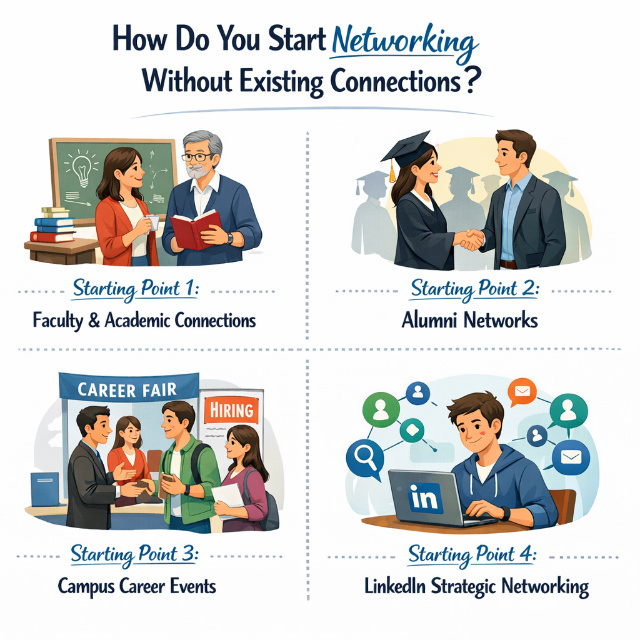
Starting Point 1: Faculty and Academic Connections
Professors maintain extensive professional networks through their careers, research, and consulting. They often enthusiastically help motivated students make connections.
How to leverage faculty networks:
- Perform well in courses to build professor relationships
- Attend office hours asking thoughtful questions (not just about grades)
- Express genuine interest in their research or professional work
- Request informational interview introductions to their industry contacts
- Ask for advice on entering their field or related careers
Effective professor request: "Professor Smith, I've really enjoyed your marketing strategy course and am considering careers in brand management. I noticed you worked at Procter & Gamble before academia. Would you be willing to introduce me to former colleagues who might speak with me about their career paths? I'm seeking to learn about the industry, not asking for jobs."
Professors appreciate students showing initiative and genuine interest. Most are happy to facilitate introductions when asked respectfully.
Starting Point 2: Alumni Networks
Your college's alumni network provides immediate commonality with thousands of professionals. Shared alma mater creates natural connection points and most alumni feel goodwill toward students from their school.
Accessing alumni networks:
- Register with your career center's alumni database
- Search LinkedIn for "[Your University] alumni" in target companies or cities
- Attend alumni networking events your career center organizes
- Join alumni LinkedIn groups for your school
- Request specific alumni contact information from career advisors
Reaching out to alumni:
- Mention your shared school connection immediately
- Keep initial requests focused on informational interviews (20 minutes of advice)
- Demonstrate you've researched their career path
- Ask thoughtful questions showing genuine interest
- Express appreciation for their time
Alumni relationships start with built-in credibility from your shared institution, making outreach easier than cold contact with zero connection.
Starting Point 3: Campus Career Events
Career fairs, information sessions, and networking events bring employers to campus specifically seeking student interactions. These provide face-to-face networking in structured environments.
Maximizing career event effectiveness:
Before events:
- Research attending companies and prioritize targets
- Prepare 30-second introduction (name, major, career interests)
- Develop 3-5 thoughtful questions for each target company
- Bring multiple resume copies on quality paper
- Dress professionally (business casual minimum)
During interactions:
- Make eye contact and offer confident handshake
- Ask substantive questions beyond website information
- Express specific interest in their company or programs
- Request business cards and follow-up contact information
- Take notes after each conversation about key discussion points
After events:
- Send personalized follow-up emails within 24-48 hours
- Reference specific conversation details
- Reiterate interest and request next steps (informational interview, application advice)
- Connect on LinkedIn with personalized connection requests
Students who attend career events and follow up professionally report significantly higher response rates on subsequent applications and interview requests compared to those submitting only online applications.
Starting Point 4: LinkedIn Strategic Networking
LinkedIn allows you to identify and reach out to professionals in target fields or companies even without warm introductions.
LinkedIn networking strategies:
- Complete your profile professionally (headshot, detailed experience, skills)
- Connect with classmates, professors, and organization members
- Join groups related to your field or interests
- Engage with content (thoughtful comments on posts)
- Use alumni search tools to find graduates in target companies
- Send personalized connection requests explaining why you're reaching out
LinkedIn message template: "Hi [Name], I'm a [year] [major] student at [University] interested in learning about careers in [field]. I noticed you've worked in this area for several years and would greatly appreciate 15-20 minutes of your time for an informational interview to learn about your career path and gain advice. Would you be available for a brief call in the coming weeks? Thank you for considering my request."
Personalized, specific requests receive significantly higher response rates than generic "I'd like to add you to my professional network" connection requests.
What Are Effective Informational Interview Strategies?
Conduct effective informational interviews by preparing 8-10 thoughtful questions in advance, respecting the 20-30 minute time commitment you requested, focusing genuinely on learning rather than asking for jobs, taking notes to remember advice and demonstrate engagement, and always sending thank-you notes within 24 hours referencing specific insights they shared.
The most common mistakes are asking for jobs instead of advice (ruins relationships), arriving unprepared without questions (wastes their time), or failing to follow up afterward (signals you didn't value their time).
What Are Informational Interviews?
Informational interviews are brief conversations (typically 20-30 minutes) where you ask professionals about their career paths, current roles, and advice, not asking for jobs but learning from their experiences.
Why professionals agree to informational interviews:
- Gives back by helping students navigate career paths
- Expands their own networks with emerging talent
- Provides fresh perspectives from students' questions
- Builds positive reputation within their alumni network
- Low commitment compared to formal mentorship
Professionals understand you're networking and may eventually need career help. That's acceptable as long as you're genuinely seeking advice in the moment, not treating the conversation as veiled job applications.
Requesting Informational Interviews
Effective request elements:
- Clear subject line: "Informational Interview Request [University] Student."
- Brief introduction explaining how you found them.
- Specific interest in their career path or company.
- Explicit request for 20-30 minute conversation.
- Proposed time frame and format (phone, video, in-person).
- Acknowledgment that you're seeking advice, not asking for jobs.
Poor request: "Hi, I need a job at your company. Can we talk?"
Strong request: "Hi Ms. Johnson, I'm a junior marketing major at State University interested in brand management careers. I found you through our alumni database and was impressed by your progression from assistant brand manager to your current director role at P&G. Would you have 20 minutes in the next few weeks for a phone conversation where I could learn about your career path and seek advice on entering this field? I'm not asking for a job, just hoping to learn from your experience. Thank you for considering my request."
When crafting these initial outreach emails and LinkedIn messages where professional tone and strategic wording determine whether busy professionals respond to unknown students, trusted essay writing service can help you develop compelling, appropriately formal communication that demonstrates maturity and genuine interest rather than generic requests that get ignored.
Conducting the Interview
Preparation:
- Research their background (LinkedIn, company website, news)
- Prepare 8-10 questions (you'll ask 6-8 depending on conversation flow)
- Have resume ready to share if they ask
- Test technology if video call
- Arrive on time (call exactly when scheduled)
Question types to include:
Career path questions:
- "How did you enter this field? What was your path from college?"
- "What surprised you about your first job in this industry?"
- "How did you decide to transition from [role A] to [role B]?"
Current role questions:
- "What does a typical day or week look like in your position?"
- "What aspects of your work do you find most rewarding? Most challenging?"
- "What skills do you use most frequently?"
Advice questions:
- "Knowing what you know now, what would you do differently starting your career?"
- "What skills should students develop to enter this field?"
- "What's one piece of advice you'd give someone interested in this career?"
Industry questions:
- "How is [industry/field] changing? What trends should I watch?"
- "What types of companies or roles would you recommend exploring?"
Avoid:
- Asking questions easily answered through Google
- Dominating conversation talking about yourself
- Asking for jobs or internships (completely inappropriate)
- Going over time limit without their invitation to continue
- Being too rehearsed, allowing natural conversation flow
Closing:
- Thank them for their time and insights
- Ask if they know others who might be willing to speak with you (network expansion)
- Request permission to follow up occasionally with questions
- Offer to stay in touch and update them on your progress
Following Up After Informational Interviews
Within 24 hours, send thank-you email:
- Express specific appreciation for their time
- Reference 1-2 particular insights that were valuable
- Mention any actions you'll take based on their advice
- Reiterate your gratitude
Sample thank-you: "Dear Ms. Johnson, Thank you for taking time yesterday to discuss your career path in brand management. Your advice about developing both analytical and creative skills resonated strongly, and I'm now planning to take the marketing analytics course you recommended next semester. Your perspective on the importance of cross-functional collaboration was particularly valuable as I consider internship opportunities. I truly appreciate your generosity in sharing your experience. I'll keep you updated on my progress, and I hope we can stay in touch."
Long-term relationship maintenance:
- Send occasional updates (internship secured, graduation, first job)
- Share relevant articles or information they might find interesting
- Offer to help if opportunities arise where you can assist them
- Express continued appreciation for their guidance
Many informational interview relationships evolve into mentorships or lead to job referrals years later when maintained appropriately.
How Do You Network at Professional Events and Conferences?
Network effectively at professional events by arriving with researched target contacts and conversation goals, preparing concise self-introductions emphasizing shared interests, asking thoughtful questions that demonstrate event engagement, collecting contact information through business cards or LinkedIn connections, and following up within two days with personalized messages referencing specific conversations.
The biggest mistake at networking events is aggressive card-collecting without building genuine connections. Five meaningful conversations with real follow-up create more value than thirty superficial exchanges.
Pre-Event Preparation
Research attendees and speakers:
- Review attendee lists if available - Identify 5-10 people you'd like to meet
- Research their backgrounds and prepare relevant talking points
- Note speakers you want to approach after presentations
- Set specific goals (connect with 3 people in target industry, attend 2 sessions)
Prepare introduction: Your 30-second introduction should include: name, school and year, major, specific career interests (not just "business" but "supply chain management in technology companies").
Example: "Hi, I'm Sarah Chen, a junior operations management major at State University. I'm particularly interested in supply chain optimization in tech companies, which is why I wanted to attend this panel on logistics innovation."
This introduction is specific enough to spark conversation beyond generic student small talk.
During Events: Conversation Strategies
Approaching conversations:
- Join small groups (easier than approaching individuals)
- Target people standing alone (they're often grateful for conversation)
- Use environmental context as opening ("What did you think of that speaker?")
- Ask open-ended questions encouraging discussion
Maintaining conversations:
- Listen more than you talk (80/20 rule)
- Ask follow-up questions showing genuine interest
- Share relevant experiences when appropriate (briefly)
- Find common ground (shared interests, connections, experiences)
- Be authentic, forced networking is obvious and off-putting
Graceful exits:
- "I've really enjoyed our conversation. May I grab your card so we can stay in touch?"
- "I don't want to monopolize your time, but I'd love to connect on LinkedIn. What's the best way to reach you?"
- "Thank you for the advice about [topic]. I see someone I should greet, but let's stay in touch."
What to avoid:
- Dominating conversations talking about yourself
- Treating people as means to ends (transparent job-seeking)
- Collecting cards without engaging meaningfully
- Staying in comfortable groups with people you already know
- Drinking too much at social functions (impairs judgment)
Post-Event Follow-Up
Within 48 hours, reach out to meaningful connections:
Follow-up email structure:
- Reference specific conversation points
- Express appreciation for their insights or time
- Provide any promised information or resources
- Suggest a concrete next step (informational interview, staying connected)
Sample: "Hi Mr. Thompson, It was great meeting you at the Supply Chain Innovation Conference yesterday. Your perspective on blockchain applications in logistics was fascinating, particularly your experience implementing it at Walmart. As mentioned, I'm attaching the article about emerging supply chain technologies we discussed. I'd love to stay in touch as I explore career opportunities in this field. I've connected with you on LinkedIn and hope we can continue the conversation. Thanks again for your time."
Specific follow-up separates you from the dozens of people who collected cards but never followed through.
How Do You Maintain Professional Relationships Over Time?
Maintain professional relationships through periodic updates on your progress (internships secured, courses completed, graduation), sharing relevant articles or information they might find interesting, offering help when you can provide value, expressing continued appreciation without asking for favors, and staying in touch 2-4 times yearly through genuine touchpoints rather than only contacting when you need something.
Relationships require maintenance. Professionals who helped you once want to know their advice made a difference and that you value the relationship beyond transactional benefits.
The Art of Staying in Touch
Appropriate touchpoint frequency:
- Strong connections (mentors, frequent advisors): Monthly or quarterly
- Moderate connections (informational interviewees, event contacts): 2-3 times yearly
- Weak connections (brief meeting, single conversation): Annually or when truly relevant
Value-adding touchpoint types:
Progress updates: "Hi Ms. Johnson, I wanted to update you that I secured the internship at P&G you helped me prepare for. Your advice about emphasizing collaborative projects in my interview was incredibly helpful. The position starts in June, and I'm excited to apply what I've learned. Thank you again for your guidance."
Sharing relevant information: "Hi Mr. Thompson, I came across this article about supply chain AI applications and thought you might find it interesting given our conversation about emerging technologies. Hope you're doing well!"
Expressing gratitude: "Hi Dr. Martinez, As I prepare to graduate, I wanted to thank you again for the career advice you provided two years ago. Your recommendation to pursue research opportunities led to my current position at the genomics lab and my decision to apply to PhD programs. Your guidance significantly shaped my path."
Offering help: "Hi Ms. Johnson, I noticed on LinkedIn that you're recruiting brand management interns. I'd be happy to share the posting with students in my marketing courses if that would be helpful. Let me know!"
Appropriate ask when relationship is established: After maintaining contact and demonstrating appreciation, it's acceptable to ask for specific help: "Hi Ms. Johnson, I'm applying to brand management positions and noticed your company is hiring. Given your knowledge of my work ethic from our conversations, would you feel comfortable providing a referral? I understand if that's not possible, but I wanted to ask. Either way, I appreciate all your guidance."
What Not to Do
Relationship-damaging behaviors:
- Only contacting when you need favors
- Asking for jobs in first or second interaction
- Ignoring their time constraints or availability
- Failing to acknowledge or thank them for help
- Over-sharing personal information inappropriately
- Being pushy or entitled about assistance
- Forgetting about them after getting what you needed
Professional relationships are long-term investments requiring genuine care and reciprocity, not transactions you complete and abandon.
When you're managing ongoing professional correspondence, crafting LinkedIn updates, or writing graduate school application materials where your network will serve as references and recommenders, reliable essay writing service can help you develop appropriately professional communication that maintains relationships effectively while demonstrating the continued growth and maturity your connections appreciate seeing in students they've invested time helping.
Conclusion
Effective college networking combines strategic outreach through professors and alumni databases, authentic relationship-building through informational interviews and campus events, professional communication that demonstrates maturity and genuine interest, and long-term relationship maintenance through periodic valuable touchpoints rather than only contacting people when needing favors.
Key networking strategies for college students:
- Start with accessible resources, including faculty connections, alumni databases, career center events, and LinkedIn, rather than believing you need existing networks to begin networking.
- Request informational interviews focused genuinely on learning about careers, not asking for jobs, while preparing thoughtful questions demonstrating research and authentic interest.
- Attend campus career events and professional conferences prepared with company research, thoughtful questions, and follow-up plans that distinguish you from superficial card-collectors.
- Maintain relationships over time by providing progress updates, sharing relevant information, offering help when possible, and expressing continued appreciation 2-4 times per year.
- Recognize that approximately 60-85% of positions are filled through referrals and personal connections, making networking essential rather than optional for competitive career outcomes.
Begin building your network this week by scheduling career center appointments to access alumni databases, requesting one informational interview from a professor's industry contact, and completing your LinkedIn profile professionally. Students who start networking early during college build 30-50 meaningful connections by graduation compared to 5-10 for those who wait until job searches begin, and these networks provide career benefits throughout their entire professional lives.
Networking discomfort decreases dramatically with practice and successful experiences. The first outreach email feels terrifying; the twentieth feels routine. Most professionals remember being students and genuinely appreciate opportunities to help; they're not annoyed by thoughtful requests but rather appreciate students showing initiative. Your network becomes one of your most valuable career assets, providing opportunities, information, and support unavailable through official channels alone.
When you're crafting professional outreach emails, LinkedIn profile summaries, or application materials where communication quality determines whether busy professionals invest time helping you, professional essay writing can help you develop polished, strategically worded messages that demonstrate the professionalism and maturity that encourage career professionals to become valuable long-term connections.
Download our free Networking Toolkit with email templates, informational interview question guides, and relationship tracking worksheets for systematic network development.