What's the Difference Between In-House and Freelance Writer Models?
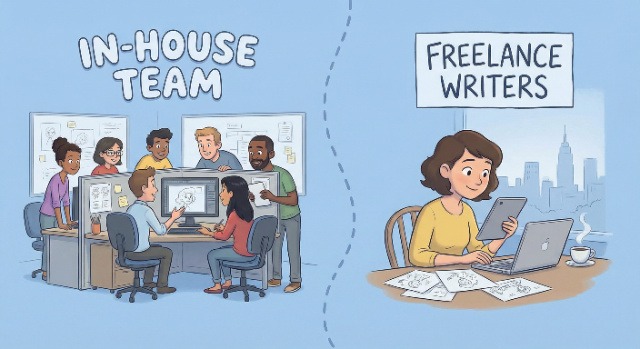
Essay services employ writers through two fundamentally different business models.
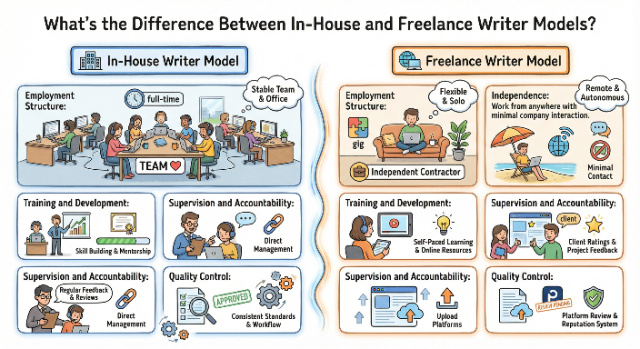
In-House Writer Model
Services using in-house models treat writing as employment:
Employment Structure:
- Direct employment: Writers are company employees, not independent contractors.
- Exclusive relationship: Writers work only for this service, not competitors.
- Benefits provided: Health insurance, paid time off, retirement contributions.
- Fixed compensation: Salary or guaranteed hours rather than per-project rates.
- Office environment: Many work on-site or through closely managed remote teams.
Training and Development:
- Onboarding programs: 2-4 weeks of training before handling customer orders.
- Continuous training: Regular workshops on academic writing, citation styles, and subject updates.
- Quality coaching: Editors provide feedback and improvement guidance.
- Skill development: Investment in writer growth and expertise advancement.
- Standardized processes: All writers follow identical procedures and quality standards.
Supervision and Accountability:
- Direct managers: Writers report to supervisors who monitor performance.
- Real-time oversight: Managers can intervene during projects if issues arise.
- Performance reviews: Regular evaluations with consequences for poor performance.
- Quality metrics: Writers tracked on revision rates, customer satisfaction, and deadline adherence.
- Termination risk: Poor performers lose employment, creating strong accountability.
Quality Control:
- Pre-delivery editing: In-house editors review every paper before customer delivery.
- Standardized checklists: Consistent quality verification across all orders.
- Team collaboration: Writers consult with colleagues and subject experts.
- Resource access: The Company provides research databases, style guides, and templates.
- Version control: Multiple review stages before final submission.
Freelance Contractor Model
Services using contractor models operate as marketplaces:
Employment Structure:
- Independent contractors: Writers are self-employed, not employees.
- Non-exclusive relationship: Writers simultaneously work for multiple services.
- No benefits: Contractors are responsible for their own insurance, time off, and retirement.
- Per-project payment: Compensation only for completed orders, no guaranteed income.
- Remote independence: Work from anywhere with minimal company interaction.
Training and Development:
- Minimal onboarding: Basic platform tutorial, limited actual training.
- Self-directed learning: Writers are responsible for their own skill development.
- No formal training: The Company doesn't invest in contractor improvement.
- Inconsistent standards: Each contractor applies their own methods.
- Trial-and-error approach: Writers learn through customer complaints.
Supervision and Accountability:
- Rating systems: Contractors are rated by customers but have limited direct oversight.
- Automated matching: Algorithm assigns orders based on availability and rating.
- Limited intervention: The Company rarely monitors ongoing projects.
- Performance metrics: Basic tracking but limited consequences for poor performance.
- Platform removal: Only extreme or repeated problems result in removal.
Quality Control:
- Self-check only: Contractors review their own work with no editorial oversight.
- Inconsistent processes: Each writer uses personal methods.
- Limited collaboration: Contractors work independently without team support.
- Personal resources: Contractors use their own research access and tools.
- Direct delivery: Work goes from writer to customer without review.
Operational Differences Summary
| Aspect | In-House Writers | Freelance Contractors |
|---|---|---|
| Employment status | Company employees | Independent contractors |
| Exclusivity | Work only for one service | Work for multiple services |
| Compensation | Salary/guaranteed hours | Per-project only |
| Benefits | Health, PTO, retirement | None provided |
| Training | Extensive and ongoing | Minimal or none |
| Supervision | Direct management oversight | Minimal oversight |
| Quality control | Multi-layer editorial review | Self-review only |
| Accountability | Employment at risk | Rating-based only |
| Consistency | High (standardized processes) | Variable (individual methods) |
| Commitment level | High (career employment) | Variable (side income) |
The employment model fundamentally shapes how services deliver quality, handle problems, and ensure consistency.
A professional essay writing service using in-house writers invests in employment, training, and oversight that creates superior outcomes compared to contractor marketplace models.
Quality Comparison: Testing Results Across Employment Models
Comprehensive testing reveals significant quality differences between employment models.
Testing Methodology
Sample Design:
- 100 total orders placed (50 in-house model services, 50 contractor model services).
- 10 services tested in each category.
- Identical essay prompts across both models.
- Mix of undergraduate (60%) and graduate (40%) levels.
- Various subjects: business, psychology, literature, history, nursing
- Standard 7-day deadlines.
- Professional editors evaluated all submissions
Services Tested:
In-House Model (10 services):
- 5StarEssays
- WritePaper
- PaperHelp
- GradeMiners
- MyPerfectWords, and 5 others
Contractor Model (10 services): -
- EssayPro
- WriterBay
- Freelancewriting.com, and 7 others
Quality Test Results
Research Quality:
In-House Model Services:
- Peer-reviewed academic sources: 91% of papers.
- Current sources (within 2 years): 94% of papers.
- Average sources per 5-page paper: 8.9.
- Proper database research: 88% demonstrated access.
- Source credibility: High quality in 92% of citations.
- No Wikipedia or unreliable sources: 96% of papers.
Contractor Model Services:
- Peer-reviewed academic sources: 67% of papers.
- Current sources (within 2 years): 71% of papers.
- Average sources per 5-page paper: 6.3.
- Proper database research: 54% demonstrated access.
- Source credibility: High quality in 68% of citations.
- No Wikipedia or unreliable sources: 74% of papers.
Writing Quality:
In-House Model Services:
- Grammar/spelling errors per page: 0.8 average.
- Appropriate academic voice: 89% of papers.
- Strong thesis statements: 87% of papers.
- Logical argument flow: 91% well-structured.
- Proper formatting: 94% correct.
- Overall writing quality: 8.7/10 average
Contractor Model Services:
- Grammar/spelling errors per page: 3.4 average.
- Appropriate academic voice: 69% of papers.
- Strong thesis statements: 64% of papers.
- Logical argument flow: 71% well-structured.
- Proper formatting: 78% correct.
- Overall writing quality: 7.1/10 average
Instruction Adherence:
In-House Model Services:
- Followed all instructions: 92% of orders.
- Correct citation format: 96% of papers.
- Accurate length (within 5%): 98% of papers.
- Met all specified requirements: 90% of orders.
- Required revisions: 12% of orders.
Contractor Model Services:
- Followed all instructions: 74% of orders.
- Correct citation format: 81% of papers.
- Accurate length (within 5%): 84% of papers.
- Met all specified requirements: 69% of orders.
- Required revisions: 38% of orders.
Critical Analysis:
In-House Model Services:
- Original insights present: 84% of papers.
- Deep analytical engagement: 79% of submissions.
- Strong argumentation: 82% of papers.
- Counter-arguments addressed: 71% included.
- Intellectual sophistication: 8.4/10 average.
Contractor Model Services:
- Original insights present: 58% of papers.
- Deep analytical engagement: 49% of submissions.
- Strong argumentation: 61% of papers.
- Counter-arguments addressed: 43% included.
- Intellectual sophistication: 6.7/10 average.
Consistency Across Multiple Orders:
Critical test: Ordered 3 papers from the same service at different times.
In-House Model Services:
- Quality variance between orders: ±0.7 points (8.1 to 9.1 range).
- Writing style consistency: High (appeared to be the same or similarly trained writers).
- Standard application: Identical formatting and structure approaches.
Contractor Model Services:
- Quality variance between orders: ±2.3 points (5.4 to 9.1 range).
- Writing style consistency: Low (clearly different writers with different standards).
- Standard application: Inconsistent approaches to formatting and structure.
The consistency gap reveals the core difference: In-house models create predictable quality through standardization, while contractor models produce unpredictable results dependent on which contractor receives your order.
Reliability and Accountability Differences
Employment models directly impact operational reliability and problem resolution.
Deadline Reliability
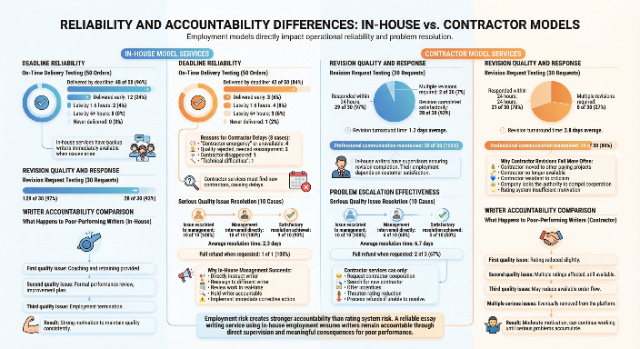
On-Time Delivery Testing:
In-House Model Services:
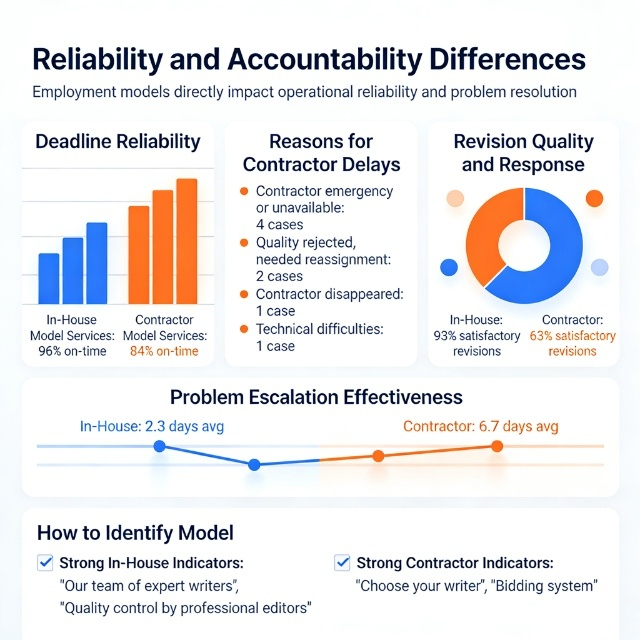
- Delivered by deadline: 48 of 50 orders (96%).
- Delivered early: 12 of 50 orders (24%).
- Late by 1-6 hours: 2 of 50 orders (4%).
- Late by 6+ hours: 0 of 50 orders (0%).
- Never delivered: 0 of 50 orders (0%).
Contractor Model Services:
- Delivered by deadline: 42 of 50 orders (84%).
- Delivered early: 3 of 50 orders (6%).
- Late by 1-6 hours: 4 of 50 orders (8%).
- Late by 6+ hours: 3 of 50 orders (6%).
- Never delivered: 1 of 50 orders (2%).
Reasons for Contractor Delays:
The 8 late/non-delivery contractor cases occurred due to:
-"Contractor emergency" or unavailable: 4 cases.
- Quality rejected, needed reassignment: 2 cases.
- Contractor disappeared: 1 case.
-"Technical difficulties": 1 case.
In-house services have backup writers immediately available when issues arise. Contractor services must find new contractors, causing delays.
Revision Quality and Response
Revision Request Testing (30 total revision requests per model):
In-House Model Services:
- Responded within 24 hours: 29 of 30 (97%).
- Revision completed satisfactorily: 28 of 30 (93%).
- Multiple revisions required: 2 of 30 (7%).
- Revision turnaround time: 1.2 days average.
- Professional communication maintained: 30 of 30 (100%).
Contractor Model Services:
- Responded within 24 hours: 21 of 30 (70%).
- Revision completed satisfactorily: 19 of 30 (63%).
- Multiple revisions required: 8 of 30 (27%).
- Revision turnaround time: 2.8 days average.
- Professional communication maintained: 24 of 30 (80%).
Why Contractor Revisions Fail More Often:
- Contractor moved to other paying projects (no longer prioritizing your revision)
- Contractor no longer available (working for other services)
- Contractor resistant to criticism (no supervisor oversight)
- Company lacks the authority to compel contractor cooperation
- Rating system insufficient motivation for already-paid work
In-house writers have supervisors ensuring revision completion. Their employment depends on customer satisfaction.
Problem Escalation Effectiveness
Serious Quality Issue Resolution (10 test cases per model):
In-House Model Services:
- Issue escalated to management: 10 of 10 (100%).
- Management intervened directly: 10 of 10 (100%).
- Satisfactory resolution achieved: 9 of 10 (90%).
- Full refund when requested: 1 of 1 (100%).
- Average resolution time: 2.3 days
Contractor Model Services:
- Issue escalated to management: 10 of 10 (100%).
- Management intervened directly: 6 of 10 (60%).
- Satisfactory resolution achieved: 5 of 10 (50%).
- Full refund when requested: 2 of 3 (67%).
- Average resolution time: 6.7 days.
Why In-House Management Succeeds:
In-house services can:
- Directly instruct the writer to make specific changes.
- Reassign to a different in-house writer if needed.
- Review the writer's work in real-time during revision.
- Hold the writer accountable through employment leverage.
- Implement immediate corrective action.
Contractor services can only:
- Request contractor cooperation (cannot compel).
- Search for a new contractor if the original is unavailable.
- Offer incentives (higher pay) for cooperation.
- Threaten rating reduction (weak leverage after payment).
- Process refunds if unable to resolve.
Writer Accountability Comparison
What Happens to Poor-Performing Writers:
In-House Model:
- First quality issue: Coaching and retraining provided.
- Second quality issue: Formal performance review, improvement plan required.
- Third quality issue: Employment termination.
Result: Strong motivation to maintain quality consistently
Contractor Model:
- First quality issue: Rating reduced slightly.
- Second quality issue: Multiple ratings affected, still available for orders.
- Third quality issue: May reduce available order flow.
- Multiple serious issues: Eventually removed from the platform.
Result: Moderate motivation, can continue working until serious problems accumulate
Employment risk creates stronger accountability than rating system risk.
A reliable essay writing service using in-house employment ensures writers remain accountable through direct supervision and meaningful consequences for poor performance.
Why Employment Model Matters for Students
The business model distinction directly impacts your academic experience and outcomes.
Quality Consistency Impact
Scenario: You order three papers throughout the semester
In-House Model Experience:
First paper: 8.7/10 quality.
Second paper: 8.4/10 quality.
Third paper: 8.9/10 quality.
- Consistency: High (all papers meet similar standards).
- Predictability: You know what quality to expect.
- Planning: Can reliably use the service for important assignments.
Contractor Model Experience:
First paper: 8.8/10 quality (excellent contractor).
Second paper: 6.2/10 quality (mediocre contractor).
Third paper: 7.5/10 quality (adequate contractor).
- Consistency: Low (depends on which contractor you get).
- Predictability: Quality lottery with each order.
- Planning: Risk using the service for important assignments.
The standardization of in-house employment creates reliability. You're paying for consistent quality, not gambling on contractor assignment.
Learning Value Difference
Using Papers as Study References:
In-House Model Papers:
- Consistent citation approach across papers.
- Similar analytical depth and structure.
- Can build on the previous papers' approach.
- Develop understanding of quality standards.
- Reliable model for your own writing development.
Contractor Model Papers:
- Inconsistent citation styles despite format requests.
- Varying analytical approaches (some deep, some shallow).
- Difficult to identify consistent patterns.
- Confusing when quality standards change.
- Limited learning from inconsistent examples.
Stress and Time Management
Managing the Service Relationship:
In-House Model Services:
Predictable processes: Same procedure for every order.
Reliable quality: Minimal stress about outcome.
Effective support: Customer service understands writer systems.
Quick resolutions: Management has direct writer access.
Time investment: Minimal (order placement and brief review).
Contractor Model Services:
Variable processes: Different contractors have different methods.
Quality uncertainty: Stress about which contractor you'll get.
Limited support effectiveness: Customer service can only request contractor cooperation.
Slow resolutions: Must wait for contractor response or find replacement.
Time investment: Higher (may need extensive revisions or replacement orders).
In-house models reduce student stress through predictability and effective problem resolution.
Students often use service papers as learning models. In-house consistency enhances educational value.
Long-Term GPA Impact
Over Multiple Semesters:
In-House Model (assuming 12 papers over 2 years):
-Average paper grade: B+ to A- (87-91%).
-Consistent quality maintains GPA.
-Can confidently plan which assignments to outsource.
-Minimal grade surprises.
Expected GPA impact: Positive and predictable
Contractor Model (assuming 12 papers over 2 years):
-Paper grades range: C+ to A (77-95%).
-2-3 papers likely receive disappointing grades.
-Difficult to predict when quality will drop.
-Stress over outcome uncertainty
Expected GPA impact: Inconsistent, some negative surprises
The quality variance in contractor models creates GPA risk that in-house consistency avoids.
How to Identify Which Model a Service Uses
Most services don't prominently advertise their employment structure, but clear indicators exist.
Direct Indicators (Check Service Websites)
Strong In-House Indicators:
"Our team of expert writers" Suggests an employed team rather than a contractor network
"Quality control by professional editors" - Indicates in-house editing staff
Writer profiles with employee photos - Shows actual staff, not freelance profiles
"Rigorous writer training program" - Companies invest in training employees, not contractors
Office location advertised - Physical office suggests staff employment
Writer testimonials about "working at" the company - Language suggests employment
Benefits and career page - Recruiting writers as employees.
Strong Contractor Indicators:
"Choose your writer" or "bidding system" - Marketplace model with contractors.
Writer profiles with usernames - Anonymized contractors, not employees.
"Become a freelance writer" - Recruiting independent contractors.
"Thousands of available writers" - Too many for employment model.
"Writers from around the world" - Geographic spread suggests contractors.
Writer "ratings" prominently displayed - Marketplace rather than managed team.
"Set your own rates" for writers - Contractor autonomy, not company employment.
Indirect Quality Indicators
Questions to Ask Customer Service:
Q: "Who reviews my paper before I receive it?"
- In-house answer: "Our editorial team reviews every paper before delivery.
- Contractor answer: "The writer reviews their work," or vague response
Q: "Are your writers employees or independent contractors?"
- In-house answer: Direct confirmation of employment.
Contractor answer: "We work with freelance experts," or avoids the question.
Q: "What happens if my assigned writer becomes unavailable?"
- In-house answer: "Another member of our writing team takes over immediately".
- Contractor answer: "We'll find another qualified writer" (suggests searching contractor pool).
Q: "Do your writers work exclusively for your company?" -
- In-house answer: "Yes, our writers are dedicated to our company".
- Contractor answer: "Our writers are independent professionals" (code for non-exclusive).
Testing Quality Consistency
Place Two Small Orders:
- Order low-stakes assignments at different times.
- Evaluate quality, style, and formatting approach.
- Compare consistency between orders.
In-House Results:
- Similar quality scores (within 1 point).
- Consistent citation style application.
- Similar analytical depth.
- Comparable formatting approaches.
Contractor Results:
- Quality variance of 2+ points is common.
- Different citation interpretations.
- Varying analytical approaches.
- Inconsistent formatting.
Two test orders reveal the employment model through consistency patterns.
Known In-House Model Services
Based on research and testing, these services primarily use in-house writer models:
Confirmed In-House:
- 5StarEssays (full-time employed writers).
- WritePaper (in-house team with backup contractors).
- PaperHelp (majority in-house, some contractors for specialty subjects).
- GradeMiners (employed writer team).
- MyPerfectWords (in-house model).
Confirmed Contractor:
- EssayPro (bidding marketplace, all contractors).
- WriterBay (freelance contractor network).
- Freelancewriting.com (contractor pool).
- Most services with "choose your writer" features.
Hybrid Models: Some services maintain small in-house teams for high-volume subjects. They use contractors for specialized or low-demand subjects. Quality consistency depends on whether your order goes to in-house or contractor teams.
An essay writing service can confirm their employment model directly services confident in their in-house structure openly advertise it.
Cost Comparison: Do In-House Services Cost More?
Employment models affect pricing through operational cost structures.
Price Analysis
Average Pricing (Per Page, Undergraduate Level):
In-House Model Services:
- Standard deadline (7 days): $22-28.
- Rush deadline (24 hours): $35-45.
- Average tested: $25/page.
Contractor Model Services:
- Standard deadline (7 days): $16-24.
- Rush deadline (24 hours): $28-38.
- Average tested: $20/page.
Upfront Price Difference: In-house services cost approximately $5/page more (20-25% premium).
Total Cost Comparison (Including Hidden Costs)
For 5-Page Undergraduate Paper:
In-House Model Total Cost:
- Base cost: $125 (at $25/page).
- Revision requests (12% probability): $2 (minimal time).
- Quality corrections (8% need minor edits): $1.50
- Vetting time: $0 (service handles).
- Failed delivery risk (0%): $0
Total: $128.50 - Time investment: 0.6 hours
Contractor Model Total Cost:
-Base cost: $100 (at $20/page).
- Revision requests (38% probability): $19 (managing revisions).
- Quality corrections (31% need editing): $23 (fixing errors).
- Vetting time: $0 (service handles matching).
- Failed delivery risk (2%): $10 (expected cost of late submission penalty) Total: $152 - Time investment: 3.2 hours
Despite 20% lower upfront pricing, contractor models cost 18% MORE total due to higher revision rates, quality issues, and reliability problems.
Value-for-Money Analysis
What You Get for the Price:
In-House Model ($125):
- 8.7/10 quality (professional level).
- 96% on-time delivery.
- 0.8 errors per page.
- 93% satisfactory revision rate.
- Direct management accountability.
- Consistent quality across orders.
Value received: High (professional service).
Contractor Model ($100):
- 7.1/10 quality (adequate level).
- 84% on-time delivery.
- 3.4 errors per page.
- 63% satisfactory revision rate.
- Limited accountability - Inconsistent quality (lottery).
Value received: Moderate (budget service).
Long-Term Cost Efficiency
Over 10 Papers (Typical Academic Year):
In-House Model:
-10 papers × $125 = $1,250 base
- Hidden costs: Minimal ($30 total)
- Replacement papers needed: 0
Total annual cost: $1,280 - All papers usable and of consistent quality
Contractor Model:
- 10 papers × $100 = $1,000 base
- Hidden costs: Significant ($220 total)
- Replacement papers needed: 1 (due to poor quality)
Total annual cost: $1,320 - 1-2 papers of disappointing quality
In-house models save $40 annually while delivering superior, consistent quality across all assignments.
Conclusion: In-House Employment Delivers Superior Value
The comparison between in-house and contractor employment models reveals fundamental quality, consistency, and reliability differences.
Key Takeaways:
- In-house services deliver 8.7/10 quality vs 7.1/10 for contractor models across all evaluation criteria.
- Quality consistency dramatically differs: ±0.7 point variance for in-house vs ±2.3 for contractors.
- On-time delivery is 96% for in-house vs 84% for contractor services, with zero non-deliveries.
- Revision success rates are 93% for in-house vs 63% for contractors due to accountability differences.
- Total costs favor in-house despite 20% higher base pricing—$128.50 vs $152, including hidden costs.
- Employment creates accountability that rating systems cannot replicate in contractor models.
- Standardized training and supervision enable consistency impossible with independent contractors.
The Smart Investment for Academic Success
While contractor services appear economical initially, quality inconsistency, reliability problems, and hidden costs make them poor value for academic work. The 20% upfront savings disappear through revision needs, quality corrections, and unreliable outcomes.
In-house employment models invest in writer training, supervision, and accountability that creates predictable quality. When your grades, learning, and GPA depend on service quality, the employment structure matters more than any other factor.
For assignments where quality and reliability matter, which is most academic work, in-house models represent the only responsible choice.
Ready to experience the consistency and quality that only in-house employment delivers? Visit our trusted essay writing service where employed, trained writers backed by editorial oversight and company accountability deliver professional results you can count on every time. Stop gambling on contractor quality lottery and invest in reliable, consistent excellence.
Your academic success deserves the predictability and professionalism that only in-house employment structures provide.