-19432.jpg)
What Should a College Student Resume Include?
College student resumes should include education (prominently placed), relevant coursework, academic and personal projects, any work experience emphasizing transferable skills, leadership roles and activities, technical skills, and optional sections for certifications, publications, or volunteer work depending on available space and relevance.
Unlike professional resumes emphasizing employment history, student resumes strategically highlight academic achievements and potential over extensive work backgrounds.
Essential Resume Sections (In Order)
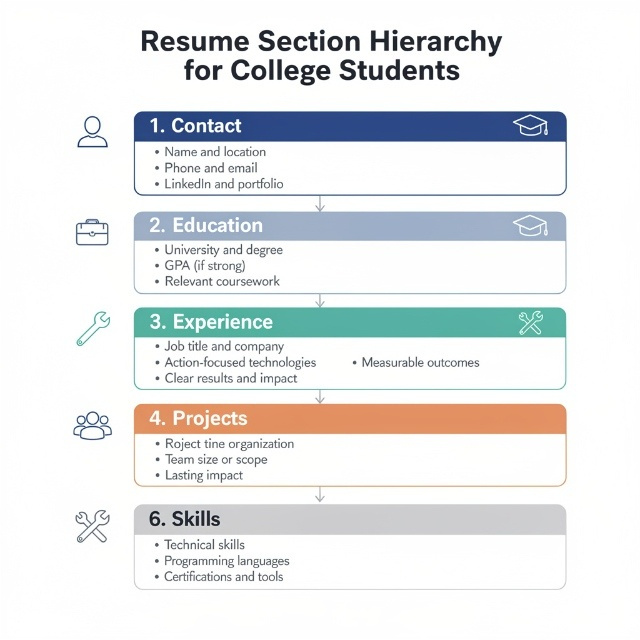
1. Contact Information (Header)
Place at the top in a clean, professional format:
- Full name (larger font, bold)
- Phone number (professional voicemail greeting)
- Email address (professional format: firstname.lastname@email.com)
- LinkedIn profile URL (customized, not default numbers)
- Portfolio or personal website (if relevant to field)
- City and state (full address unnecessary)
Avoid: Unprofessional email addresses (partygirl99@email.com), multiple phone numbers, social media beyond LinkedIn, photos (not standard in U.S. resumes), age or birthdate.
2. Education (Top Section After Header)
For students, education deserves prominent placement since it's typically your strongest credential. List most recent first if you have multiple degrees.
Include:
- University name, location (city, state) - Degree type, major (and minor if applicable)
- Expected graduation date (Month Year)
- GPA if 3.3+ (omit if lower; include "Major GPA: X.XX" if substantially higher than overall)
- Academic honors (Dean's List, Latin honors, scholarships)
- Relevant coursework (3-6 courses most relevant to target position)
Example:
Bachelor of Science in Computer Science
University of California, Los Angeles | Los Angeles, CA
Expected Graduation: May 2026 | GPA: 3.65/4.0

Relevant Coursework: Data Structures, Machine Learning, Database Systems,
Software Engineering, Algorithms, Web Development

Honors: Dean's List (Fall 2023, Spring 2024), UCLA Merit Scholarship
3. Experience Section (Any Relevant Work)
List all work experience, but emphasize transferable skills relevant to target positions rather than describing irrelevant job duties.
Structure each entry:
- Job title
- Company/Organization name, location (city, state)
- Employment dates (Month Year – Month Year or "Present")
- 2-4 bullet points describing responsibilities and achievements
Use action verbs and quantify achievements when possible. Even retail or service jobs develop valuable skills.
4. Projects Section (Often Strongest Content)
Academic projects, independent work, hackathons, or research provide evidence of skills and initiative when work experience is limited.
Include for each project:
- Project title (bold or italicized)
- Brief descriptor (1 line explaining context)
- 2-3 bullet points describing what you built/accomplished and skills demonstrated
Example:
Student Course Registration System | Database Systems Course Project
A. Designed and implemented MySQL database managing 10,000+ student records
B. Built Python-based web interface allowing course registration and scheduling
C. Collaborated with 3 team members using Git for version control
5. Leadership and Activities
Campus involvement, volunteer work, and leadership roles demonstrate initiative, teamwork, and time management beyond academics.
Include:
- Organization name and your role - Dates of involvement
- 1-3 bullet points describing responsibilities or achievements
- Focus on leadership, impact, or skills developed
6. Skills Section
Create a concise list of relevant technical and language skills. Tailor this section to match job descriptions.
Organize by category:
- Programming Languages: Python, Java, JavaScript, SQL
- Tools & Technologies: Git, AWS, Tableau, Microsoft Office
- Languages: Spanish (fluent), French (intermediate)
Be honest about skill levels. Claiming expertise you lack becomes obvious during interviews.
Optional Sections (Include if Relevant):
- Certifications (professional certifications, technical credentials)
- Publications (research papers, articles)
- Volunteer Work (if substantial and not covered elsewhere)
- Awards and Honors (significant recognitions)
What to Exclude from Student Resumes
Never include:
- High school information (once in college, high school becomes irrelevant)
- Objective statements ("Seeking a position where I can grow..." wastes space)
- References or "References available upon request" (assumed and outdated)
- Personal information (age, marital status, photo, religion)
- Unrelated hobbies unless directly relevant or impressive
Use judgment about:
- Mediocre GPAs (below 3.3, typically omit)
- Very brief jobs (under 2 months unless highly relevant)
- Controversial activities (political campaigns, religious organizations may alienate)
How Do You Describe Limited Experience Effectively?
Transform limited experience into compelling content by using strong action verbs, quantifying achievements with specific numbers, emphasizing transferable skills applicable across roles, and connecting seemingly unrelated jobs to target position requirements through strategic framing. The key is showing what you accomplished and learned rather than simply listing job duties.
The Action Verb + Task + Result Formula
Every bullet point should follow this structure: Strong action verb + specific task + measurable outcome or skill demonstrated
Weak bullet points (what not to write):
- "Responsible for customer service"
- "Worked on team projects"
- "Helped with social media"
- "Duties included data entry"
These passive, vague descriptions tell employers nothing about your actual capabilities.
Strong bullet points (effective approach):
- "Resolved 50+ customer inquiries daily, maintaining 4.8/5.0 satisfaction rating and receiving Employee of Month recognition"
- "Collaborated with 5-person team to design marketing campaign reaching 10,000+ students and increasing event attendance 40%"
- "Created and scheduled 30+ social media posts weekly, growing Instagram following from 200 to 1,500 in 4 months"
- "Processed and organized 500+ records weekly with 99.8% accuracy, implementing new filing system reducing retrieval time 30%"
The difference: Specific actions, concrete numbers, and demonstrated impact.
Mining Transferable Skills from Any Job
Every job, even those seemingly unrelated to your career goals, develops valuable transferable skills employers seek.
Retail/Food Service Jobs Demonstrate:
- Customer service and communication
- Problem-solving under pressure
- Teamwork and collaboration
- Time management during busy periods
- Cash handling and accuracy (attention to detail)
- Training or mentoring new employees (leadership)
Frame retail experience for different applications:
- For business roles: "Managed inventory tracking and customer relationship building, consistently exceeding monthly sales targets 20%"
- For technical roles: "Utilized POS system and inventory management software, identifying process inefficiencies and implementing solutions reducing checkout time 15%"
- For education roles: "Mentored and trained 8 new employees on company policies and customer service procedures, receiving positive feedback from management"
The same retail job becomes relevant to diverse fields through strategic framing emphasizing different aspects.
Quantifying Impact Without Traditional Metrics
Not every accomplishment has obvious numbers, but you can often create meaningful metrics:
Time-based quantification:
- "Completed project 2 weeks ahead of deadline"
- "Processed average of 50 applications daily"
- "Committed 10 hours weekly to volunteer tutoring"
Frequency quantification:
- "Published 12 articles over 6-month period"
- "Organized 6 fundraising events annually"
- "Presented research findings at 3 academic conferences"
Scale quantification:
- "Served community of 500+ members"
- "Managed budget of $15,000 for student organization"
- "Contributed to codebase with 10,000+ lines of code"
Improvement quantification:
- "Improved process efficiency by 30%"
- "Increased social media engagement by 45%"
- "Reduced errors by implementing new quality check system"
Numbers make accomplishments concrete and memorable. Use them whenever possible.
Highlighting Academic Projects as Experience
When work experience is truly minimal, expand your projects section to demonstrate skills through academic work.
Strong project descriptions:
Computer Science:
- Machine Learning Price Predictor | Python, Scikit-learn
- Developed algorithm predicting housing prices with 87% accuracy using regression models
- Cleaned and analyzed dataset of 5,000+ records, handling missing data and outliers
- Presented findings to class of 50 students, receiving top project award
Business/Marketing:
- Social Media Strategy for Local Nonprofit | Marketing Principles Course
- Conducted market research through 100+ user surveys identifying target demographics
- Created comprehensive 6-month content calendar with platform-specific strategies
- Presented recommendations to organization leadership, with 3 strategies implemented
Engineering:
- Sustainable Water Filtration System | Senior Design Project
- Designed and built prototype water purification system for developing regions
- Collaborated with 4-person team through full engineering design process
- Tested system achieving 99.5% contaminant removal rate under $50 budget constraint
These project descriptions demonstrate real skills and accomplishments despite occurring in academic contexts.
Weak vs. Strong Resume Points
| Weak Bullet Point (Ineffective) | Strong Bullet Point (Effective) |
|---|---|
| Responsible for customer service | Resolved 50+ customer inquiries daily, maintaining a 4.8/5.0 satisfaction rating and receiving Employee of the Month recognition |
| Worked on team projects | Collaborated with a 5-person team to design a marketing campaign reaching 10,000+ students and increasing event attendance by 40% |
| Helped with social media | Created and scheduled 30+ social media posts weekly, growing Instagram following from 200 to 1,500 in 4 months |
| Duties included data entry | Processed and organized 500+ records weekly with 99.8% accuracy, implementing a new filing system that reduced retrieval time by 30% |
| Assisted in organizing events | Coordinated logistics for 3 campus events with 200+ attendees each, improving participant feedback scores by 25% |
| Did tutoring for students | Provided one-on-one tutoring to 15+ students weekly, improving average exam scores by 20% over one semester |
| Used Microsoft Office | Developed complex Excel models to track budget spending, reducing reporting errors by 15% and saving 5 hours weekly |
| Participated in fundraising | Led a fundraising team that raised $10,000 for charity through 6 events, exceeding the goal by 25% |
What Resume Formatting and Design Standards Matter?
Use clean, professional single-column layout with consistent formatting, 10-12 point readable fonts (Calibri, Arial, or Times New Roman), 0.5-1 inch margins, strategic use of bold and italics for emphasis, and single-page length unless extensive relevant experience justifies two pages.
The most common formatting mistake is sacrificing readability for visual creativity hiring managers need to quickly scan content, not decipher artistic designs.
Length Guidelines
One page is standard and preferred for:
- Undergraduate students
- Graduate students with limited professional experience
- Internship and entry-level applications
- Most situations where experience spans less than 5 years
Two pages acceptable for:
- Graduate students with substantial research, publications, or professional experience
- Students with extensive relevant work history
- Academic CVs for research or PhD applications
Force yourself to edit ruthlessly. If your content barely extends onto a second page with large white space, consolidate to one page. Sparse two-page resumes appear unprofessional.
Font and Format Standards
Professional font choices:
- Calibri, Arial, Helvetica (modern, clean sans-serif)
- Times New Roman, Georgia (traditional, readable serif)
- Font size: 10-12 point body text, 14-16 point name header
Avoid:
- Decorative fonts (Papyrus, Comic Sans, Script fonts)
- Tiny fonts (under 10 point) to cram content
- Multiple font types within one resume
- Colors beyond black text (conservative navy or dark gray acceptable for headers)
Formatting consistency:
- Use same bullet style throughout (or)
- Consistent date formats (Month Year, not varied abbreviations)
- Parallel structure in bullet points (all start with action verbs)
- Uniform spacing between sections
- Aligned margins and text (use tabs, not spaces)
Applicant Tracking System (ATS) Compatibility
Many companies use automated systems scanning resumes before humans review them. ATS-incompatible formatting causes rejection regardless of qualifications.
ATS-friendly practices:
- Use standard section headers (Education, Experience, Skills)
- Submit as Word documents or clean PDFs (test that PDF text is selectable)
- Avoid tables, text boxes, headers/footers, or graphics
- Include keywords from job description naturally in your content
- Spell out acronyms first time (then abbreviate): "American Marketing Association (AMA)"
ATS killers:
- Creative infographic-style resumes
- Multiple columns or complex layouts
- Important information in headers or footers
- Images or graphics with embedded text
- Unusual section headers systems can't recognize
Balance ATS compatibility with human readability systems filter resumes, but people make final decisions.
Visual Hierarchy and White Space
Make your resume scannable in 6-8 seconds:
- Clear section headers (bold, slightly larger font)
- Adequate white space between sections
- Bullet points for easy scanning (not dense paragraphs)
- Most important information in top half of page
- Strategic bold text for job titles, company names, or key achievements
Hiring managers scan rather than read. If they can't quickly identify your qualifications, they move to the next resume.
When you're preparing resumes for graduate school applications, prestigious scholarships, or competitive fellowship programs where selection committees evaluate hundreds of applications and professional presentation quality determines advancement, trusted essay writing service can help you develop polished, strategically structured resumes that frame your academic accomplishments compellingly and meet the specific formatting standards these high-stakes opportunities require.
What Are Common College Student Resume Mistakes?
The five most damaging resume mistakes are: including irrelevant high school information that wastes space, using passive language and vague descriptions lacking specific achievements, poor formatting that fails applicant tracking systems or is visually cluttered, submitting identical resumes without tailoring to specific positions, and including obvious typos or grammatical errors signaling lack of attention to detail.
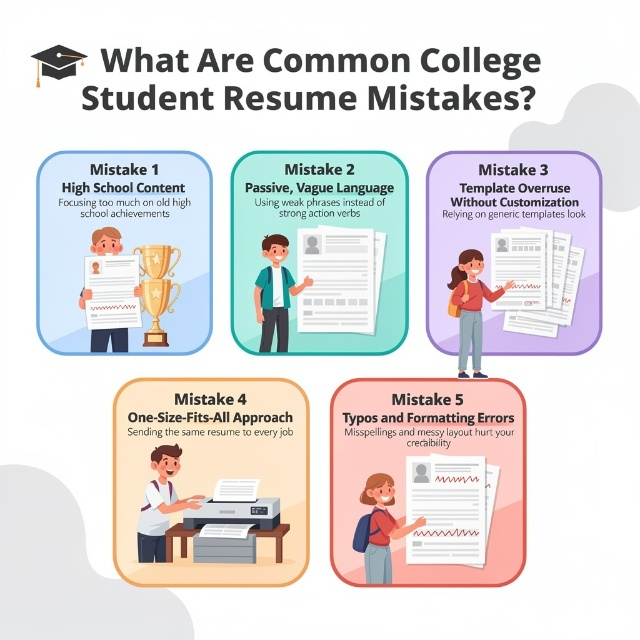
These mistakes are completely preventable through careful review and strategic content development.
Mistake 1: High School Content
Once enrolled in college, high school becomes irrelevant. Including high school information signals you don't understand professional norms or lack sufficient college-level content.
Remove:
- High school name, location, graduation date
- High school GPA or class rank - High school clubs, sports, or activities
- High school academic awards (unless truly exceptional like national recognition)
Exception: Recent college freshmen in fall semester may briefly include high school until accumulating college-level content, but remove by spring semester.
Mistake 2: Passive, Vague Language
Weak verbs and vague descriptions fail to communicate actual capabilities.
Passive language to avoid:
- "Responsible for..." (what did you actually do?)
- "Helped with..." (what was your specific contribution?)
- "Worked on..." (what did you accomplish?)
- "Duties included..." (focus on achievements, not job descriptions)
Replace with strong action verbs:
- Leadership: Led, Managed, Directed, Coordinated, Organized
- Creation: Developed, Designed, Created, Built, Implemented
- Improvement: Increased, Reduced, Streamlined, Enhanced, Optimized
- Analysis: Analyzed, Researched, Evaluated, Assessed, Investigated
- Communication: Presented, Collaborated, Trained, Mentored, Negotiated
Mistake 3: Template Overuse Without Customization
Generic templates often include outdated elements (objective statements, "References available") and create cookie-cutter resumes identical to thousands of others.
Use templates as starting points but customize heavily. Your resume should reflect your unique qualifications and personality within professional standards, not look exactly like every other resume from the same template.
Mistake 4: One-Size-Fits-All Approach
Submitting identical resumes to every application ignores that different positions emphasize different qualifications. Tailor resumes to each application.
Customization strategies:
- Adjust skills section emphasizing tools/technologies mentioned in job description
- Reorder bullet points placing most relevant accomplishments first
- Modify project descriptions emphasizing aspects relevant to position
- Include keywords from job posting naturally in your content
Tailoring requires 15-30 minutes per application but dramatically improves success rates. Customize your top-priority applications at minimum.
Mistake 5: Typos and Formatting Errors
Nothing undermines credibility faster than obvious errors. Typos signal carelessness and lack of attention to detail traits no employer wants.
Proofreading protocol:
- Read resume aloud slowly (catches errors silent reading misses)
- Check every date, GPA, and number for accuracy
- Verify consistency in formatting, capitalization, and punctuation
- Use spell-check but don't rely solely on it (won't catch "manger" instead of "manager")
- Have 2-3 other people review for errors you've become blind to
- Take breaks between editing sessions fresh eyes catch more mistakes
One typo might be forgiven; multiple errors guarantee rejection.
How Do You Tailor Resumes for Different Opportunities?
Tailor resumes by carefully reading position descriptions and matching your content to stated requirements, prioritizing relevant skills and experiences while minimizing unrelated content, incorporating keywords from job postings naturally throughout your resume, and adjusting emphasis across sections depending on whether roles prioritize technical skills, leadership, research, or other specific qualifications.
Generic resumes get rejected; targeted resumes generate interviews.
Reading Job Descriptions Strategically
Job descriptions contain critical information about what employers prioritize. Mine them for customization guidance.
Identify:
- Required vs. preferred qualifications (must-haves vs. nice-to-haves)
- Frequently mentioned skills or tools (these matter most)
- Keywords and phrases describing ideal candidates
- Specific responsibilities and projects mentioned
Create a list of 10-15 key terms from the job description, then ensure your resume naturally incorporates these terms where truthful and relevant.
Creating Position-Specific Versions
Maintain a "master resume" containing all your experiences, then create tailored versions emphasizing different aspects for different opportunities.
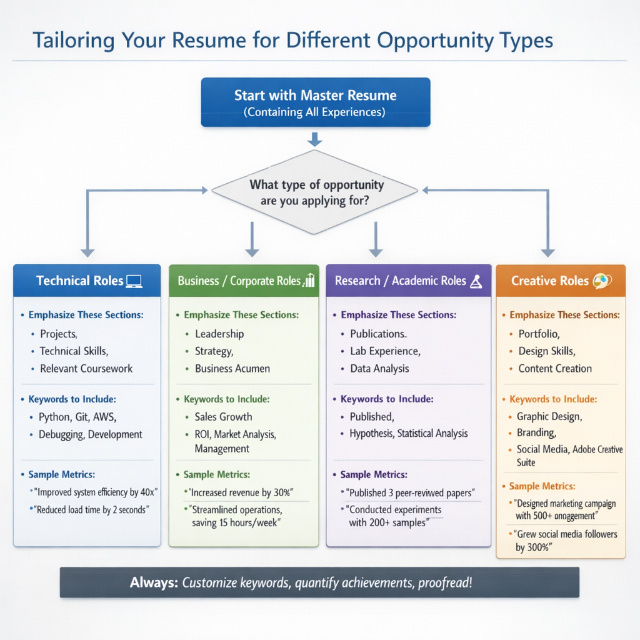
For technical roles:
- Expand skills section listing relevant technologies
- Lead with technical projects over less relevant experience
- Quantify technical achievements (lines of code, system performance improvements)
- Emphasize coursework in relevant technical areas
For business roles:
- Highlight leadership positions and team collaboration
- Emphasize results and impact using business metrics (revenue, growth, efficiency)
- Include relevant business coursework (finance, marketing, strategy)
- Focus on communication and interpersonal skills
For research positions:
- Feature research experience and academic projects prominently
- Include publications, presentations, or conference attendance
- Highlight analytical skills and methodological knowledge
- Emphasize relevant advanced coursework and GPA
For creative roles:
- Include portfolio link prominently
- Describe creative projects and their impact
- Show both creative and technical skills (design software proficiency)
- Quantify engagement or reach when possible.
Keyword Integration Best Practices
Applicant tracking systems scan for keywords matching job descriptions. Strategic inclusion improves passing automated screening.
Effective keyword integration:
- Use exact phrases from job postings when describing your skills
- Include both spelled-out terms and acronyms: "Customer Relationship Management (CRM)”
- Naturally incorporate in skills, experience, and project descriptions
- Don't keyword stuff maintain readable, natural language
Example: If job description mentions "data visualization," ensure your resume includes that exact phrase if you have that experience: "Created data visualizations using Tableau" rather than just "Made charts and graphs."
Conclusion
Effective college student resumes strategically emphasize academic achievements, relevant projects, and transferable skills from any experience rather than focusing on extensive work history most students lack, using clean professional formatting that passes both automated systems and human review.
Key strategies for strong student resumes:
- Structure with education prominently at top, followed by experience, projects, leadership, and skills sections tailored to available content strength
- Transform limited experience into compelling content through action verbs, quantified achievements, and strategic framing emphasizing transferable skills
- Use clean single-column formatting with 10-12 point professional fonts, consistent styling, and careful attention to ATS compatibility
- Tailor resumes for each application by incorporating relevant keywords, reordering content to prioritize applicable experience, and adjusting emphasis across sections
- Eliminate common mistakes including high school content, passive vague language, identical templates without customization, and preventable typos
Start building your resume now by creating a master document containing all experiences, coursework, projects, and activities. Then develop tailored versions emphasizing different aspects for different opportunity types. Students who invest time developing strong resumes early in college report significantly higher internship placement and job offer rates compared to those creating rushed resumes only when applications require them.
Your resume serves as your marketing document in competitive application processes quality directly determines whether you advance to interviews or face rejection. Treat resume development as an ongoing process, updating quarterly as you gain new experiences, complete projects, or develop skills. When you're preparing resumes for graduate school applications, competitive fellowships, or prestigious scholarship programs where selection committees evaluate hundreds of applicants and professional presentation quality determines advancement, reliable essay writing service can provide expert resume development services ensuring your academic accomplishments and limited experience are framed strategically to meet the specific standards these high-stakes opportunities require.
Download our free College Student Resume Template with ATS-optimized formatting, section-by-section guidance, and before/after examples showing effective content transformation.