When Should You Start Reviewing Before Exams?
Begin structured review 7-10 days before major exams to allow proper spacing between review sessions. This timeline provides enough repetitions with increasing intervals to build lasting retention without the stress and poor results of cramming.
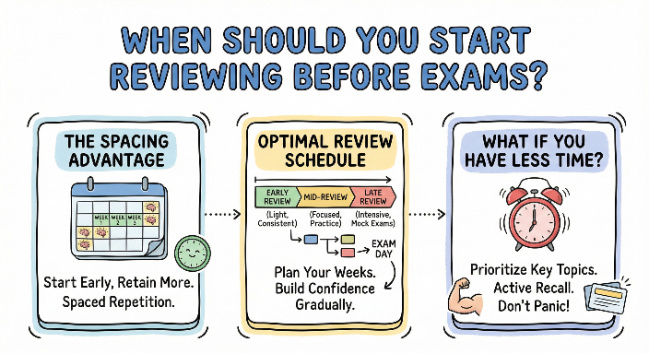
The Spacing Advantage
Your brain consolidates memories during sleep and time between study sessions. Cramming the night before doesn't allow consolidation, so information stays in fragile short term memory rather than transferring to durable long term storage. Students who space review over a week retain 60-80% of material after exams, while cramming produces only 15-25% retention.
| A 2024 study tracked 500 students across multiple institutions. Students who began review 7-10 days before exams scored an average of 12 points higher (on 100 point scales) than students who started 1-2 days before. The spacing group also reported lower stress and better sleep quality during exam periods. |
Optimal Review Schedule
For a major exam 10 days away:
|
This schedule provides four spaced retrieval sessions with increasing intervals, optimal for memory consolidation. Each session builds on the previous one while allowing time for your brain to strengthen neural pathways.
What If You Have Less Time?
If you discover an exam with only 3-4 days to prepare, compress the schedule but maintain the principle of multiple spaced sessions. Review once per day with active recall rather than multiple reviews in one day. Even 3 spaced reviews beat 8 hours of single day cramming for both immediate performance and retention.
For students managing multiple simultaneous exams and finding they lack adequate review time for all courses, many strategically use an essay writing service for specific papers, creating bandwidth to implement proper 7-10 day review schedules for their highest priority exams.
What Are the Most Effective Review Activities?
The review activities you choose determine whether your time produces results or wastes effort. Focus on high value activities that build retrieval strength.
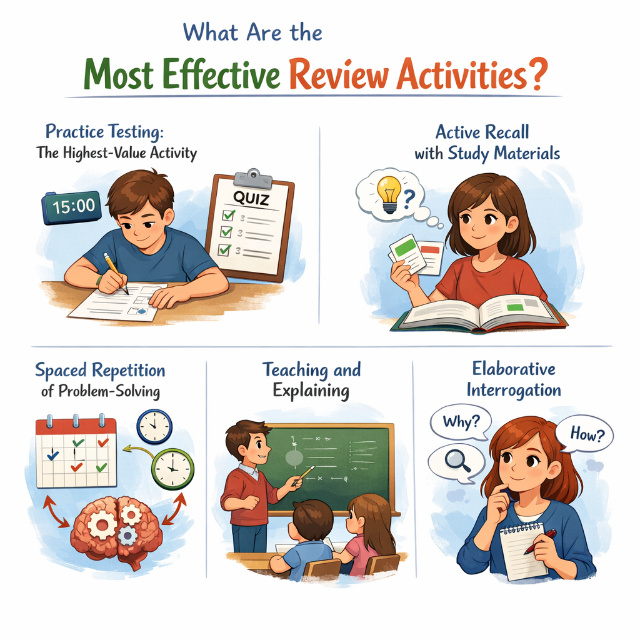
Practice Testing: The Highest Value Activity
Taking practice tests is 2-3 times more effective than any other review activity for improving exam performance. Practice testing forces retrieval, reveals knowledge gaps, builds confidence, and provides exam experience all critical for success.
Complete full length practice exams under realistic conditions: timed, closed notes, no phone. After finishing, carefully review every question especially ones you got wrong or guessed on. Understand why wrong answers are incorrect and why right answers are correct. This analysis cements understanding.
| Research consistently shows students who take 2-3 practice exams score 15-25% higher than students who spend equivalent time re-reading or reviewing notes. The testing effect is cognitive science's most robust finding about learning. |
Active Recall with Study Materials
Close your notes and force yourself to retrieve information from memory. See a concept or question in your study guide, then write everything you know about it without looking. Only after genuine retrieval attempts should you check accuracy.
This retrieval practice strengthens memory pathways dramatically more than passive review. Students report it feels harder and less comfortable than reading, but that discomfort signals actual learning occurring. Embrace the difficulty that's what builds lasting retention.
| For each major topic, spend 60-70% of review time on active recall and only 30-40% checking answers and filling gaps. This ratio maximizes learning efficiency. |
Spaced Repetition of Problem Solving
For STEM courses, work practice problems repeatedly with spacing. Don't just work problems once and move on. Return to the same problem types 2-3 days later and solve them again from scratch. This spaced practice builds the automaticity exams require.
Students often feel they "get it" after working a problem once, but can't reproduce the solution days later. Multiple spaced attempts cement procedural knowledge.
| A 2023 study found engineering students who solved problems 3+ times with spacing scored 28% higher than students who solved each problem once. |
Teaching and Explaining
Explain concepts out loud as if teaching someone else. This forces you to organize knowledge, identify gaps, and articulate clearly all processes that deepen understanding. If you can explain a concept without notes, you've mastered it.
Join study groups specifically for teaching rounds where each person explains different topics. The preparation forces learning, and the teaching cements it. Students who regularly teach material to others retain 40% more information than those who only review independently.
Elaborative Interrogation
Ask yourself "why" and "how" questions about material rather than just reviewing what you know. Why does this process work this way? How does this concept connect to that one? What would happen if this variable changed?
This deep processing creates richer memory traces with more retrieval pathways. Simple memorization creates shallow, fragile memories. Elaboration creates robust understanding that survives exam pressure.
For students balancing effective review practices across multiple courses while also managing major writing assignments, many use a professional essay writing service for specific papers, protecting the time needed for high value review activities like practice testing and active recall.
How Do You Identify and Address Weak Areas?
Strategic review focuses effort on actual weaknesses, not comfortable repetition of already-mastered material. Diagnostic assessment reveals where to concentrate your limited time.
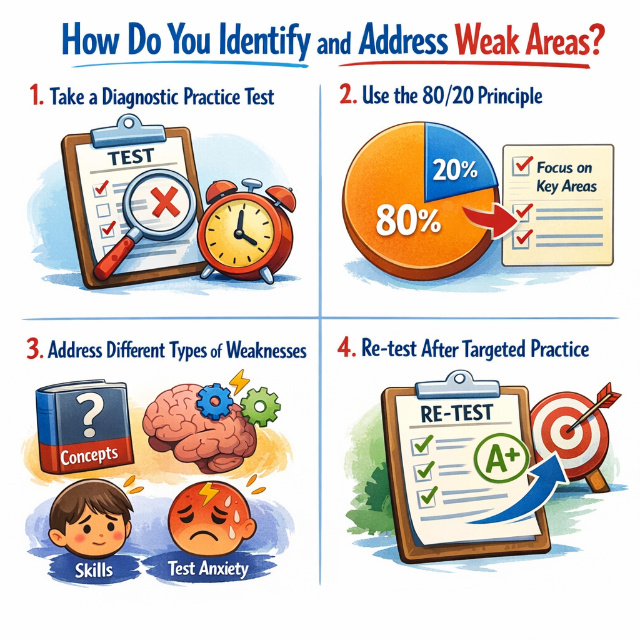
1. Take a Diagnostic Practice Test
Within the first 2-3 days of your review period, take a comprehensive practice test covering all exam material. Don't study first this test diagnoses your current knowledge level. The results show exactly where you're weak, strong, and overconfident.
Score the test honestly, noting not just wrong answers but also lucky guesses and answers you weren't confident about. These are all areas requiring additional work. Create a weakness list ranking topics from "need serious work" to "just need review."
Research shows students who use diagnostic testing to guide review allocate time more efficiently and score 18% higher than students who review all material equally. Strategic focus beats comprehensive coverage when time is limited.
2. Use the 80/20 Principle
Spend 80% of review time on your 20% weakest areas. Once you can reliably retrieve and apply information, it doesn't need more review time. Your weak areas need repeated practice, elaboration, and additional examples.
Many students fall into the comfort trap spending time on material they already know because it feels good to get answers right. This wastes review time. Force yourself to prioritize discomfort over comfort. The topics you least want to review are often exactly what you most need to study.
3. Address Different Types of Weaknesses
Conceptual gaps (don't understand the underlying idea):
- Find alternative explanations from different sources
- Create analogies connecting to familiar concepts
- Draw diagrams showing relationships
- Teach the concept to someone else
Procedural gaps (understand concept but can't execute):
- Work 10-15 additional practice problems
- Write out solution steps explicitly
- Practice without looking at examples
- Time yourself solving problems
Application gaps (know facts but can't apply to new situations):
- Work novel practice problems
- Create your own application scenarios
- Connect concepts across different contexts
- Practice explaining when/why to use specific approaches
4. Re-test After Targeted Practice
After spending time addressing weaknesses, re-test yourself on those specific areas. If you still struggle, you need different approaches or more practice. If you've improved, you can reduce time allocation to those topics in future review sessions.
This iterative process ensures review time produces actual improvement rather than just creating the illusion of preparation. Students using this diagnostic practice retest cycle consistently outperform those using less structured approaches.
For students discovering major conceptual gaps late in their review period while also facing writing deadlines, many strategically use a reliable essay writing service for specific papers, protecting the concentrated time needed to address identified weaknesses before exams.
What Review Mistakes Should You Avoid?
Common review mistakes waste time and produce false confidence. Recognizing and avoiding these errors dramatically improves effectiveness.
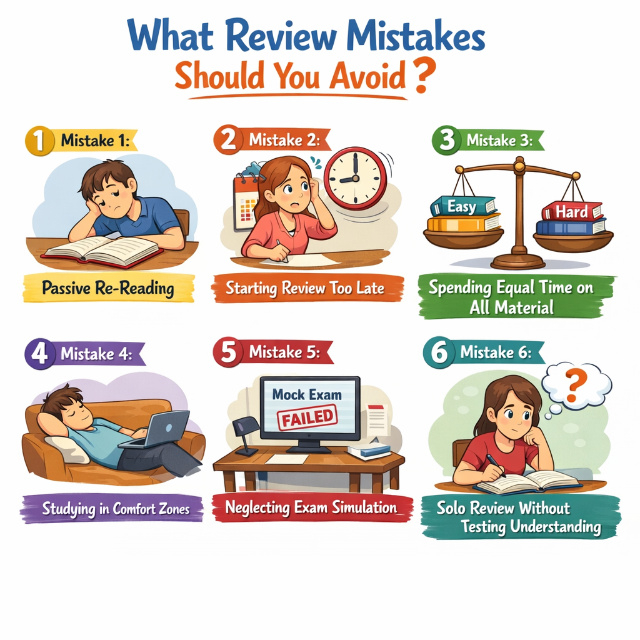
Mistake 1: Passive Re-Reading
Re-reading textbooks and notes is the least effective review activity yet the most common. Reading creates fluency material feels familiar and comprehensible but fluency isn't learning. You recognize information when you see it but can't produce it independently.
Studies show students dramatically overestimate their learning from re-reading. They confuse recognition with recall, then panic during exams when recognition doesn't help. Replace re-reading with retrieval practice for 2-3x better retention.
Mistake 2: Starting Review Too Late
Beginning review 1-2 days before exams eliminates spacing benefits and creates stress that impairs performance. Cramming feels necessary when you've waited too long, but it produces significantly worse results than spaced review.
Students who cram report higher anxiety, worse sleep, and lower performance than those who review progressively. Emergency cramming is sometimes unavoidable, but make it the exception, not your standard approach.
Mistake 3: Spending Equal Time on All Material
Reviewing everything equally means under preparing weak areas and over preparing strong areas. Diagnostic testing reveals where time produces maximum benefit. Equal coverage feels fair and complete but is strategically inefficient.
| The student who spends 50% of review time on their weakest 20% of material typically outperforms the student who evenly distributes time across all content, despite studying less total material thoroughly. |
Mistake 4: Studying in Comfort Zones
Students naturally gravitate toward material they already understand because getting answers right feels good. This creates the illusion of productive studying while avoiding the discomfort where actual learning happens.
Force yourself into difficulty. Study the topics you least want to review. Practice the problem types you keep getting wrong. This strategic discomfort is what improves performance, not comfortable repetition of mastered material.
Mistake 5: Neglecting Exam Simulation
Studying without timed practice under exam conditions leaves you unprepared for performance pressure. Knowing material in relaxed study sessions doesn't guarantee you can access that knowledge quickly under exam stress.
Practice exams reveal whether you can perform under constraints. They build time management skills and reduce anxiety through exposure. Students who take multiple practice exams report feeling significantly calmer and more confident during actual exams.
Mistake 6: Solo Review Without Testing Understanding
Studying alone without verbalizing or writing answers creates overconfidence. Information floating in your mind feels accessible until you try to produce it. Only through actual retrieval attempts do you discover what you truly know versus what you merely recognize.
Force external accountability: write answers, speak them aloud, explain to others, or take practice tests. Internal review alone consistently produces overconfidence and underperformance.
For students recognizing they've made these mistakes and need to maximize remaining review time, combining corrected review practices with strategic use of a trusted essay writing service for specific papers can help recover performance while building better long term habits.
Conclusion: Strategic Review Beats Comprehensive Coverage
Learning how to review before exams effectively means replacing passive re-reading with active retrieval practice, starting 7-10 days early for proper spacing, using diagnostic testing to guide effort toward weak areas, and simulating exam conditions through practice testing. Students using these evidence based strategies score 20-30% higher than those relying on traditional last minute cramming and re-reading.
Key Takeaways:
|
Start implementing these strategies for your next exam. Take a diagnostic practice test early to identify weaknesses. Schedule spaced review sessions over 7-10 days. Replace re-reading with retrieval practice. Compare your results to previous exams using different methods. The performance improvement will demonstrate that strategic review produces better outcomes with less wasted effort.
For students balancing effective exam review across multiple courses while managing writing assignments, strategic use of a fast essay writing service for specific papers creates bandwidth to implement proper review schedules without compromising on either exam preparation or assignment quality.
Transform your review process from anxious last minute cramming into confident, strategic preparation that maximizes performance.