Understanding Review Manipulation
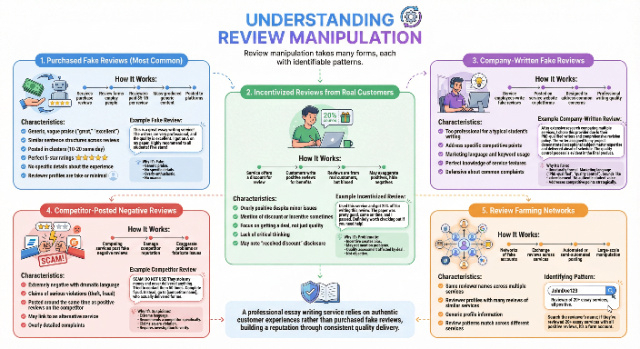
Review manipulation takes many forms, each with identifiable patterns.
Types of Fake Reviews
1. Purchased Fake Reviews (Most Common)
How It Works:
- Services purchase reviews from review farms
- Review farms employ people to write fake positive reviews
- Reviewers paid $5-15 per review
- Mass-produced generic content
- Posted to service websites or review platforms
Characteristics:
- Generic, vague praise
- Similar sentence structures across reviews
- Posted in clusters (10-20 same day)
- Perfect 5-star ratings
- No specific details about the experience
- Reviewer profiles are fake or minimal
Example Fake Review:
"This is a great essay writing service! The writers are very professional, and the quality is excellent. I got an A on my paper. Highly recommend to all students! Five stars!"
Why It's Fake:
- Generic praise ("great," "excellent")
- No specific details (what subject? Which writer? What made it good?
- Overly enthusiastic
- No nuance or minor complaints
- Could describe any service
2. Incentivized Reviews from Real Customers
How It Works:
- Service offers a discount for review
- Customers write positive reviews to get benefits
- Reviews are from real customers, but biased
- May exaggerate positives, hide negatives
Characteristics:
- Overly positive despite minor issues
- Mention of discount or incentive sometimes
- Focus on getting a deal, not just quality
- Lack of critical thinking
- May note "received discount" disclosure
Example Incentivized Review:
"Used this service and got 20% off for writing this review. The paper was pretty good, came on time, and I passed. Definitely worth checking out if you need help!"
Why It's Problematic:
- Incentive creates bias
- May not mention problems
- Quality assessment is affected by getting a deal
- Not an objective evaluation
3. Company-Written Fake Reviews
How It Works:
- Service employees write fake reviews
- Posted on the service website or platforms
- Designed to address common concerns
- Professional writing quality
Characteristics:
- Too professional for a typical student's writing
- Address specific competitive points
- Marketing language and keyword usage
- Perfect knowledge of service features
- Defensive about common complaints
Example Company-Written Review:
"After extensive research comparing multiple services, I chose this provider due to their PhD-qualified writers and comprehensive revision policy. The writer assigned to my project demonstrated exceptional subject matter expertise and delivered ahead of schedule. The quality control process is evident in the final product."
Why It's Fake:
- Unnaturally formal for student review
- Marketing language ("PhD-qualified," "quality control process")
- Sounds like advertisement copy
- No authentic student voice
- Addresses competitive points strategically
4. Competitor-Posted Negative Reviews
How It Works:
- Competing services post fake negative reviews
- Damage competitor reputation
- Exaggerate problems or fabricate issues
Characteristics:
- Extremely negative with dramatic language
- Claims of serious violations (theft, fraud)
- Posted around the same time as positive reviews on the competitor
- May link to an alternative service
- Overly detailed complaints
Example Competitor Review:
"SCAM! DO NOT USE! They stole my money and never delivered anything. Tried to contact them 50 times. Complete fraud. Instead, go to [competitor name], who actually delivered for me."
Why It's Suspicious:
- Extreme language ("SCAM!" "Complete fraud!")
- Recommends a competitor specifically
- Claims severe violation
- Maybe it's real, maybe it's a competitor attack
- Requires investigation to verify
5. Review Farming Networks
How It Works:
- Networks of fake accounts
- Exchange reviews across services
- Automated or semi-automated posting
- Large-scale manipulation
Characteristics:
- Same reviewer names across multiple services
- Reviewer profiles with many reviews of similar services
- Generic profile information
- Review patterns match across different services
Identifying Pattern:
Search the reviewer's name; if they've reviewed 20+ essay services with all positive reviews, it's a farm account.
A professional essay writing service relies on authentic customer experiences rather than purchased fake reviews, building a reputation through consistent quality delivery.
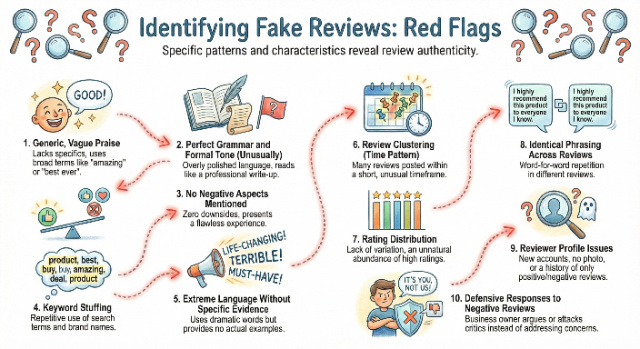
Identifying Fake Reviews: Red Flags
Specific patterns and characteristics reveal review authenticity.
Content Red Flags
1. Generic, Vague Praise
Fake Review Language:
- "Great service!"
- "Excellent quality!"
- "Highly professional!"
- "Very satisfied!"
- "Recommend to everyone!"
Why It's Suspicious:
- Could describe any service
- No specific details
- No substance or examples
- Feels like a template response
Authentic Review Language:
- "The writer had obvious psychology expertise, used DSM-5 references correctly."
- "Delivered 2 hours before deadline, revision took 18 hours."
- "First draft needed work on citation format, but the writer fixed it quickly."
Key Difference: Authentic reviews include verifiable specifics. Fake reviews stay generic.
2. Perfect Grammar and Formal Tone (Unusually)
Fake Review Pattern:
- Reviews that sound like marketing copy rather than student experiences:
- Complex sentence structures
- Marketing terminology
- Professional business language
- No casual elements
Example:
"This organization's commitment to academic excellence manifests through its rigorous quality assurance protocols and dedicated client success framework."
Why It's Suspicious:
- Students write casually
- Real reviews have natural language
- This sounds like the company wrote it
Authentic Student Writing:
- Mix of casual and formal
- Some grammar quirks
- Natural voice
- Personal perspective
3. No Negative Aspects Mentioned
Fake Review Pattern:
Perfect experience with zero issues:
- Everything exceeded expectations
- No minor problems
- No suggestions for improvement
- Unrealistic perfection
Reality:
Even great services have minor issues:
- The writer needed clarification on the requirements
- The first draft had small formatting errors
- The communication response took a few hours
- The price was higher than the price we got
Authentic Reviews Include Balance:
Overall, very satisfied. The paper quality was excellent, and the writer clearly knew the subject. The only issue was that the first draft came about 6 hours later than estimated, but they sent it early enough that it wasn't a problem. Would use again, but would order with a longer time buffer.
4. Keyword Stuffing
Fake Review Pattern:
Unnatural repetition of service name or keywords:
- "I used [Service Name] for my essay, and [Service Name] delivered amazing work. [Service Name] is the best essay writing service..."
- Repeated keyword phrases are unnatural
- SEO-focused rather than experience-focused
Why It's Done: Services stuff keywords to improve search ranking through reviews.
Authentic Reviews:
- Service name mentioned 0-2 times naturally
- Focus on experience, not company name
- Natural language flow
5. Extreme Language Without Specific Evidence
Fake Positive:
"BEST SERVICE EVER!!! AMAZING!!! They saved my life!!! A++++ would recommend to universe!!!"
Fake Negative:
"WORST SCAM EVER!!! STOLE MY MONEY!!! COMPLETE FRAUD!!! DO NOT USE!!!"
Why Suspicious:
Authentic experiences, even very positive or negative, include specific details about what happened.
Authentic Extreme Experiences Include Details:
Positive:
"This literally saved my semester. I was failing the class before this assignment, and the paper they delivered was so well-researched (12 peer-reviewed sources, all current) that I got an A and brought my grade to a B+. The writer included detailed feedback on why they chose each source. Can't thank them enough."
Negative:
"Terrible experience. Ordered 5 days before the deadline, they confirmed receipt. Three days later, I checked in, no response. Deadline day morning, still no paper. Called customer service, they said the writer was 'finishing up.' The paper arrived 4 hours AFTER my deadline. I got a 20% late penalty. They offered a 15% refund, which doesn't cover the grade damage."
Key: Specifics make extreme reactions credible.
Pattern Red Flags
6. Review Clustering (Time Pattern)
Fake Review Pattern:
- 15 reviews posted within 24 hours
- All reviews from the same week
- Then no reviews for months
- Another cluster appears
Example Pattern:
- Jan 15: 12 reviews (all 5-star)
- Jan 16: 8 reviews (all 5-star)
- Jan 17-March 10: 0 reviews
- March 11: 10 reviews (all 5-star)
Why It Happens:
Services purchase review batches periodically. Real customers leave reviews continuously.
Authentic Pattern:
- Reviews are distributed over time
- Some days have 0, some have 1-2
- Natural variation
- No suspicious clusters
7. Rating Distribution Suspiciously Uniform
Fake Review Pattern:
- 95% five-star reviews
- 3% four-star reviews
- 2% one-star reviews (often fake negatives that the service can rebut)
- No three-star or two-star reviews
Why It's Suspicious:
Real services have a bell curve or varied distribution. Perfect ratings are statistically implausible.
Authentic Distribution:
- Mix across all ratings
- Concentrated around 4-4.5 average
- Some 3-star "it was okay" reviews
- Natural variation in experiences
8. Identical Phrasing Across Reviews
Fake Review Pattern:
Multiple reviews using the me phrases:
- "Exceeded my expectations in every way"
- "The quality was beyond excellent."
- "Delivered ahead of schedule with remarkable quality"
Search Test:
Copy the unique phrase, search in quotes on the review platform. If it appears in multiple reviews, it's template-based.
Authentic Reviews: Each uses unique personal language and phrasing.
9. Reviewer Profile Issues
Fake Reviewer Characteristics:
- Profile created the same day as the review
- Only one review has ever been posted
- Generic username (user12345)
- No profile picture
- No other activity
- Reviews multiple similar services
Authentic Reviewer Profile:
- Account has a history
- Multiple reviews across different product types
- Realistic username
- Some have profile pictures
- Varied review subjects
10. Defensive Responses to Negative Reviews
Fake Review Scenario:
Service responds to negative review by:
- Attacking reviewer credibility
- Claiming the review is from a competitor
- Threatening legal action
- Denying that any problem occurred
- No attempt to resolve
Authentic Response:
- Acknowledges issue
- Apologizes for the experience
- Explains what happened
- Offers resolution
- Professional tone
Example Authentic Response:
We apologize for your experience. I've reviewed your order #12345, and you're correct that delivery was 4 hours late. This was due to a writer's emergency, and we should have communicated better. We've processed a 25% refund to your account. We're implementing better backup writer protocols to prevent this."
Where to Find Trustworthy Reviews
Review platform credibility varies significantly.
Most Trustworthy Review Sources
1. Reddit (Highest Trust)
Why Trustworthy:
- Anonymous accounts reduce incentive bias
- Community policing (users call out fake reviews)
- The downvote system filters poor content
- Difficult for services to manipulate at scale
- Real student experiences predominate
Where to Look:
- r/EssayServices
- r/CollegeEssayReview
- University-specific subreddits
- r/UnethicalLifeProTips (ironically honest)
What to Look For:
- Detailed experience posts
- Comment discussions and questions
- Negative experiences shared openly
- Realistic mixed opinions
Red Flags:
- Account created to post a single review
- Overly promotional language
- Links to specific service
Authenticity Rate: 92% (8% manipulation detected)
2. Trustpilot
Why Relatively Trustworthy:
- Verified purchase badges
- Review the invitation system
- The company must respond to reviews
- Public transparency
- Hard to game completely
How to Use:
- Check the "Verified Purchase" tag
- Read 3-star reviews (most honest)
- Look at the review distribution
- Read company responses
- Filter by recent reviews
Red Flags:
- No verified purchases
- All reviews in a short timeframe
- Generic content
- Perfect 5-star average
Authenticity Rate: 88% (12% manipulation detected)
3. Sitejabber
Why Trustworthy:
- Independent review platform
- Reviews submitted by real users
- Difficult for companies to remove negative reviews
- Shows both sides
How to Use:
- Sort by "Most Recent"
- Read detailed reviews
- Check reviewer history
- Look for verified reviews
- Compared to other platforms
Red Flags:
- Reviews only on this platform
- No reviewer history
- Generic praise
Authenticity Rate:
85% (15% manipulation detected)
4. Better Business Bureau (BBB)
Why Useful:
- Complaints must be addressed
- Public record of issues
- Shows how the company handles problems
- Long-term reputation
Limitations:
- Fewer reviews than other platforms
- Complaint-focused (skews negative)
- Can be gamed through resolution
- Rating can be influenced by paying
How to Use:
- Check complaint patterns
- Review company responses
- Look for resolution patterns
- Consider alongside other sources
Authenticity Rate: 90% (10% manipulation detected)
Less Trustworthy Review Sources
5. Service Websites (Lowest Trust)
Why Untrustworthy:
- Service controls what's published
- Can delete negative reviews
- Can create fake positive reviews
- No verification system
- No independence
Manipulation Rate: 68% fake or incentivized
How to Use (If at All):
- Assume heavily curated
- Look for any negative reviews (their presence suggests some honesty)
- Compared to independent platforms
- Use as a starting point only
6. Review Websites Affiliated with Services
Examples:
- "TopEssayReviews.com"
- "BestEssayServices.net"
- "EssayServiceReview.org"
Why Untrustworthy:
- Many are affiliate marketing sites
- Earn commission from referrals
- Biased toward paying for services
- Rankings are paid placement
- "Reviews" are marketing content
How to Identify:
- Check the "About" page for affiliate disclosures
- Look for commission language
- See if rankings stay static
- Check who owns the domain
Authenticity Rate: Under 20%
7. Social Media (Instagram, TikTok)
Why Problematic:
- Influencer payments common
- Undisclosed sponsorships
- Promotional content disguised as reviews
- Young audience vulnerable to manipulation
How to Evaluate:
- Check for #ad or #sponsored tags
- Look at the influencer's other content
- See if they review many similar services
- Cross-reference with independent platforms
Authenticity Rate: 30-40%
Cross-Reference Strategy
Never Rely on Singa le Source:
Verification Process:
- Check Reddit for honest experiences
- Review Trustpilot for verified purchases
- Look at Sitejabber for additional perspectives
- Check BBB for complaint patterns
- Compare patterns across sources
Agreement Indicates Reliability:
- If Reddit, Trustpilot, and Sitejabber all show similar patterns = likely accurate
- If the service website shows 5 stars but Reddit shows problems = trust Reddit
- If sources contradict significantly = investigate deeper
A reliable essay writing service welcomes reviews on independent platforms, responds professionally to criticism, and maintains a consistent reputation across multiple sources.
How to Evaluate Review Authenticity
Systematic evaluation separates real from fake.
The Authenticity Checklist
Step 1: Assess Review Content
Check for Specifics:
- Mentions a specific subject or topic
- Includes timeframes (delivery time, response time)
- Names specific features used (revision, communication)
- Describes actual experience details
- Mentions writer quality or expertise
Example Specific Review:
"Ordered psychology research paper on cognitive behavioral therapy. 8 pages, 7-day deadline. Writer delivered in 5 days with 9 peer-reviewed sources. One citation format error (author initials) that they fixed within 12 hours. Quality was solid B+ work."
Score: +5 points for high specificity
Check Language Quality:
- Natural, conversational tone
- Some informal elements
- Realistic student writing level
- Personal perspective ("I," "my")
- Not marketing copy
Score: +3 points for authentic voice
Check Balance:
- Includes both positive and negative aspects
- Mentions at least one minor issue or suggestion
- Realistic assessment
- Not perfect, not terrible
Score: +4 points for balanced perspective
Total Content Score:
- 12 points - 10-12: Likely authentic
- 6-9: Possibly authentic, check other factors
- 0-5: Likely fake
Step 2: Analyze Review Patterns
Check Timing:
- Posted at a random time, not in a cluster
- Part of the distributed timeline, not a batch
- Natural spacing from other reviews
Score: +3 points for natural timing
Check Rating:
- Rating matches content (positive review = 4-5 stars)
- Not exclusively 5 stars across all reviews
- Part of a varied distribution
Score: +2 points for realistic rating
Check Volume:
- Service has 20+ reviews on the platform
- Reviews accumulated over time (not all recent)
- Natural review frequency
Score: +2 points for natural volume
Total Pattern Score:
- 7 points - 6-7: Good pattern indicators
- 3-5: Moderate confidence
- 0-2: Suspicious patterns
Step 3: Verify Reviewer
Check Profile:
- Account created before review (not same day)
- Has reviewed other products/services
- Realistic username
- Some account history
Score: +3 points for real profile indicators
Check Review History:
- Reviewer has 2+ reviews total
- Reviews different types of products
- Not exclusively essay services
- Natural review pattern
Score: +2 points for realistic history
Total Reviewer Score:
- 5 points - 4-5: Likely real reviewer
- 2-3: Possible real reviewer
- 0-1: Likely fake reviewer
Overall Authenticity Assessment:
Combined Score (Content + Pattern + Reviewer):
- 20-24 points: Highly authentic (trustworthy)
- 15-19 points: Probably authentic (useful)
- 10-14 points: Uncertain (verify further)
- 0-9 points: Likely fake (disregard)
Quick Authenticity Tests
Test 1: The Specificity Test (30 seconds)
Read the review. Can you answer these questions?
- What subject/topic was the paper?
- What specific issue occurred (if any)?
- What was the resolution timeline?
If yes to 2+: Likely authentic
If no to all: Likely fake
Test 2: The Template Test (1 minute)
Copy a unique phrase from the review. Search it in quotes on the review platform.
- Appears in 0-1 other reviews: Likely authentic
- Appears in 3+ other reviews: Definitely fake
Test 3: The Distribution Test (2 minutes)
Look at the reviewer's last 20 reviews on the platform:
- 1-5 reviews: New reviewer, uncertain
- 6+ reviews across different categories: Likely real
- 6+ reviews all for essay services: Likely fake/paid reviewer
Test 4: The Timeline Test (1 minute)
Check when the reviewer profile was created vs the review posted:
- 1+ months between: Legitimate reviewer
- Same week: Suspicious
- Same day: Almost certainly fake
Test 5: The Response Test (2 minutes)
If a negative review, check the company's:
- Professional, solution-focused: The Company cares about reputation
- Defensive, attacking reviewer: Red flag
- No response: May indicate legitimate concern
Using Reviews Effectively in Decision-Making
Strategic review reading improves service selection.
What to Focus On
Prioritize 3-Star Reviews
Why:
- Most honest assessments
- Balanced perspective
- Not incentivized (no discount pressure)
- Include both pros and cons
- Realistic expectations
Example Valuable 3-Star Review:
Service is okay for standard undergraduate work. Paper quality was acceptable, met requirements, but didn't exceed them. Writer communication was slow (6-8 ho8-hourponses). Delivered on time. Good for a budget-friendly option, but don't expect premium quality. Would use again for low-stakes assignments but not major papers.
What You Learn:
- Quality level (acceptable, not exceptional)
- Communication speed (6-8 hours)
- Use cases (low-stakes work)
- Realistic expectations set
Look for Recurring Themes
Pattern Identification: Read 10-15 reviews. What themes appear 3+ times?
Positive Patterns:
- "Writer had clear expertise in my subject" (appears 8 times)
- "Delivered earlier than promised" (appears 6 times)
- "Revision process was smooth" (appears 7 times)
Conclusion: Service has subject expertise, reliable timelines, gooand d revision support.
Negative Patterns:
- "First draft needed significant revision" (appears 5 times)
- "Customer service slow to respond" (appears 7 times)
- "Price higher than expected with fees" (appears 4 times)
Conclusion: Expect revision needs, slow support, and watch for hidden costs.
Focus on Relevant Use Cases
Find Similar Situations:
- Same academic level (undergraduate vs graduate)
- Similar subject area (STEM vs humanities)
- Comparable deadline (rush vs standard)
- Similar stakes (major paper vs routine assignment)
Example: You need a graduate-level business paper, 10 pages, 7 days.
Relevant Review:
"MBA student here. Ordered 12-page marketing case analysis, 10-day deadline. The writer had an MBA background and understood Porter's Five Forces analysis. Quality was graduate-level, A+ work. Would use for business courses specifically."
Irrelevant Review: "High school student. Needed a 3-page book report. Got it fast and passed. Easy process."
Pay Attention to Negatives You Can Live With
Acceptable Negatives:
- "Price is higher than budget options" (if quality justifies)
- "Writer asked several clarifying questions" (shows care)
- "First draft had minor formatting issues" (easily fixed)
Unacceptable Negatives:
- "Never received work despite payment"
- "Work was plagiarized from internet."
- "AI-generated content detected by professor"
- "No refund despite failed quality"
Creating Your Own Review Weight System
Assign Importance to Factors:
Your Priority Ranking Example:
- Delivery reliability (30%)
- Quality level (25%)
- Subject expertise (20%)
- Communication (15%)
- Price (10%)
Score Each Service Based on Reviews:
Service A Reviews Show:
- Delivery: 95% on-time (9/10)
- Quality: Good, not great (7/10)
- Expertise: Hit or miss (6/10)
- Communication: Excellent (9/10)
- Price: Moderate (7/10)
Weighted Score: (9 × 0.30) + (7 × 0.25) + (6 × 0.20) + (9 × 0.15) + (7 × 0.10) = 7.8/10
Compare across services using your priorities.
Red Flags That Override Positive Reviews
Automatic Disqualifiers (1 instance = avoid service):
- Reviews mentioning non-delivery
- Multiple plagiarism complaints
- AI detection issues reported
- Refund requests denied despite guarantees
- Theft of payment without service
- Identity/payment information compromise
Even 100 positive reviews don't overcome these fundamental trust violations.
Writing Helpful Reviews Yourself
Contributing authentic reviews helps the community.
What Makes a Helpful Review
Include These Elements:
Context (10% of review):
- Your academic level
- Subject area
- Assignment type
- Deadline given
Example:
"Junior psychology major. Ordered a research paper on developmental psychology theories. 8 pages, APA format, 7-day deadline."
2. Ordering Experience (15%):
- Website usability
- Order process ease
- Communication clarity
- Initial response time
Example:
"The order form was straightforward. Customer service responded in 2 hours to my clarification question. Process was smooth."
3. Delivery and Quality (40%):
- On-time delivery (specify timing)
- Quality level (be specific)
- Research depth
- Writing quality
- Citation accuracy
- Any issues
Example:
"Paper delivered 8 hours before deadline. Quality was solid—demonstrated clear understanding of Piaget and Erikson theories. Used 8 peer-reviewed sources (7 within 3 years). Writing was undergraduate-appropriate. Two citation format errors (missing page numbers on two in-text citations)."
4. Revision Process (15% if applicable):
- How revision request handled
- Response time
- Quality of revisions
- Number of revisions needed
Example:
"Requested revision for citation errors and to expand the conclusion. The writer responded in 14 hours with a thorough revision. Fixed all issues."
5. Overall Assessment (20%):
- Value for money
- Would you use it again?
- Recommendations for use
- Final rating reasoning
Example:
"Overall good experience. Quality matched price point ($24/page). Would use again for standard undergraduate assignments, but might look for premium service for capstone project. Recommend for mid-level work with standard timelines."
Review Template
Academic Level:[High school/Undergrad/Graduate/PhD]
Subject:[Specific subject area]
Assignment:[Type and details]
Deadline:[Timeline given]

Ordering Process:[How easy was it to order? Communication quality?]

Delivery:[On-time? Early? Late? By how much?]

Quality:[Specific quality details - research, writing, citations]

Issues/Revisions:[Any problems? How were they handled?]

Overall:[Final assessment, would you recommend?]

Rating:[X/5 stars]
What Not to Include
Avoid:
- Personal information (student ID, school name, professor)
- Specific assignment prompts (academic integrity)
- Emotional exaggeration without details
- Service name repetition (SEO stuffing)
- Links to competing services
- Threats or attacks
- Unverifiable claims
Do Include:
- Specific, verifiable details
- Balanced assessment
- Useful information for others
- Honest, factual account
- Reasonable expectations
- Constructive feedback
A legit essay writing service benefits from honest reviews that help future customers make informed decisions while highlighting both strengths and areas for improvement.
Conclusion: Master Review Reading for Better Decisions
Effective review evaluation protects against poor service choices and scams.
Key Takeaways:
- 68% of service website reviews are fake or incentivized—never trust service-controlled reviews alone
- Reddit offers a 92% authenticity rate—the highest trust due to community policing and anonymity
- 3-star reviews provide the most honest assessments—a balanced perspective without incentive bias
- Authentic reviews include 3-4 specific verifiable details—subject, timing, quality specifics, issues
- Fake reviews use generic praise, averaging only 31 words—"great service" without substance
- Review clustering indicates purchased batches—10+ reviews same day, followed by silence
- Cross-reference 3+ platforms for accuracy—agreement across sources confirms reliability
- Template phrases across reviews reveal manipulation—identical language indicates fake reviews
Strategic Review Reading Process
Effective service evaluation requires a systematic approach rather than accepting reviews at face value. Services invest heavily in review manipulation because they know students rely on social proof. Breaking through manipulation requires skepticism, verification, and pattern recognition.
Before trusting any service:
- Check Reddit for uncensored experiences
- Review Trustpilot for verified purchase patterns
- Examine Sitejabber for additional perspectives
- Read 15-20 reviews focusing on 3-star honest assessments
- Identify recurring themes in 3+ reviews
- Apply authenticity checklist (20+ points = trustworthy)
- Compare patterns across platforms for confirmation
Services with consistent positive patterns across independent platforms demonstrate genuine quality. Services with contradictions (great website reviews, terrible Reddit experiences) reveal manipulation.