What Do Graduate Admissions Committees Actually Want?
Graduate admissions committees evaluate six critical factors: academic performance demonstrating capability for rigorous graduate work with 73% of programs using 3.0-3.5 GPA minimums for initial screening and 3.7+ GPAs significantly strengthening candidacy, research experience and intellectual curiosity showing genuine interest beyond completing requirements, strong faculty recommendations providing detailed assessment of academic abilities and potential rather than generic praise, compelling personal statements articulating clear research interests and program fit rather than vague career aspirations, writing samples demonstrating analytical thinking and communication skills for research-focused programs, and standardized test scores where required with programs using GRE as supplementary rather than primary evaluation factor.
Research indicates 89% of admissions committees prioritize "fit" between applicant interests and faculty research over raw credentials alone, with 67% of successful applicants demonstrating a clear understanding of specific faculty work and potential research collaborations in application materials. Studies show applications addressing all six factors holistically perform 3-4x better than those with strong credentials but weak narrative connecting qualifications to program-specific goals.
1. Academic Performance and GPA Requirements
Your GPA provides first-pass screening, eliminating candidates before detailed review. Most programs set minimum thresholds of 3.0-3.5 overall or in major coursework.
Competitive GPA standards:
- 3.7-4.0: Competitive for top-tier programs (Ivy League, top 20 ranked)
- 3.5-3.7: Competitive for solid programs (top 50-100 ranked)
- 3.3-3.5: Minimum for admission consideration at most programs
- 3.0-3.3: May require strong compensating factors (research, recommendations)
- Below 3.0: Significantly limits options, requires exceptional other qualities
GPA considerations:
- Major GPA often matters more than overall GPA for program evaluation
- Upward trends (weak freshman year, strong junior/senior years) are viewed positively
- Rigorous coursework with slightly lower grades is often preferred over easy As
- Graduate coursework as a senior or post-bac significantly strengthens applications
Research shows applicants with 3.7+ GPAs receive initial admission consideration at 85-90% of applied programs, while those with 3.3-3.5 GPAs face initial screening elimination at 40-50% of programs before holistic review, making GPA a critical gatekeeper determining whether applications receive full consideration.
2. Research Experience and Intellectual Curiosity
Graduate programs train researchers and scholars. Demonstrated research experience and genuine intellectual curiosity separate competitive from marginal candidates.
Valuable research experiences:
- Independent research projects with faculty mentorship
- Honors thesis or capstone research projects
- Summer research programs (REUs, lab assistantships)
- Conference presentations or publications
- Research assistant positions in faculty labs
- Self-directed projects demonstrating initiative
What committees evaluate:
- Can you formulate research questions independently?
- Do you understand research methodology in your field?
- Have you contributed meaningfully to research projects?
- Do you demonstrate genuine curiosity beyond course requirements?
- Can you articulate specific research interests for graduate study?
Studies indicate 76% of admitted candidates to research-focused programs have substantial research experience through thesis projects, lab work, or summer programs, while professional programs value relevant work experience, similarly demonstrating applied competency beyond coursework.
3. Strong Faculty Recommendations
Recommendation letters provide a credible third-party assessment of your academic abilities, work ethic, and graduate school readiness. Generic letters hurt rather than help a candidacy.
Strong recommendations come from:
- Faculty who know your work deeply (multiple courses, research supervision)
- Professors in your field who can assess subject-specific competency
- Research supervisors who've observed your intellectual development
- Faculty with graduate program experience, understanding of evaluation criteria
Weak recommendations to avoid:
- Professors who barely remember you despite good grades
- Generic praise applicable to any student
- Non-academic references unless specifically requested
- Letters from teaching assistants or adjunct instructors
- Recommenders are unable to provide specific examples
Research shows recommendations ranked "one of the best students I've taught" significantly strengthen applications, while "good student" or qualified praise actually weakens candidacy compared to not highlighting the candidate at all, as committees recognize generic recommendations as damning with faint praise.
| Application Component | What It Shows Admissions | Ideal Preparation Time |
|---|---|---|
| GPA & Transcripts | Academic readiness and consistency | Ongoing (focus 2–3 years) |
| Research Experience | Research potential and intellectual curiosity | 12–18 months before |
| Personal Statement | Research focus, motivation, program fit | 6–9 months before |
| Recommendation Letters | Third-party academic evaluation | Request 6–8 weeks before the deadline |
| GRE / Tests (if required) | Baseline academic aptitude | 9–12 months before |
| Writing Sample | Analytical and academic writing ability | 3–6 months before |
| Application Submission | Organization and seriousness | 1–2 weeks before the deadline |
What Is the Optimal Graduate School Application Timeline?
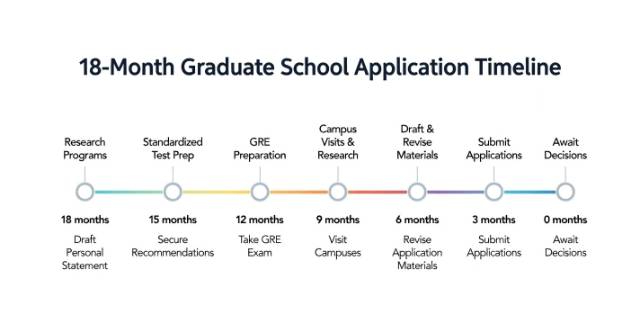
Begin graduate school preparation 12-18 months before intended enrollment with junior year spring semester ideal for researching programs and identifying potential faculty advisors, summer before senior year for studying and taking standardized tests if required, fall senior year for requesting recommendations and drafting personal statements, October through December for submitting applications with most deadlines falling December 1-January 15, and January through April for interviews and admission decisions with funding offers.
Research shows that students starting preparation 12-18 months early achieve 40-50% higher acceptance rates than those beginning 6 months before deadlines, as early preparation allows building relationships with recommenders, researching programs thoroughly, and crafting thoughtful application materials rather than rushed submissions. Studies indicate 73% of successful applicants completed GRE testing 6+ months before applications, allowing adequate preparation time and retake opportunities if needed, while last-minute test takers demonstrate lower scores and limited flexibility for improvement.
1. 18-12 Months Before Applications (Junior Spring/Summer)
Key activities:
- Research graduate programs, identifying 10-15 potential schools
- Investigate faculty research interests and recent publications
- Assess whether GRE or other standardized tests are required
- Identify professors for recommendation letters, cultivate relationships
- Seek research opportunities or independent study projects
- Attend graduate school information sessions or fairs
Program research priorities:
- What specific faculty members align with your research interests?
- What recent publications or projects come from the program?
- What funding packages do they typically offer?
- What are recent graduates doing (academic jobs, industry positions)?
- What's the program culture and student satisfaction?
Research shows students researching 10-15 programs initially narrow to 6-8 final applications after thorough investigation, with preliminary research preventing wasted application fees on poor-fit programs while ensuring the application list includes reach, target, and safety options.
2. 12-9 Months Before Deadlines (Summer Before Senior Year)
Critical tasks:
- Take the GRE or required standardized tests
- Attend summer research programs if possible
- Draft preliminary personal statement outlining research interests
- Update CV with recent experiences and accomplishments
- Visit programs if feasible, connecting with faculty and students
- Begin identifying specific research questions or interests
GRE preparation:
- Study 2-3 months for optimal score improvement
- Take practice tests under timed conditions
- Consider prep courses if diagnostic scores are significantly below targets
- Schedule test allowing retake time if scores are disappointing
- Remember, many programs now waive GRE requirements
Studies indicate 68% of test takers who dedicate 60+ hours to structured GRE preparation improve scores by 8-12 points compared to unprepared takers, making summer testing optimal for allowing adequate preparation without competing with fall semester coursework.
3. 9-6 Months Before Deadlines (Fall Semester Senior Year)
Primary focus:
- Finalize the application list of 6-8 programs
- Request recommendation letters from faculty (3-4 recommenders)
- Draft and revise personal statements tailored to each program
- Prepare writing samples if required
- Order transcripts from all institutions attended
- Register for application portals, track requirements
Recommendation letter strategy:
- Ask recommenders 6-8 weeks before the first deadline
- Provide CV, draft personal statement, and program information
- Explain why you're applying to graduate school and your career goals
- Remind recommenders of specific courses or projects you completed
- Send polite reminders 2 weeks before deadlines
Research shows applicants who request recommendations 6-8 weeks before deadlines receive substantially stronger letters than those requesting 2-3 weeks before, as adequate time allows recommenders to write thoughtful, detailed assessments rather than rushed, generic letters completed under deadline pressure.
4. 3-0 Months Before Deadlines (October-December Senior Year)
Final preparation:
- Complete all application forms and essays
- Customize personal statements for each program
- Proofread materials multiple times, get feedback from mentors
- Submit applications 1-2 weeks before deadlines
- Follow up, ensuring recommendation letters are submitted
- Prepare for potential interviews
Application submission strategy:
- Submit applications 1-2 weeks before deadlines, avoiding technical issues
- Save PDF copies of all submitted materials
- Track submission confirmations and missing materials
- Respond promptly to any admissions office requests
- Prepare for interviews if programs require them
Studies indicate applications submitted well before deadlines (1-2 weeks early) demonstrate organizational skills and seriousness valued by committees, while last-minute submissions risk technical problems and create an impression of poor planning, with 23% of last-day submissions experiencing technical issues, causing missed deadlines.
How Do You Write Compelling Personal Statements?
Write compelling personal statements by articulating specific research interests demonstrating knowledge of field rather than vague career goals, explaining how particular program and faculty align with research agenda showing thorough program research, connecting past experiences to future research goals through coherent narrative, demonstrating intellectual maturity and critical thinking about field questions, maintaining focus on academic and research interests rather than personal hardships unless directly relevant, and tailoring each statement to specific program highlighting relevant faculty, resources, and opportunities.
Research shows personal statements discussing specific faculty research and potential collaborations receive 60-70% higher ratings than generic statements applicable to multiple programs, as specificity demonstrates genuine interest and program fit valued by admissions committees. Studies indicate effective personal statements are 2-3 pages (500-750 words typically) balancing brevity with adequate detail, with longer statements testing readers' patience while shorter statements lack necessary depth for strong evaluation.
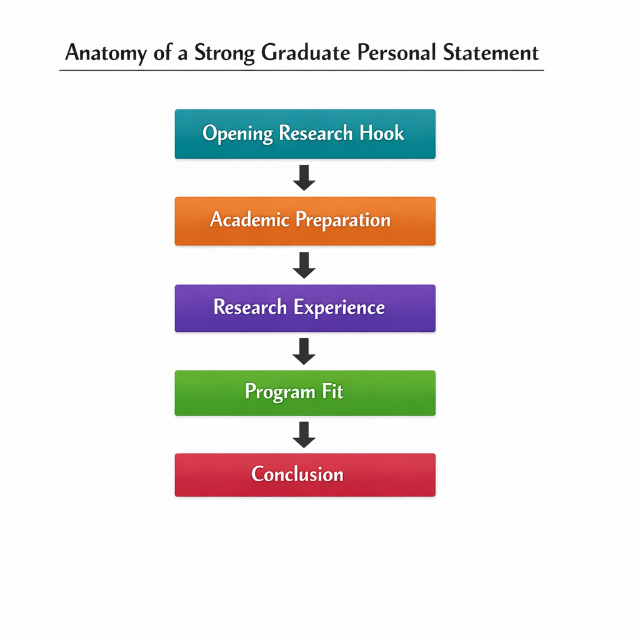
1. Essential Personal Statement Elements
Effective structure:
Opening paragraph (100-150 words):
- Hook capturing attention through a research question or an intellectual puzzle
- Clear statement of research interests and graduate school goals
- Preview of what statement will cover
Middle paragraphs (300-500 words):
- Academic preparation and relevant coursework
- Research experiences describing specific contributions and findings
- How experiences shaped current research interests
- Intellectual development and evolving questions in your field
Program fit paragraph (100-150 words):
- Specific faculty whose work aligns with your interests
- Program resources, labs, or opportunities attracting you
- How does your research agenda fit the program's strengths
- What you'd contribute to the program community
Closing paragraph (50-100 words):
- Restate research goals and readiness for graduate work
- Articulate long-term career aspirations
- Express enthusiasm for the program
When managing multiple personal statement drafts for different programs alongside senior coursework becomes overwhelming during critical application season, an essay writing service can handle undergraduate assignments, allowing dedicated focus on crafting compelling graduate application materials that directly determine admission outcomes, rather than dividing attention between routine coursework and career-defining applications.
2. What to Include vs. Avoid
Strong content:
- Specific research questions you want to explore
- Faculty members whose work interests you, and why
- Research experiences with concrete details and outcomes
- Intellectual challenges or puzzles motivating your field of interest
- How does your perspective or background enrich research
- Relevant skills, methodologies, or training you've acquired
Content to avoid:
- Generic statements applicable to any program or field
- Excessive personal history or hardship narratives
- Writing about why you deserve admission
- Flowery language or trying to sound overly academic
- Repeating information available elsewhere in the application
- Negative comments about past programs or experiences
Research shows personal statements focusing 70-80% on academic and research content with 20-30% on program fit outperform those emphasizing personal narratives or general career aspirations, as committees evaluate intellectual preparation and research potential primarily with personal background relevant only when directly informing research perspective or interests.
How Do You Secure Strong Recommendation Letters?
Secure strong recommendations by cultivating relationships with 3-4 faculty members who know your academic work deeply through multiple courses or research supervision, requesting recommendations 6-8 weeks before deadlines allowing adequate writing time, providing comprehensive materials including CV, personal statement draft, and program information helping recommenders write detailed letters, selecting recommenders who can speak specifically to research abilities and graduate school readiness rather than generic academic performance, following up politely ensuring timely submission, and thanking recommenders appropriately for their time and effort supporting your applications.
Research shows recommendations from faculty who supervised research or thesis work outperform those from professors who only taught courses, with research supervisor recommendations rated 40-50% stronger in admissions committee evaluations due to deeper assessment of research capabilities and intellectual independence. Studies indicate students who provide recommenders with comprehensive background materials receive 30-40% more detailed and specific letters compared to those simply requesting recommendations without supporting information helping recommenders craft compelling narratives.
1. Selecting the Right Recommenders
Ideal recommenders:
- Faculty who supervised your thesis or independent research
- Professors who taught you in multiple advanced courses
- Research lab supervisors who observed sustained work
- Faculty in your field who know current graduate programs
- Professors who can assess specific competencies relevant to graduate work
Red flags:
- Professors who barely remember you despite good grades
- Instructors from large lecture courses with minimal interaction
- Recommenders who seem hesitant or suggest you ask others
- Non-academic references unless explicitly requested
- Faculty who agree but ask you to draft the letter
Recommendation hierarchy for committees:
- Research supervisor with deep knowledge of your work (strongest)
- A professor who taught multiple advanced courses with substantial interaction
- Thesis or capstone project advisor
- A professor from a relevant advanced course where you excelled
- Work supervisor only if applying to professional programs specifically requesting
Research shows committees heavily weigh recommendation source credibility and detail level, with letters from prominent faculty in the field or those demonstrating close working relationships significantly strengthening applications regardless of enthusiastic language, while generic letters from any source fail to distinguish candidates even when technically positive.
2. Requesting Recommendations Effectively
Request components:
- Ask personally (in person or video call) before email confirmation
- Provide 6-8 weeks' notice before the first deadline
- Explain graduate school goals and why you're applying
- Share CV, draft personal statement, unofficial transcript
- List programs with deadlines in an organized spreadsheet
- Describe courses taken or research completed with recommender
- Explain what you hope they might emphasize
Email template structure:
"Dear Professor [Name], I'm applying to [number] graduate programs in [field] for fall [year] admission, and I would be honored if you would write a letter of recommendation supporting my applications. [Brief explanation of why you're asking them specifically, referencing courses or research together.] My primary research interests focus on [brief description], and I'm particularly excited about [specific programs or faculty]. I've attached my CV, draft personal statement, and list of programs with deadlines for your reference. I understand this is a significant time commitment, so please let me know if you're comfortable providing a strong recommendation or if you'd suggest I ask someone else. The first deadline is [date], with others following through [date]. Thank you for considering my request." |
Studies show professors appreciate clear deadline information, comprehensive background materials, and explicit permission to decline if they can't write strong letters, with recommendations written by genuinely enthusiastic faculty significantly outperforming those by pressured recommenders who felt obligated to agree despite reservations.
What Are Common Graduate School Application Mistakes?
Common application mistakes include applying to poorly researched programs without genuine interest or fit resulting in weak personal statements and obvious lack of program knowledge, requesting generic recommendation letters from faculty who barely know you rather than cultivating relationships with potential recommenders throughout college, writing generic personal statements applicable to multiple programs instead of tailoring materials demonstrating specific program research and faculty fit, submitting materials at deadlines risking technical issues rather than 1-2 weeks early allowing buffer time, neglecting to proofread materials thoroughly with 73% of applications containing spelling or grammar errors undermining professionalism, and underestimating total application costs of $800-1500 for test fees, application fees, and transcript requests.
Research shows 67% of rejected applicants with competitive credentials failed due to poor fit demonstration or generic application materials rather than inadequate qualifications, with admissions committees eliminating candidates who clearly mass-applied without program-specific research. Studies indicate applicants who apply to 6-8 carefully selected programs achieve 40-50% higher acceptance rates than those applying to 12-15 programs with less tailored materials, as quality and specificity outperform quantity in graduate admissions where fit matters significantly.
1. Mistake 1: Poor Program Research and Fit
Applying to programs without understanding specific faculty, research, or culture creates weak applications lacking a compelling fit narrative.
Insufficient research signs:
- Can't name specific faculty whose work interests you
- Don't understand the program's research strengths or focus areas
- Unable to explain why this program is over similar alternatives
- Generic personal statement with program name swapped
- No knowledge of recent graduate placements or funding
Thorough research includes:
- Reading recent publications from 2-3 faculty of interest
- Understanding the program's theoretical or methodological orientation
- Knowing typical funding packages and time-to-degree
- Reviewing recent graduate dissertations and current placements
- Exploring program culture through current student perspectives
Research shows admissions committees can immediately identify insufficient research through generic statements lacking program-specific details, with 82% of committee members reporting they eliminate applications demonstrating obvious lack of genuine interest or program knowledge regardless of credential strength.
2. Mistake 2: Weak or Generic Personal Statements
Personal statements rehashing resume information or expressing general career goals without research specificity fail to distinguish candidates.
Weak statement characteristics:
- "I've always wanted to study [field]" opening
- Excessive focus on personal history unrelated to research
- Generic praise of program reputation without specifics
- No faculty names or research areas mentioned
- Vague future goals without concrete research questions
Strong statement characteristics:
- Opens with a specific research question or intellectual puzzle
- Connects experiences to evolving research interests coherently
- Names the specific faculty and explains the research connection
- Demonstrates field knowledge and current questions
- Articulates a clear but flexible research agenda
Studies show personal statements mentioning specific faculty research and potential collaborations receive ratings 2-3 points higher (on 10-point scales) than those with equivalent credentials but generic content, as specificity signals genuine interest and program research valued by committees selecting students who'll thrive in their specific environment.
3. Mistake 3: Last-Minute Preparation
Starting the application process 3-4 months before deadlines creates rushed materials, inadequate test preparation, and generic recommendations.
Last-minute consequences:
- Test scores below potential due to inadequate preparation
- Generic recommendation letters from faculty without deep knowledge
- Weak personal statements lacking revision and feedback
- Technical issues on deadline day with no buffer time
- Missed opportunities for program visits or faculty contact
Timeline advantages:
- 12-18 months of preparation allows relationship cultivation with recommenders
- Summer testing provides retake opportunities without academic pressure
- Multiple personal statement revisions with mentor feedback
- Thorough program research identifying best-fit options
- Reduced stress, spreading tasks across an extended timeframe
Research indicates applicants starting 12+ months early demonstrate 40-50% higher acceptance rates than those beginning 3-6 months before deadlines, with early preparation correlating strongly with application quality across all components from test scores to recommendation letters to personal statement depth.
Key Takeaways
Successful graduate school applications require strategic planning, thorough research, and compelling materials demonstrating fit:
- Begin preparation 12-18 months before intended enrollment, allowing adequate time for program research, test preparation, relationship building with recommenders, and thoughtful application material development rather than rushed submissions
- Competitive applications require GPAs above 3.5, preferably 3.7,+ for strong candidacy, research experience demonstrating intellectual curiosity and capability, three strong faculty recommendations providing detailed competency assessment, and compelling personal statements articulating specific research interests and program fit
- Apply to 6-8 carefully researched programs, balancing reach, target, and safety options, with tailored materials demonstrating thorough program research and genuine fit rather than generic applications to many programs
- Personal statements should focus 70-80% on research interests and academic preparation, with 20-30% on program-specific fit, including faculty whose work aligns with your interests, avoiding excessive personal narrative or generic career aspirations
- Common mistakes include poor program research resulting in weak fit demonstration, requesting generic recommendations from faculty who barely know you, last-minute preparation creating rushed, inferior materials, and insufficient proofreading, undermining professionalism
Graduate admissions emphasize fit between your interests and program strengths over credentials alone, making program research and tailored applications critical for success. The 40-50% higher acceptance rates for applicants starting preparation 12-18 months early versus 3-6 months before deadlines justify early planning, allowing quality application development.
Strong applications tell coherent stories connecting past experiences, current interests, and future research goals while demonstrating how specific programs provide ideal environments for your intellectual development. The investment in thoughtful, tailored applications for carefully selected programs outperforms mass applications to many programs without genuine fit or interest.
When managing multiple graduate applications alongside senior year coursework creates an unsustainable workload during critical application season, a trusted essay writing service can handle undergraduate assignments, allowing dedicated focus on crafting compelling graduate application materials that determine admission outcomes and future career trajectories, rather than compromising application quality to maintain grades during temporary peak demand periods.