Why Are Traditional Essays Being Challenged as Assessment Tools?
Traditional essays face increasing scrutiny because they measure limited skill sets and don't reflect how people actually work in professional environments. Essays primarily assess written communication and analytical thinking, valuable skills, but not comprehensive measures of competence.
Research from the National Education Association shows that 82% of employers prioritize collaboration, problem-solving, and digital literacy over pure writing ability. Traditional essays fail to evaluate these competencies. When students spend four years writing papers in isolation, they graduate unprepared for team-based projects, presentations, and multimedia communication that dominate modern workplaces.
The rise of AI writing tools has intensified this challenge. According to a 2025 study, 34% of students have used AI assistance for essay assignments, making it harder for educators to assess genuine understanding versus technological support. This doesn't mean students are cheating—it reflects how writing has evolved. Just as calculators changed math assessment, AI tools are forcing educators to reconsider what they're actually measuring.
Traditional essays also create equity concerns. Students who struggle with written expression due to learning differences, language barriers, or socioeconomic factors may understand material deeply but perform poorly on essay-based assessments. A Stanford University study found that 41% of students with high content knowledge received lower grades due to writing mechanics rather than conceptual understanding.
The time lag between submission and feedback presents another limitation. Essays typically take 7-14 days for grading, delaying learning opportunities. Modern assessment methods using technology can provide immediate feedback, allowing students to adjust their understanding while the material remains fresh.
These factors don't invalidate essays—they remain excellent tools for developing argumentation and synthesis skills. However, relying exclusively on essays creates an incomplete picture of student competency. That's why educators are embracing trusted essay writing services as supplements while developing broader assessment strategies.
What Assessment Methods Are Replacing Traditional Essays?
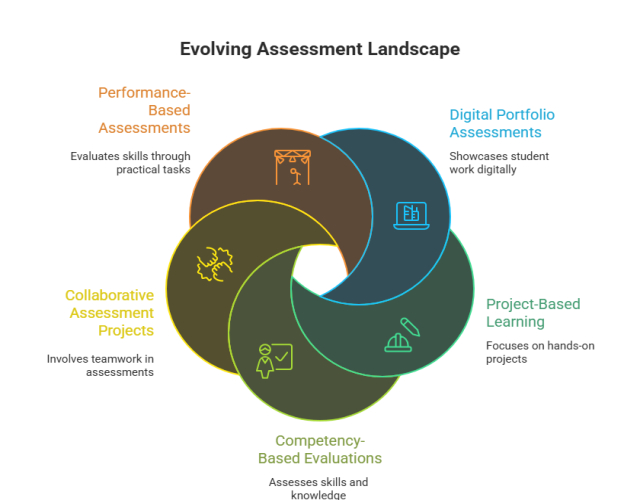
Five major alternative assessment formats are gaining prominence in academic institutions worldwide:
1. Digital Portfolio Assessments
Portfolios compile diverse work samples demonstrating growth over time. Students curate their best projects, reflections, and artifacts into digital showcases. According to research from the American Association of Colleges and Universities, 56% of universities now incorporate portfolio requirements in at least some programs.
Portfolios offer several advantages: they show progress rather than single-moment performance, allow students to demonstrate skills across multiple formats, and create tangible career resources. Medical schools, for instance, increasingly require portfolios documenting clinical experiences, research projects, and community service rather than relying solely on written case analyses.
2. Project-Based Learning Assessments
Students tackle complex, real-world problems over extended periods, presenting solutions through various media. A 2024 meta-analysis of 94 studies found that project-based learning improved knowledge retention by 31% compared to traditional assessment methods.
These projects mirror professional work. Engineering students design sustainable housing solutions. Business students develop marketing campaigns for actual nonprofits. Literature students create podcasts analyzing themes across multiple texts. The assessment focuses on process, problem-solving, and final product quality rather than a single written document.
3. Competency-Based Evaluations
This approach measures specific, clearly defined skills rather than time spent in class. Students advance by demonstrating mastery, regardless of how long it takes. Western Governors University pioneered this model, and over 600 institutions now offer competency-based programs.
Competency assessments use rubrics defining performance levels for each skill. Students receive detailed feedback on which competencies they've mastered and which need work. This precision helps both students and educators identify exactly where learning gaps exist.
4. Collaborative Assessment Projects
Group projects with peer evaluation components assess teamwork, communication, and collective problem-solving. Research from the Collaborative for Academic, Social, and Emotional Learning shows that students in collaborative assessments develop 24% stronger interpersonal skills than those assessed individually.
Modern collaborative assessments include individual accountability mechanisms, each team member's contribution is tracked and evaluated separately. Digital tools allow instructors to monitor participation levels, ensuring fair assessment of individual effort within group contexts.
5. Performance-Based and Practical Assessments
These evaluations require students to demonstrate skills through action. Nursing students complete clinical simulations. Business students pitch to panels. Computer science students build functioning applications. A 2025 survey found that 71% of STEM programs now include substantial performance-based assessment components.
Performance assessments directly measure what students can do rather than what they can write about. This alignment with real-world expectations makes these evaluations particularly valuable for career preparation.
How Is Artificial Intelligence Transforming Academic Assessment?
AI is revolutionizing both how assessments are created and how they're evaluated, fundamentally changing the assessment landscape within just two years.
Automated Grading Systems
AI grading tools can now evaluate not just multiple-choice questions but also short-answer responses, code submissions, and even longer written work. According to EdTech Magazine, 43% of higher education institutions use some form of AI-assisted grading as of 2025.
These systems provide immediate feedback, allowing students to revise and resubmit work while concepts remain fresh. Research from MIT shows that students receiving AI-powered instant feedback improved performance by 18% compared to traditional delayed grading cycles.
However, AI grading has limitations. While effective for factual accuracy and technical correctness, AI struggles with nuance, creativity, and argumentation quality. Most institutions use hybrid models where AI handles initial review and human instructors evaluate higher-order thinking.
Adaptive Assessment Platforms
These systems adjust question difficulty based on student responses, efficiently identifying each student's competency level. Similar to how streaming platforms recommend content, adaptive assessments personalize the evaluation experience.
Khan Academy's adaptive assessments have demonstrated 27% faster skill mastery compared to fixed-sequence testing. Students aren't frustrated by questions too easy or overwhelmed by those too difficult—the system finds their optimal challenge level.
AI-Powered Plagiarism and Originality Detection
Modern AI detection extends beyond traditional plagiarism checking. Tools like GPTZero and Turnitin AI Detection identify AI-generated content, though with limitations. Current detection accuracy ranges from 65-85% depending on content type and AI model used.
This cat-and-mouse game between AI writing tools and detection systems is pushing assessment away from take-home essays toward supervised assessments or formats where AI assistance is explicitly permitted and properly cited. Universities are revising academic integrity policies to address this reality.
Personalized Learning Pathways
AI analyzes student performance across multiple assessments to identify learning gaps and recommend targeted resources. A 2024 study of 15,000 students using AI-powered learning platforms showed 34% improvement in areas where students previously struggled.
These systems don't replace instructors but augment their capabilities, providing data-driven insights about each student's needs. Teachers can then focus their time on high-impact interventions rather than administrative assessment tasks.
Natural Language Processing for Feedback
Advanced NLP systems provide detailed, actionable feedback on writing assignments. Rather than simple grammar checking, these tools analyze argument structure, evidence quality, and logical consistency.
Students using AI feedback tools show 22% improvement in revision quality according to research from Stanford's Graduate School of Education. The key is that AI supplements rather than replaces human feedback—students receive immediate technical guidance while instructors focus on conceptual and creative development.
The integration of AI into assessment raises important questions about authenticity and learning. When students can generate essays with AI assistance, what should assessments actually measure? This question drives the shift toward demonstration-based, process-focused, and collaborative assessment methods that are harder to automate and more reflective of real-world skills.
What Are the Benefits and Challenges of Alternative Assessment Methods?
The shift away from traditional essays offers significant advantages but also introduces implementation difficulties that institutions must navigate carefully.
Key Benefits:
Improved Engagement and Motivation
Students demonstrate 41% higher engagement levels in alternative assessment formats, according to the Journal of Educational Psychology. When assessments connect to real-world applications and allow creative expression, students invest more effort.
Projects, presentations, and portfolios give students ownership over their learning. Instead of writing papers they perceive as meaningless exercises, students create work they're genuinely proud to showcase.
Better Alignment with Career Skills
The National Association of Colleges and Employers identifies these top skills employers seek:
- Teamwork
- Communication
- Problem-solving
- Technical proficiency
Alternative assessments develop these competencies directly, while traditional essays primarily strengthen written communication.
Students completing portfolio programs report 28% more confidence in job interviews because they have concrete work samples to discuss. This tangible evidence of capability resonates more with employers than grade transcripts alone.
More Inclusive Evaluation
Alternative assessments accommodate diverse learning styles and abilities. Visual learners excel in multimedia presentations. Kinesthetic learners thrive in performance-based assessments. Students with writing disabilities can demonstrate knowledge through alternative formats.
Research from the Center for Applied Special Technology shows learning differences impact assessment scores 33% less in multi-format evaluation systems compared to essay-only assessments.
Immediate and Actionable Feedback
Digital assessments and performance evaluations often provide faster feedback than traditional essays. Students see results within hours or days rather than weeks, allowing timely course correction.
This rapid feedback loop accelerates learning. Studies show students receiving immediate feedback retain information 26% better than those waiting for delayed essay grades.
Major Challenges:
- Scalability and Resource Requirements
Grading 50 essays takes less time than evaluating 50 portfolios or supervising 50 individual presentations. Alternative assessments are resource-intensive, particularly for large classes.
A survey of 800 instructors found that alternative assessments require 47% more grading time on average. Universities must invest in teaching assistants, grading rubrics, and technology infrastructure to make these methods feasible at scale.
- Standardization Difficulties
Traditional essays, despite their limitations, offer relatively consistent evaluation criteria. Alternative assessments introduce variability—how do you fairly compare a video presentation to an infographic to a community project?
Developing detailed rubrics helps, but subjectivity increases with format diversity. Two instructors might grade the same essay similarly but evaluate a creative project quite differently. This inconsistency concerns stakeholders accustomed to standardized metrics.
- Technology Access Barriers
Digital portfolios and online collaborative projects assume students have reliable technology access. According to 2024 data, 17% of college students lack consistent internet access at home, while 11% don't own laptops suitable for multimedia creation.
Institutions must address these equity issues through equipment lending programs and on-campus technology access. Otherwise, alternative assessments risk disadvantaging students based on economic factors rather than academic ability.
- Faculty Training Needs
Most educators learned through traditional essays and teach that way. Implementing alternative assessments requires substantial professional development. A 2025 survey found that 62% of instructors feel inadequately trained in designing and evaluating alternative assessments.
Universities must invest in faculty development programs, providing workshops, mentoring, and teaching resources. This investment takes time and money, slowing adoption rates.
- Student Adjustment Period
Students conditioned to essay-based assessment often struggle initially with alternative formats. They're uncertain about expectations, worried about technological requirements, and sometimes resistant to unfamiliar evaluation methods.
This transition requires clear communication, detailed instructions, and practice opportunities. Institutions report that student performance typically improves after one or two semesters once students adapt to new formats.
Despite these challenges, 78% of institutions surveyed report that benefits outweigh difficulties once systems are established. The key is thoughtful implementation rather than wholesale abandonment of traditional methods.
How Can Students Succeed in This Evolving Assessment Landscape?
Adapting to diverse assessment formats requires strategic approach changes. Here's how students can thrive:
Develop Digital Literacy Skills
- Master tools beyond word processors.
- Learn presentation software (PowerPoint, Prezi, Canva)
- Learn video editing basics (iMovie, Adobe Premiere)
- Learn collaborative platforms (Google Workspace, Microsoft Teams).
According to LinkedIn's 2025 Workplace Learning Report, digital fluency ranks among the top three skills employers value.
Most universities offer free workshops on these tools. Take advantage early in your academic career rather than scrambling when a project requires unfamiliar software.
Build Portfolio Habits Early
- Don't wait until portfolio requirements appear.
- Start collecting your best work from day one.
- Save excellent papers, project reports, presentations, and creative work with organized file naming systems.
- Create a simple digital portfolio platform using free tools like Google Sites or WordPress.
- Add 3-5 pieces each semester with brief reflections explaining what you learned.
By graduation, you'll have a comprehensive showcase requiring minimal last-minute effort.
Embrace Collaborative Skills
- Group projects aren't going away—they're increasing.
- Develop reliability, communication, and conflict resolution skills.
- Use project management tools like Trello or Asana for group work.
- Document your contributions clearly.
Research shows that 89% of students who actively develop teamwork strategies report more positive group experiences. These practices both improve project outcomes and provide evidence of your individual effort if evaluation issues arise.
Understand AI's Role
- Learn when and how AI assistance is appropriate.
- Many institutions now permit AI use with proper citation and transparency.
- Focus on using AI as a brainstorming and editing tool rather than a content generator.
- Develop prompt engineering skills—the ability to get useful output from AI systems. This competency is valuable professionally and academically.
The key is maintaining authentic understanding and original thinking even when using technological support.
Seek Clarification on Rubrics
- Alternative assessments often use detailed rubrics defining evaluation criteria.
- Study these carefully before starting work.
- If expectations are unclear, ask instructors for clarification or examples of exemplary work.
Understanding exactly what's being measured allows you to focus effort effectively. Students who thoroughly review rubrics before beginning projects score an average of 15% higher according to assessment research.
Practice Diverse Communication Formats
- Don't limit yourself to writing.
- Practice explaining concepts verbally, creating visual presentations, and demonstrating physical skills.
- Record yourself presenting and identify improvement areas.
- Join clubs requiring various communication formats—debate teams, theater groups, and podcast productions.
These experiences build confidence and competency across assessment types.
Leverage Support Resources
- Most universities offer writing centers, tutoring services, and essay writing services for traditional assignments.
- They're also expanding support for alternative formats with presentation coaching, portfolio development assistance, and project planning guidance.
Don't hesitate to use these resources. They're designed to help you succeed across all assessment types, not just essays.
Manage Time Differently
- Alternative assessments often unfold over weeks rather than consisting of single submission deadlines.
- Break large projects into smaller milestones with personal deadlines well before official due dates.
- Portfolio development, collaborative projects, and performance preparations require sustained effort rather than last-minute cramming.
Students who create detailed timelines report 31% less stress and higher-quality final products.
What Does Research Say About Assessment Effectiveness?
Extensive research over the past decade provides evidence about which assessment methods most effectively promote learning and measure competency.
Learning Retention Rates
A 2023 meta-analysis examining 127 studies found significant differences in long-term retention:
- Traditional essays: 64% retention after 6 months
- Project-based assessments: 81% retention after 6 months
- Portfolio-based learning: 77% retention after 6 months
- Performance assessments: 83% retention after 6 months
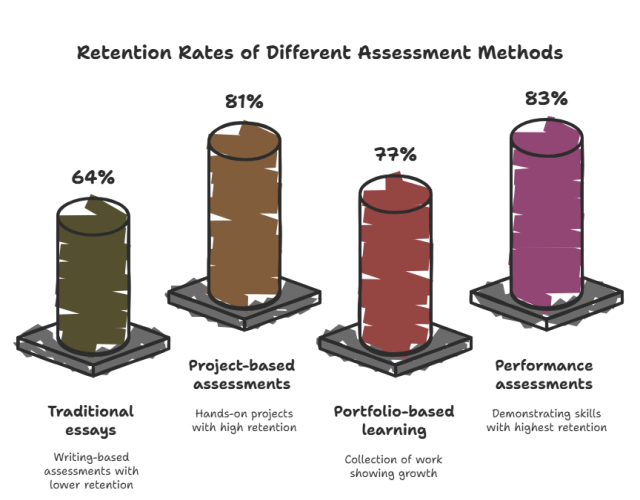
Students remember what they actively create, present, and apply more than what they passively write about.
Skills Transfer to Professional Settings
Employers report that graduates assessed primarily through alternative methods demonstrate 37% stronger practical problem-solving abilities in workplace settings. However, these same graduates sometimes struggle with formal business writing—a reminder that essays still serve important purposes.
The most successful programs combine multiple assessment types, ensuring students develop both traditional academic skills and contemporary competencies.
Student Stress and Well-being
Interestingly, research shows mixed results on stress levels. Some studies indicate that alternative assessments reduce anxiety by offering multiple ways to demonstrate knowledge. Other research suggests that unfamiliarity with alternative formats initially increases student stress.
The pattern that emerges:
Stress decreases as students gain experience with diverse assessment methods. First-time portfolio or presentation assignments cause anxiety, but by the second or third experience, students report feeling more comfortable than with traditional essays.
Equity Outcomes
Assessment diversity particularly benefits first-generation college students and those from underrepresented backgrounds. When Georgetown University implemented portfolio requirements alongside traditional exams, the achievement gap between first-generation and continuing-generation students decreased by 19%.
Alternative assessments reduce the advantages that come from economic privilege—expensive test prep, private tutoring, and family members familiar with academic writing conventions.
Grade Distribution Patterns
Alternative assessments typically produce wider grade distributions than traditional essays, which often cluster in the B/C range. This spread means excellent work receives higher recognition while deficient work is more clearly identified.
For students concerned about grades, this cuts both ways—exceptional effort yields higher rewards, but insufficient work is less forgiving. The solution is engaging fully with the assessment process rather than relying on formula-driven essay techniques.
Conclusion: Preparing for Assessment Evolution
The future of academic assessment embraces diversity over uniformity. Here are the essential takeaways:
- Assessment methods are expanding, not replacing, essays remain valuable alongside portfolios, projects, performances, and collaborative evaluations
- AI is transforming both assessment creation and evaluation, requiring students to develop technological literacy while maintaining authentic learning
- Alternative assessments better align with professional skills employers prioritize, including teamwork, problem-solving, and multimedia communication
- Success requires adaptability—students who develop competency across multiple assessment formats position themselves for both academic and career success
- Equity improves when institutions offer diverse ways to demonstrate knowledge, accommodating varied learning styles and abilities
The assessment landscape will continue evolving. Rather than resisting change, focus on building versatile skills that translate across formats. Develop digital literacy, collaborative abilities, and communication competencies that serve you regardless of the evaluation method.
Traditional essays taught valuable lessons about structured thinking and persuasive writing. Alternative assessments add dimensions of creativity, practical application, and teamwork. Together, they create a more comprehensive education than either approach alone.
As you navigate this evolving landscape, remember that assessment exists to promote learning, not merely measure it. Engage authentically with diverse evaluation methods, seek support when needed from professors, peers, or legit essay writing service services, and view each assessment as an opportunity to develop skills that extend far beyond any single grade.
The future of academic assessment isn't about making education easier, it's about making evaluation more meaningful, more equitable, and better aligned with the complex demands of modern professional life.