Why Has Fact-Checking Become More Critical for Students?
The information environment has transformed dramatically in just five years, making fact-checking an essential survival skill rather than an optional academic exercise.
The AI Content Explosion
Generative AI tools produce millions of articles, images, and videos daily. According to research from MIT's Media Lab, AI-generated content comprises approximately 31% of all new online content as of 2025, up from just 8% in 2023. Much of this content appears authoritative but contains subtle inaccuracies, fabricated statistics, or entirely fictional "facts."
Students encounter AI-generated textbook summaries, fake research papers, and synthetic images that seem authentic. Traditional red flags like poor grammar and obvious bias no longer reliably identify false information. AI generates content that passes surface-level scrutiny, requiring deeper verification methods.
Social Media as Primary Information Source
A Pew Research study found that 64% of students aged 18-24 use social media as their primary news source, surpassing traditional media for the first time. TikTok, Instagram, and Twitter clips rarely provide full context, frequently misattribute sources, and spread information faster than fact-checkers can verify it.
Viral content reaches millions within hours. By the time fact-checkers debunk false claims, the misinformation has already shaped opinions and appeared in student papers. Students who don't verify social media information before citing it submit papers built on viral falsehoods.
Sophisticated Misinformation Campaigns
Misinformation has evolved from obviously fake news to sophisticated operations using legitimate-looking websites, fabricated expert credentials, and manufactured consensus. The Stanford Internet Observatory documented over 200 coordinated misinformation networks in 2024, many specifically targeting academic audiences.
These operations create fake research institutes, publish pseudo-scientific papers, and generate thousands of social media accounts that amplify false narratives. Students researching controversial topics encounter this manufactured consensus, believing they've found multiple independent sources when they've actually found one source with many faces.
Academic Integrity Expectations
Universities have dramatically increased fact-checking requirements. Professors now routinely verify citations, check source credibility, and use specialized tools to evaluate the reliability of student references. A 2025 survey of 1,500 professors found that 78% now deduct significant points for citing unreliable sources, even if the rest of the paper demonstrates strong analysis.
This represents a shift from previous decades when citation format mattered more than source quality. Today's rubrics explicitly evaluate information literacy and source verification alongside traditional writing criteria.
Real-World Consequences
Poor fact-checking doesn't just affect grades—it has real consequences. Students who graduate without strong verification skills struggle professionally. A LinkedIn survey found that 82% of employers consider fact-checking and information literacy among their top five desired skills for new hires.
Medical students who don't verify drug information put future patients at risk. Journalism students who don't fact-check become sources of misinformation. Business students who base strategies on unverified market data make costly recommendations. Every field requires these skills, making them foundational rather than discipline-specific.
Students working with trusted essay writing services should ensure these services prioritize source verification and fact-checking, as this reflects the professional standards expected in academic writing.
What Are the Essential Fact-Checking Techniques for 2025?
Professional fact-checkers use specific techniques that students can learn and apply within minutes. These methods go far beyond simply checking if a website looks legitimate.
1. Lateral Reading: The Gold Standard
Lateral reading means leaving a source immediately to investigate it elsewhere rather than reading deeply within the source itself. This technique proved 93% more effective than traditional evaluation methods in Stanford research.
Here's how it works: When you encounter a new source, don't evaluate it by reading its "About" page or assessing its design. Instead, open new tabs and search for information about the source from independent parties. What do other sources say about this organization? Who funds it? What's its track record?
Professional fact-checkers spend 30 seconds on the original source and 3-5 minutes investigating it laterally. Students typically do the opposite—spending 10 minutes reading an unreliable source without ever verifying its credibility. This wastes time and builds arguments on shaky foundations.
Practical application: Before citing any source, open three new browser tabs. Search "[source name] + bias," "[source name] + credibility," and "[source name] + funding." If you find controversy, funding from interested parties, or patterns of unreliability, find alternative sources.
2. Source Triangulation
Never rely on a single source for any important claim, especially surprising or controversial information. Verify through at least three independent sources using different methodologies or perspectives.
Independent means truly separate—not three websites all citing the same original source. According to the International Fact-Checking Network, 67% of misinformation spreads through citation chains where dozens of sources reference one unreliable original without independent verification.
How to triangulate effectively:
- Find one mainstream media report
- Find one academic or expert analysis
- Find one primary source (original data, document, or statement)
If you can't find three genuinely independent sources confirming a claim, treat it as unverified. This doesn't mean it's false—just that you haven't adequately verified it for academic use.
3. Reverse Image Search
Images lie constantly. Photos get cropped to remove context, dated images illustrate current events, and AI generates increasingly realistic fake photos. Reverse image searching reveals when and where images originally appeared.
Tools like Google Lens, TinEye, and Bing Visual Search let you upload or link images to find other instances online. A 2024 analysis found that 41% of viral social media images either misrepresent their context or come from entirely different events.
Example: A photo claiming to show recent protest violence might actually be from a different country, different year, or different event entirely. Reverse image search reveals the truth in seconds.
4. Date and Context Verification
Information loses validity over time. Medical studies get superseded by new research. Economic statistics become outdated. Legal precedents change. Students frequently cite "recent" information that's actually 5-10 years old.
Check publication dates on everything. For scientific claims, verify that newer research hasn't contradicted or refined the findings. For statistics, ensure the data timeframe matches your claim. For news events, confirm the date aligns with your context.
AI-generated content often includes fabricated dates or misattributes old information to recent time periods. Always verify timestamps independently, not just by what the source claims.
5. Cross-Referencing Citations
When sources cite research, experts, or data, verify those citations lead to real sources that actually say what's claimed. A shocking 2025 study found that 34% of citations in popular online articles either lead to nonexistent sources or misrepresent what the original source stated.
Click through to original sources. Read the abstract or relevant sections yourself. Confirm the cited source actually supports the claim. This catches:
- Fake citations to nonexistent research
- Real citations that say something different than claimed
- Out-of-context quotes that misrepresent original meaning
- Studies that have been retracted or discredited
6. Domain and URL Analysis
Sophisticated misinformation sites often use URLs designed to confuse. They register domains like "CBSnews-daily.com" (not CBS), "time.com.co" (not Time Magazine), or "harvardresearch.info" (not Harvard).
Look carefully at the actual domain, not just the name that appears in links. Check the domain registration date using WHOIS lookup—newly registered domains (less than a year old) claiming to be established news sources are red flags.
Be especially suspicious of:
- Unusual domain extensions (.com.co, .info, .buzz)
- Domains mixing legitimate brand names with extra words
- Hyperpartisan language in domain names themselves
- Sites lacking clear organizational information
7. Author Verification
Real experts have digital footprints. Before citing someone as an authority, verify their credentials through independent sources. Search their name plus their institution. Check if they're actually affiliated where claimed. Review their publication history and qualifications.
AI-generated fake experts proliferate online. These "authorities" have profiles, headshots (AI-generated faces), and impressive credentials—all fabricated. They appear on sophisticated-looking sites that manufacture credibility.
Real experts typically have:
- University or institution faculty pages
- Peer-reviewed publication records
- Speaking engagement histories
- Professional association memberships
- Multiple independent references across years
8. Statistical Literacy and Number Sense
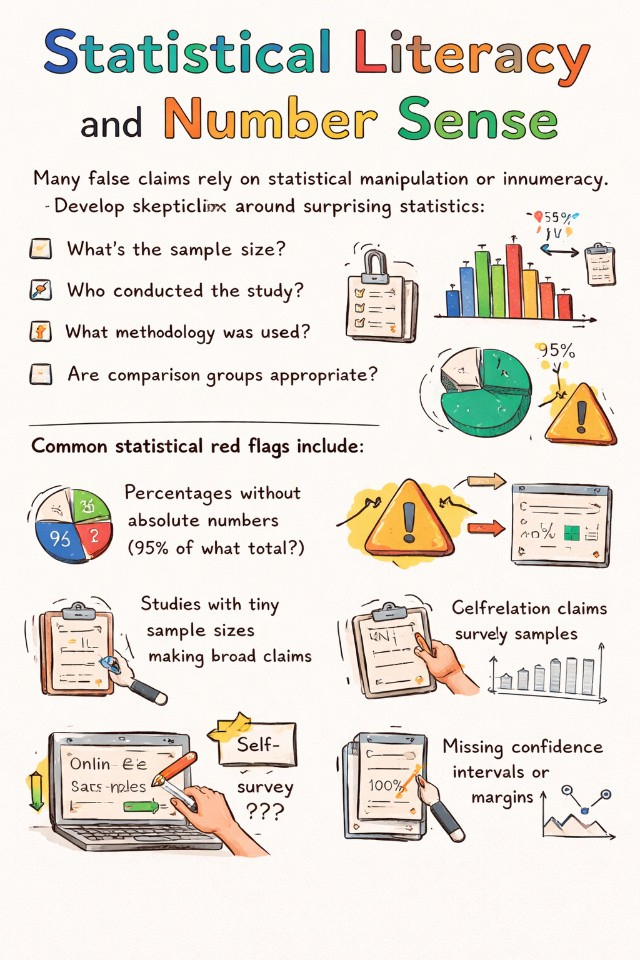
Many false claims rely on statistical manipulation or innumeracy. Develop skepticism around surprising statistics. Ask: What's the sample size? Who conducted the study? What methodology was used? Are comparison groups appropriate?
Common statistical red flags include:
- Percentages without absolute numbers (95% of what total?)
- Correlation claimed as causation
- Studies with tiny sample sizes making broad claims
- Self-selected survey samples
- Missing confidence intervals or error margins
How Can Students Identify AI-Generated Misinformation?
AI-generated content presents unique challenges requiring specific detection strategies beyond traditional fact-checking.
Recognizing AI-Generated Text Patterns
While AI writing improves constantly, certain patterns remain detectable. AI-generated academic content often exhibits:
- Overly balanced tone: AI typically presents multiple perspectives equally, even on settled questions, creating false balance. Real expert writing shows clear positions based on evidence.
- Lack of specific examples: AI often makes general claims without the detailed, specific examples human experts naturally include. Compare "Studies show effectiveness" (AI-typical) to "The 2023 Johnson et al. study at Northwestern demonstrated 67% improvement in the treatment group" (human-typical).
- Temporal inconsistencies: AI sometimes confuses timelines, referring to future events in past tense or describing things as "recent" that occurred years ago. Its training data cutoffs create knowledge gaps it fills with plausible-sounding fabrications.
- Citation hallucinations: AI frequently invents realistic-sounding sources that don't exist. It generates author names, journal titles, and publication years that seem authentic but reference nonexistent research. Always verify citations independently.
Detection Tools and Their Limitations
AI detection tools like GPTZero, Originality.ai, and Turnitin AI Detection achieve 70-85% accuracy under ideal conditions. However, they produce false positives and false negatives regularly, making them imperfect screening tools.
Use these tools as one factor among many rather than definitive judgments. They're most reliable when:
- Text is longer than 250 words
- Content is in English
- Writing style is fairly formal
They're least reliable with:
- Short passages
- Multiple languages mixed
- Heavily edited AI content
- Technical or specialized writing
Verification Strategy for Suspected AI Content
When you suspect AI-generated misinformation, apply this systematic approach:
- Cross-reference claims: Check if other independent sources confirm key claims
- Verify citations: Confirm cited sources exist and say what's claimed
- Check author credentials: Verify the author is real and actually wrote the piece
- Look for primary sources: Find original research, data, or statements rather than aggregated content
- Assess specificity: Note whether content includes specific details AI typically omits
AI-Generated Images and Video
Visual misinformation grows more sophisticated but still shows detectable flaws. AI-generated images often have:
Anatomical impossibilities: Extra fingers, asymmetrical faces, impossible body proportions, especially in hands and complex structures
Inconsistent lighting: Light sources that don't match across different elements within the same image
Background anomalies: Nonsensical text, melted or distorted objects in backgrounds, and surreal architectural elements
Lack of compression artifacts: Real photos accumulated online show compression artifacts from multiple saves and resizes. AI-generated images often look too "clean"
Temporal metadata issues: Check image metadata for creation dates. AI-generated images claiming to show historical events have creation timestamps after the supposed event date
Tools like AI or Not, Illuminarty, and Hive Moderation help detect AI-generated images, though like text detectors, they're imperfect. The most reliable approach combines multiple verification methods rather than depending on single tools.
Deepfake Video Detection
Video deepfakes require more sophisticated detection but show consistent patterns:
- Unnatural eye blinking or no blinking
- Inconsistent lighting on face versus background
- Audio-visual synchronization issues
- Edge artifacts around the face
- Unusual skin texture or coloring
Universities increasingly train students in deepfake detection as these videos become tools for spreading misinformation. When encountering surprising video content, especially of public figures making unexpected statements, verify through official sources before accepting as factual.
What Tools and Resources Simplify Fact-Checking?
Technology provides powerful shortcuts for verification, though tools supplement rather than replace critical thinking.
Browser Extensions
- NewsGuard: Rates news and information websites based on credibility and transparency criteria. Shows red, yellow, or green ratings directly in search results and social media feeds. Covers over 8,500 news and information sites.
- Official Media Bias Chart Extension: Displays media bias and reliability ratings from Ad Fontes Media directly in your browser, helping evaluate source positioning and credibility.
- InVID Verification Plugin: Specialized for video verification, offering reverse video search, metadata extraction, and fragmentation for checking video authenticity.
- Fact-Check Explorer Extension: Shows fact-checks from verified organizations directly when browsing, alerting you when you encounter previously debunked claims.
Research Databases and Academic Tools
- Google Scholar Alerts: Set alerts for key topics to receive notifications when new peer-reviewed research publishes, ensuring you work with current academic consensus.
- PubMed: For health and medical claims, this database provides access to peer-reviewed medical literature, helping verify health-related information.
- Connected Papers: Visualizes research connections, showing how papers relate to each other and helping identify the most influential research in a field.
- Retraction Watch Database: Searches over 40,000 retracted papers, catching when students cite discredited research.
Specialized Fact-Checking Websites
- Snopes: Best for urban legends, viral claims, and social media rumors. Extensively documents claim origins and provides detailed analyses.
- FactCheck.org: Focuses on political claims, government statements, and policy assertions. Run by the Annenberg Public Policy Center at the University of Pennsylvania.
- PolitiFact: Uses the Truth-O-Meter rating system for political claims. Particularly useful for verifying statements by public figures.
- Science Feedback: Specifically evaluates scientific claims in media coverage, useful for STEM-related research projects.
- Full Fact (UK) and AFP Fact Check (International): Excellent resources for international fact-checking beyond U.S.-centric services.
Image and Video Verification Tools
- Google Lens and TinEye: Reverse image search to find original sources and contexts for images.
- InVID/WeVerify: Comprehensive video verification tool analyzing metadata, thumbnails, and source authentication.
- FotoForensics: Analyzes image compression levels, revealing edited or manipulated sections within photos.
AI Detection Platforms
- GPTZero: Free tool detecting AI-generated text, useful for verifying if sources might be AI-created.
- Originality.ai: More comprehensive plagiarism and AI detection, though requires subscription.
- Content at Scale AI Detector: Analyzes text for AI patterns with detailed probability scores.
Citation Management Tools
- Zotero: Beyond organizing citations, Zotero helps track source details and verify you're citing accurately.
- Mendeley: Similar citation management with verification features and academic networking.
- Citation Machine: Checks citation formats and helps locate original source details.
News Aggregators with Verification
- Ground News: Shows how different news outlets cover the same story, revealing bias and helping find the most neutral reporting.
- AllSides: Presents news from left, center, and right perspectives, helping understand how different outlets frame stories.
Tool Integration Strategy
Don't use every tool for every source—that's impractical. Develop a tiered approach:
- Tier 1 (Quick Check - 30 seconds): NewsGuard rating, domain check, author verification
- Tier 2 (Standard Verification - 2-3 minutes): Lateral reading, citation verification, reverse image search if images present
- Tier 3 (Deep Verification - 5-10 minutes): Cross-reference through multiple fact-checking sites, verify through academic databases, check research connectivity
Apply Tier 1 to all sources. Use Tier 2 for anything you'll cite substantially. Reserve Tier 3 for controversial claims, surprising statistics, or information central to your argument.
How Should Students Fact-Check Different Content Types?
Different information formats require specialized verification approaches. Generic fact-checking misses format-specific manipulation techniques.
Social Media Content
Social media presents unique challenges—speed, brevity, and decontextualization make verification difficult but essential.
Verification process:
- Screenshot and note timestamp immediately (content often disappears)
- Check account verification status and history
- Search for the claim across multiple platforms
- Look for original source beyond social media
- Verify images/videos haven't been taken out of context
Red flags:
- Accounts created recently but claiming breaking news
- Identical posts across multiple accounts (coordinated campaigns)
- Lack of specifics (no names, dates, locations)
- Emotional manipulation ("Share before they delete this!")
- Missing source attribution
Academic Papers and Research
Even peer-reviewed research requires verification. Predatory journals, retracted papers, and preliminary findings all circulate online.
Verification process:
- Confirm journal legitimacy through directory listings (DOAJ for open access)
- Check paper hasn't been retracted via Retraction Watch
- Verify author affiliations and credentials independently
- Assess sample size and methodology appropriateness
- Check if findings have been replicated or contradicted by subsequent research
- Note whether it's preliminary, pre-print, or peer-reviewed
Evaluation criteria:
- Sample size adequate for claims made
- Methods clearly described and appropriate
- Conflicts of interest disclosed
- Data availability for verification
- Citation by other researchers (more citations suggest validation)
News Articles
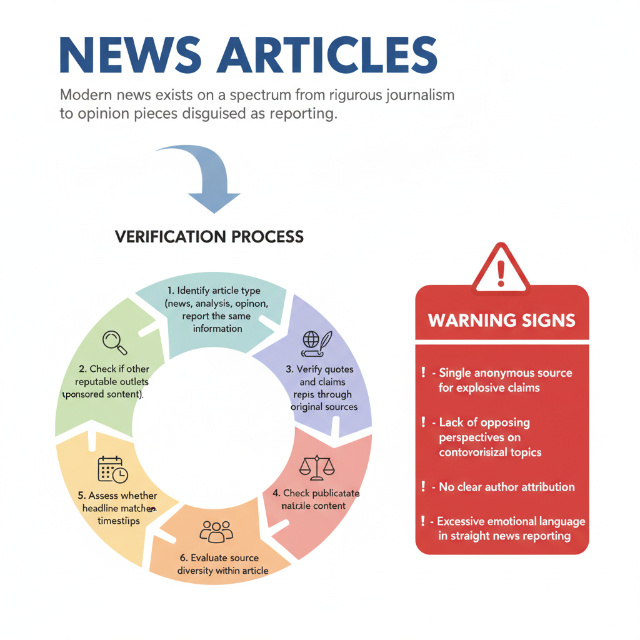
Modern news exists on a spectrum from rigorous journalism to opinion pieces disguised as reporting.
Verification process:
- Identify article type (news, analysis, opinion, sponsored content
- Check if other reputable outlets report the same information
- Verify quotes and claims through original sources
- Assess whether headline matches article content
- Check publication date and update timestamps
- Evaluate source diversity within the article
Warning signs:
- Single anonymous source for explosive claims
- Lack of opposing perspectives on controversial topics
- Headline contradicts article content
- No clear author attribution
- Excessive emotional language in straight news reporting
Statistics and Data Visualizations
Numbers mislead easily through selective presentation, inappropriate comparisons, or mathematical manipulation.
Verification process:
- Find original data source, not secondary reporting
- Check sample size and methodology
- Verify appropriate comparison groups
- Assess whether visualization scale misleads
- Confirm percentages calculate correctly from given numbers
- Check if absolute numbers provided alongside percentages
Common manipulations:
- Y-axis truncation making small differences appear dramatic
- Cherry-picked time frames excluding contrary data
- Comparing incomparable groups
- Relative versus absolute risk confusion
- Simpson's paradox (trends in subgroups reverse when combined)
Expert Commentary and Opinion
Distinguishing genuine expertise from manufactured authority requires specific verification.
Verification process:
- Confirm expert credentials through institutional pages
- Check publication record in relevant field
- Verify they're speaking within their expertise area
- Assess whether other recognized experts agree
- Check for conflicts of interest or funding sources
Red flags:
- Credentials in unrelated field
- No institutional affiliation
- Claims contradicting broad expert consensus without extraordinary evidence
- Financial incentives connected to claims
- Lack of peer-reviewed publications
Historical Claims
History gets rewritten constantly on the internet. Verifying historical claims requires accessing reliable historical sources.
Verification process:
- Find primary historical sources (original documents, firsthand accounts)
- Check academic historical databases and peer-reviewed history journals
- Verify through multiple independent historians' analyses
- Assess whether claim represents consensus or fringe interpretation
- Check for anachronistic elements suggesting fabrication
Video and Multimedia Content
Video feels authentic but manipulates easily through editing, context removal, or complete fabrication.
Verification process:
- Reverse search video thumbnails and keyframes
- Check metadata for creation date and location
- Verify audio-visual synchronization
- Look for original upload source
- Cross-reference with news coverage from event date
- Check for environmental consistency (lighting, weather, background details)
What Common Fact-Checking Mistakes Should Students Avoid?
Even diligent students make systematic errors that undermine their verification efforts. Recognizing these patterns helps avoid them.
Confirmation Bias in Source Selection
Students unconsciously seek sources confirming existing beliefs while dismissing contradictory evidence. Research shows that when presented with mixed evidence, students remember 73% of information supporting their thesis but only 41% of contradictory information.
Solution: Intentionally seek sources challenging your position. If you can't find credible opposing arguments, you haven't researched thoroughly. The strongest papers acknowledge and refute counterarguments rather than ignoring them.
Credential Blindness
Impressive-sounding titles or affiliations don't guarantee credibility. "Dr." might reference a PhD in philosophy while making medical claims. "Harvard researcher" might be a janitor who works at Harvard, technically true but misleading.
Solution: Verify specific credentials relevant to the claim. A medical doctor isn't automatically an expert on economic policy. A physicist isn't necessarily qualified to evaluate biological research.
Source Age Neglect
Students cite outdated information without realizing research has evolved. What seemed cutting-edge in 2018 might be superseded or contradicted by 2025 research.
Solution: Set date limits for sources, especially in rapidly evolving fields. Medical research over three years old needs verification that findings still hold. Technology information over one year old often requires updating.
Citation Chain Following
Finding five sources that all say the same thing feels like thorough verification. But if those five sources all cite the same original study or news report without independent verification, you haven't actually verified through five sources—you've verified through one.
Solution: Trace citations to original sources. Ensure your sources represent independent verification, not citation chains.
False Balance Creation
Treating fringe positions equal to scientific consensus creates false balance. If 97% of climate scientists support one position and 3% contradict it, presenting them equally misrepresents reality.
Solution: Assess consensus, not just controversy. When experts overwhelmingly agree, acknowledge minority positions exist without suggesting equal validity.
Tool Over-Reliance
Fact-checking tools provide helpful shortcuts but make errors. Students sometimes accept tool results without applying critical thinking, creating a different form of uncritical acceptance.
Solution: Use tools as first-pass filters, not final arbiters. When tools flag concerns or give surprising results, investigate further manually.
Abstract Reading Only
Students often cite research papers after reading only abstracts. Abstracts summarize but sometimes oversimplify, especially regarding limitations, context, and caveats.
Solution: Read methodology and conclusion sections. Check for limitations sections that qualify claims. Ensure the full paper supports how you're using it.
Logical Fallacy Blindness
Students sometimes verify facts while missing logical fallacies in how those facts connect. True facts arranged with faulty logic create false conclusions.
Solution: Evaluate argument structure separately from fact verification. Can the conclusion logically follow from verified premises? Are there hidden assumptions?
Context Stripping
Facts verified in isolation can mislead when removed from context. A technically accurate statistic might create false impressions without surrounding information.
{{10383}
How Can Students Develop a Healthy Skeptical Mindset?
Fact-checking isn't just a skill set—it's a mindset balancing appropriate skepticism with remaining open to new information.
Constructive Skepticism Principles
- Question proportionally: Extraordinary claims require extraordinary evidence. Routine claims need routine verification. Adjust skepticism to claim magnitude.
- Maintain intellectual humility: Recognize your own knowledge limitations. Being wrong is part of learning, not a character flaw. Update beliefs when better evidence emerges.
- Seek disconfirmation: Actively look for information that might prove you wrong. This approach produces stronger conclusions than only seeking confirmation.
- Separate people from ideas: Critique claims and arguments, not people. Focus on evidence quality rather than source motivation.
- Accept uncertainty: Not everything can be definitively verified. Sometimes the honest conclusion is "insufficient evidence to determine" rather than forced certainty.
Practical Skepticism Habits
The "Three Sources Before Believing" Rule
Before accepting surprising claims as true, find three genuinely independent sources confirming them. This simple habit prevents most misinformation acceptance.
The "Why Would I Believe This?" Question
When encountering new information, ask explicitly: "What evidence supports this claim? How do I know this source is reliable? What might I be missing?" Making questioning habitual rather than occasional strengthens verification instincts.
The "Devil's Advocate" Exercise
For every major claim in your research, write three sentences arguing the opposite position. This forces engagement with counterevidence and strengthens your actual argument by addressing weaknesses.
The "Original Source" Mandate
Whenever possible, go to original sources rather than secondary reporting. Read the actual study, not just news coverage. Watch the full speech, not just quoted excerpts. This habit provides fuller context and reveals when intermediaries misrepresent sources.
The "Emotion Check" Pause
Content designed to manipulate typically triggers strong emotional responses—outrage, fear, excitement. When you feel strong emotions from content, pause before accepting or sharing. Emotional manipulation often accompanies misinformation.
Cognitive Biases to Monitor
Understanding your own cognitive biases helps counteract them:
- Availability heuristic: Overestimating likelihood of events you've recently heard about. Recent viral stories feel more common than they are.
- Dunning-Kruger effect: Overconfidence when you have superficial knowledge. Recognize that reading one article doesn't make you an expert.
- Bandwagon effect: Believing things because many others believe them. Popular isn't the same as true.
- Anchoring bias: Over-relying on first information encountered. Your initial source disproportionately influences interpretation of later sources.
Cultivating Intellectual Curiosity
The best fact-checkers maintain genuine curiosity about how the world works. They want to understand truth more than they want to be right. This mindset shift from ego protection to truth-seeking fundamentally changes how you engage with information.
Read widely across ideological perspectives. Follow experts who disagree with each other. Expose yourself to ideas that make you uncomfortable. Intellectual curiosity thrives on diversity while confirmation bias withers in its presence.
Students developing these habits find that fact-checking transforms from burdensome requirement to intellectual protection—a shield against manipulation and a path toward genuine understanding.
Conclusion: Building Your Fact-Checking Foundation
Fact-checking has evolved from optional skill to fundamental competency in 2025's information landscape. The essential takeaways:
- Lateral reading outperforms deep reading for source evaluation—investigate sources through independent parties rather than accepting self-descriptions
- AI-generated content requires specialized detection beyond traditional verification, including citation verification and cross-referencing
- Different content types need different verification approaches—social media, academic research, news articles, and statistics each have unique manipulation patterns
- Technology provides powerful verification shortcuts but doesn't replace critical thinking—use tools as supplements to systematic verification strategies
- Healthy skepticism balances questioning with openness—question proportionally, maintain intellectual humility, and actively seek disconfirmation
The investment in developing these skills pays immediate dividends through better research papers, higher grades, and professor recognition of your information literacy. Long-term benefits include professional advantages, protection against manipulation, and contribution to a more informed society.
Start small. Choose one verification technique and apply it consistently until it becomes automatic. Then add another technique. Within weeks, systematic fact-checking becomes second nature rather than conscious effort.
Remember that fact-checking isn't about cynically distrusting everything—it's about having confidence in what you believe because you've verified it. This confidence transforms your academic work from uncertain assertions to well-supported arguments built on solid factual foundations.
As you develop these essential skills, use available resources strategically. University writing centers increasingly offer fact-checking workshops and verification assistance. Essay writing services staffed with experienced researchers can demonstrate professional verification techniques while supporting your academic work. Librarians possess specialized expertise in source evaluation and database navigation.
The future belongs to those who can navigate information effectively—distinguishing truth from fiction, recognizing manipulation, and building understanding on verified facts. These fact-checking skills position you for success not just in academia but in every aspect of modern life requiring informed decision-making.
Your ability to verify information determines the quality of decisions you make, arguments you build, and understanding you develop. Make fact-checking not just a skill you use but a habit you embody.