What Is Academic Integrity?
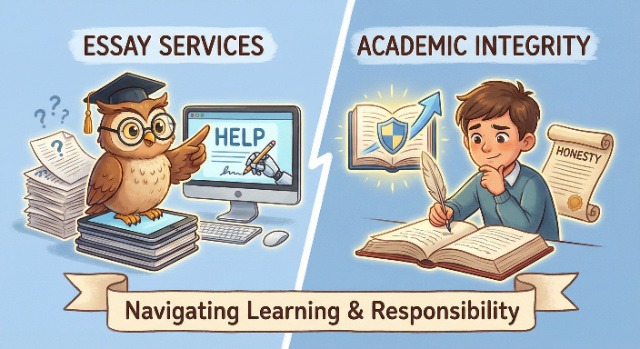
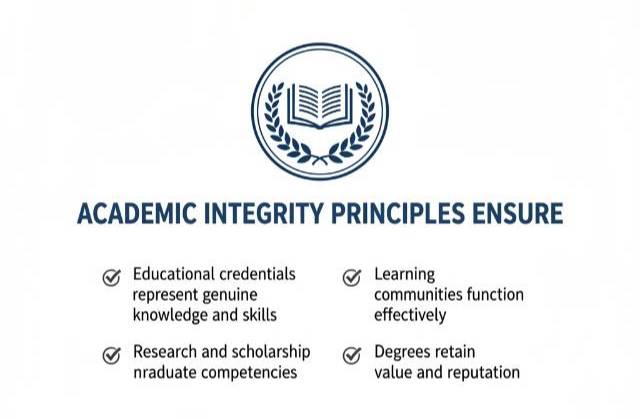
Academic integrity represents the ethical foundation of education, defining standards that preserve educational value and institutional credibility.
The International Center for Academic Integrity defines academic integrity as “a commitment, even in the face of adversity, to six fundamental values: honesty, trust, fairness, respect, responsibility, and courage.”
The Six Core Values
1. Honesty - Students present their own work truthfully, acknowledge sources properly, and represent their abilities accurately. This includes honest self-assessment and transparent communication about capabilities and challenges.
2. Trust - Academic communities function through mutual trust between students, faculty, and administrators. Students trust that the evaluation will be fair; faculty trust that students submit authentic work. Without trust, the entire educational system becomes suspicious and adversarial.
3. Fairness - All community members deserve equal treatment under consistent standards. Students earn grades through equivalent effort and ability. Faculty apply policies uniformly. Administrators create equitable systems.
4. Respect - Members value diverse perspectives, acknowledge others’ intellectual contributions, and maintain courteous professional interactions. Respect includes listening to viewpoints, being prepared, and treating others’ work appropriately.
5. Responsibility - Students accept personal accountability for learning, meeting deadlines, and understanding requirements. Faculty fulfill teaching obligations. Everyone takes ownership of maintaining integrity.
6. Courage - Acting on these values requires courage, especially when facing adversity, peer pressure, or convenient shortcuts. Speaking up about misconduct or admitting mistakes demands bravery.
Why These Values Matter?
Australian higher education defines academic integrity as “the expectation that teachers, students, researchers and all members of the academic community act with honesty, trust, fairness, respect and responsibility.”
How Do Essay Services Challenge Academic Integrity?
An online essay writing service creates multiple integrity challenges when used inappropriately, directly conflicting with foundational academic values.
Contract Cheating Violates Honesty
Submitting purchased work as your own constitutes fundamental dishonesty. You misrepresent:
- Authorship of ideas and arguments
- Your actual capabilities and understanding
- The effort and time invested
- Your engagement with learning
One student’s perspective: “I don’t think it’s cheating because you’re paying someone to write an essay, which they don’t plagiarize.” This logic ignores that the student is plagiarizing by claiming someone else’s work.
Universities universally reject this rationalization. The University of Liverpool states clearly: “Using Essay Mills is a type of academic misconduct” where “someone else completes work for a student (in full or in part) which is passed off by the student as their own work.”
Breaking Trust With Faculty
Essay service usage erodes the trust essential to education: Faculty trust students to submit authentic work reflecting personal effort and understanding. When students betray this trust through purchased submissions, professors:
- Question all student work more skeptically
- Spend valuable time investigating suspected cheating
- Become disillusioned with teaching
- Implement harsher policies affecting honest students
This broken trust transforms educational relationships from collaborative to adversarial, harming entire academic communities.
Creating Unfairness
Contract cheating creates multiple unfairness dimensions:
1. Unfair Advantages - Students purchasing essays gain grades without equivalent effort compared to peers working honestly. This violates fundamental fairness, where evaluation should reflect actual abilities.
2. Grading Inequity - Professors can’t accurately assess true student capabilities when some submit professional work. Grades lose meaning as performance indicators.
3. Competitive Disadvantages - Honest students compete against artificially inflated performance from purchasers, particularly problematic for scholarships, graduate admissions, or competitive programs with limited spots.
4. Economic Inequality - Wealthy students afford premium services while poorer students cannot, creating class-based academic advantages unrelated to merit.
As one policy states: “Illegitimate cooperation can unfairly advantage a student or group of students over others.”
Disrespecting the Academic Community
Using essay services disrespects:
- Faculty who design assignments for learning purposes
- Classmates who complete work honestly
- Alumni whose degrees lose value when integrity declines
- Future employers who hire based on false credentials
- The institution whose reputation suffers
Respect requires acknowledging others’ intellectual contributions. Purchasing essays without attribution disrespects the actual authors while claiming false credit.
Avoiding Responsibility
Academic responsibility means accepting accountability for your learning and performance. Essay service uses outsources this responsibility:
- You don’t engage with the required learning
- You avoid developing necessary skills
- You refuse to face academic challenges
- You prioritize grades over genuine education
As one integrity framework notes: “Students are fair to alumni when they maintain the good reputation of the institution.” Using services irresponsibly damages institutional credibility.
Lacking Courage
Genuine academic integrity “even in the face of adversity” requires courage. Students face pressures, including:
- Overwhelming workloads
- Fear of failing
- Scholarship requirements
- Parental expectations
- Time constraints
Acting with integrity means facing these challenges honestly rather than taking shortcuts.
This might involve:
- Asking professors for help or extensions
- Using legitimate support services
- Accepting lower grades when circumstances limit performance
- Being honest about capabilities
Purchasing essays represents the opposite of courage—avoiding difficulty through deception.
Can Essay Services Ever Align With Academic Integrity?
Despite inherent tensions, essay services can support rather than violate academic integrity when used appropriately within clearly defined boundaries.
Legitimate Use Cases
Reference and Learning Tools
Treating purchased essays as study materials rather than submission content maintains integrity. This approach:
- Studies professional writing as educational examples
- Learns structure, argumentation, and citation methods
- Understands assignment requirements through completed examples
- Develops writing skills through analysis and imitation
One service provider explains: “Papers produced by our writers are created on individual request and serve as good examples of academic papers… Our service is not a source of ready-made papers that students can submit as their own work.”
This usage resembles consulting textbooks or published articles—legitimate academic research.
Understanding Complex Topics
Professional essays help students comprehend difficult material:
- Breaking down complex theories into understandable explanations
- Providing starting points for deeper exploration
- Clarifying confusing assignment requirements
- Offering alternative perspectives on topics
Students then write original papers demonstrating genuine understanding gained through study.
Citation and Format Training
Learning proper citation prevents unintentional plagiarism:
- Studying APA, MLA, or Chicago format examples
- Understanding when and how to cite sources
- Seeing proper quote integration
- Learning reference list construction
This educational use prevents future integrity violations caused by citation ignorance rather than dishonest intent.
Language Support for Non-Native Speakers
International students comprise 74% of essay writing service users. For students who understand content but struggle with English:
- Studying grammatically correct English helps language acquisition
- Understanding academic vocabulary and phrasing
- Learning discipline-specific writing conventions
- Developing comfort with English academic style
However, submitting entire purchased essays doesn’t constitute language learning—only studying and applying lessons does.
Ethical Boundaries Required
For service use to align with integrity, students must:
- Write Original Work: Final submissions must be entirely student-written based on understanding gained from references.
- Disclose When Required: If institutional policies require acknowledging external help, students must disclose honestly.
- Maintain Authorship: Ideas, arguments, and writing must originate from students, not purchased sources.
- Follow Institutional Policies: Some schools prohibit even reference use of essay services. Students must respect these policies.
Service Provider Responsibility
Ethical service providers should:
- Clearly state papers are reference materials
- Discourage submission as student work
- Explain proper ethical usage
- Refuse obviously problematic requests
- Educate students about academic integrity
As one service states: “We strictly refrain students from engaging in academic dishonesty. All our services are in accordance with the updated academic integrity laws.” However, many services market themselves ambiguously or even encourage misuse, complicating students’ ethical decision-making.
What Do Universities Say About Essay Services?
Institutional policies universally condemn contract cheating, while some acknowledge legitimate academic support distinctions.
Universal Prohibition of Contract Cheating
Universities consistently define having others complete work for submission as serious misconduct:
University of Liverpool: “Using Essay Mills is a type of academic misconduct… someone else completes work for a student (in full or in part) which is passed off by the student as their own work.”
Yale University: Considers submission of purchased essays “an especially egregious form of plagiarism” warranting the most serious penalties, including expulsion.
Australian Higher Education: Defines contract cheating as “getting someone else to complete part or all of your work and then submitting the work as if you had completed it yourself.”
These policies extend beyond traditional text plagiarism to encompass any outsourced work, regardless of originality.
Clear Consequences
Institutions impose severe penalties:
- Zero on assignments
- Course failure
- Academic probation
- Suspension (typically one to two semesters)
- Permanent expulsion
- Degree revocation even post-graduation
- Transcript notation affecting future opportunities
One policy framework states: “Students can face a range of penalties for breaching academic integrity… It is often thought that students rarely get caught. Yet research shows teachers and institutions can detect breaches of academic integrity, and students doing the wrong thing do get caught.”
Evolving AI Policies
Recent institutional responses to AI writing tools provide insight into academic integrity thinking:
University of Oxford: “Students can use AI-generated content only for those assessments where prior authorization has been given and they must cite these AI sources in their work.”
UK Universities Generally: In 2025, 155 universities reported proven cases of AI-generated content submission, with 131 updating plagiarism policies specifically for AI detection.
These policies establish that the undisclosed use of any content-generation tool—AI or human constitutes misconduct. The pattern: external assistance requires authorization and attribution.
Recognition of Legitimate Support
Some policies acknowledge appropriate academic help:
- University writing center consultations
- Editing for grammar and clarity (not content)
- Tutoring on concepts and skills
- Peer feedback on drafts
- Faculty office hours guidance
The distinction: these services teach rather than replace student work.
Institutional Responsibility
Universities bear responsibility for an integrity culture:
- Clear Communication: Policies must be explicit, accessible, and consistently applied. Ambiguity creates confusion, enabling rationalizations.
- Support Services: Institutions should provide adequate legitimate help: writing centers, tutoring, mental health services, time management workshops, and language support for international students.
- Fair Assessment: When workloads become unreasonable or assessments are poorly designed, students turn to desperate measures. Institutions must ensure assignments support learning rather than merely measuring it.
- Prevention Over Punishment: The Focus should emphasize developing integrity values rather than solely detecting violations.
As one framework notes: “Universities should raise awareness… utilize technology and establish an institution-wide policy” as part of comprehensive integrity strategies.
How Do Students Justify Using Essay Services?
Understanding student rationales reveals systemic pressures and misconceptions requiring institutional attention beyond simple punishment.
Overwhelming Academic Pressure
A survey of 16,000+ U.S. college students identified overwhelming workloads as the primary reason for service usage. Students describe:
- Multiple demanding courses simultaneously
- Essays constituting 20-80% of semester grades
- Unrealistic deadline clustering
- Part-time work requirements for financial survival
- Family responsibilities conflicting with study time.
One NYU student explained: “I was overwhelmed with my part-time job and coursework. I needed to pass the class, and I couldn’t keep up with the deadlines.” While pressure doesn’t justify cheating, it reveals institutional failures in workload management and student support.
“It’s Not Really Cheating” Rationalization
Many students construct elaborate justifications:
“I’m paying for original work, so it’s mine now.” “The service writes it; I just submit it— that’s not plagiarism.” “Everyone does it, so it’s basically accepted.” “I understand the material; I just can’t write well.” “It’s like hiring a tutor, just more efficient.”
These rationalizations ignore fundamental authorship questions. One student interview reveals this cognitive dissonance: “That’s just a difficult question to answer. I don’t know how to feel about that. It’s kind of like a gray area. It’s maybe on the edge, kind of?”
When pressed, students recognize the ethical problems but feel trapped by circumstances.
Language and Cultural Barriers
International students face unique challenges:
74% of service users are international students struggling with English academic writing. They often:
- Understand course content thoroughly
- Cannot express ideas in proper English
- Fear grades don’t reflect actual knowledge
- Experience cultural differences in academic integrity definitions
Some cultures view collaborative work differently or have less stringent plagiarism concepts, creating genuine confusion about Western academic standards.
While language struggles are real, submitting purchased essays doesn’t constitute language learning. Ethical alternatives include ESL support services, language tutoring, and editing assistance.
Mental Health and Crisis Situations
Students facing crises sometimes view services as survival mechanisms: One Boston College student: “I was struggling with mental health issues and couldn’t bring myself to focus on schoolwork. I used the service to avoid failing while I worked on getting better.”
Depression, anxiety, family emergencies, illness, or trauma genuinely impair academic performance. However, universities offer legitimate accommodations:
- Medical withdrawals
- Incomplete grades with extensions
- Reduced course loads
- Counseling support
- Disability services accommodations
These options maintain integrity while addressing real problems. Essay services provide temporary relief but don’t resolve underlying issues.
Skill Deficits and Writing Anxiety
Some students genuinely struggle with writing: “I’m not a strong essay writer, and my scholarship depends on maintaining a 3.5 GPA.”
Writing anxiety, learning differences, or inadequate preparation create real challenges. However:
- Writing centers teach skills
- Tutors provide personalized instruction
- Practice improves abilities over time
- Professors offer guidance during office hours
Short-term outsourcing prevents the developing essential skills needed throughout careers.
Perceived Low Risk
Many students believe detection is unlikely: “Professors don’t check that carefully.” “Services guarantee Turnitin-proof essays.” “My friend used one and never got caught.”
These perceptions ignore improving detection technology and faculty training. As data shows, two-thirds of professors suspect purchased work, even if only half report it.
What Are Alternative Approaches to Academic Support?
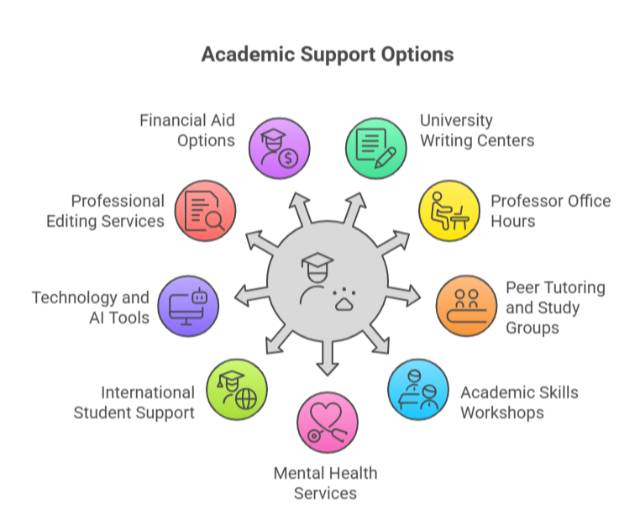
Numerous legitimate resources provide help without compromising integrity, addressing the same pressures driving essay service use.
University Writing Centers
Free campus writing centers offer:
- Individual consultations with trained tutors
- Feedback on drafts at any development stage
- Citation and formatting instruction
- Brainstorming and outlining assistance
- Skill development workshops
Unlike essay services, writing center consultations teach skills enabling future independent work.
Professor Office Hours
Faculty dedicate time specifically to student support:
- Clarifying assignment requirements
- Discussing topic ideas and approaches
- Answering questions about course material
- Reviewing draft sections for guidance
- Providing extension flexibility when warranted
Many students don’t utilize this free, legitimate resource despite its availability.
Peer Tutoring and Study Groups
Collaborative learning with peers maintains integrity:
- Subject-specific tutoring from advanced students
- Study groups discussing course concepts
- Peer review providing feedback on drafts
- Collaborative learning on concepts (not assignments)
The distinction: working together to understand material versus having others complete individual assignments.
Academic Skills Workshops
Institutions offer training on:
- Time management and organization
- Research and source evaluation
- Citation methods and plagiarism avoidance
- Test-taking and exam strategies
- Stress management and wellbeing
These workshops develop capabilities to prevent future struggles requiring external help.
Mental Health and Counseling Services
When psychological challenges impair performance:
- Individual counseling for anxiety, depression, trauma
- Stress management programs
- Crisis intervention services
- Disability services for learning differences
- Medical accommodations for health conditions
Addressing root causes prevents desperate measures.
International Student Support
Specialized services for non-native speakers:
- English language learning centers
- Academic writing for multilingual students
- Conversation practice groups
- Grammar and vocabulary development
- Cultural orientation to academic expectations
These resources help international students develop English proficiency legitimately.
Technology and AI Tools (With Proper Boundaries)
When permitted by instructors:
- Grammar checkers like Grammarly for objective errors
- Citation management tools (Zotero, EndNote)
- Brainstorming with AI (when disclosed and allowed)
- Outline generation for structure ideas
Critical requirement: These tools assist rather than replace your work, and usage must comply with course policies.
Professional Editing Services (Limited Scope) Some legitimate editing services:
- Fix grammar, spelling, and punctuation errors
- Improve sentence clarity and flow
- Ensure consistent formatting
- Verify citation accuracy
Boundary: Editors don’t rewrite content, add ideas, or alter arguments. You maintain complete authorship.
Financial Aid and Reduced Course Load Options
When financial pressure forces excessive work hours:
- Financial aid offices can adjust packages
- Emergency grants for crisis situations
- Reduced course loads, extending graduation
- Part-time enrollment options
Taking longer to graduate with integrity beats rushing with cheating.
Key Takeaways: Balancing Support With Integrity
Essay services create inherent tension with academic integrity principles, but understanding this relationship enables ethical choices supporting genuine learning.
Critical points to remember:
- Academic integrity commits all community members to six fundamental values: honesty, trust, fairness, respect, responsibility, and courage. Contract cheating— submitting purchased work as your own—violates every principle by misrepresenting authorship, betraying trust, creating unfair advantages, disrespecting the community, avoiding responsibility, and choosing easy shortcuts over courageous honesty.
- Universities universally prohibit contract cheating as serious misconduct warranting severe penalties, including expulsion. In 2025, 155 UK universities reported cases, with 131 updating policies for content-generation tools. Policies require students to submit authentic work reflecting personal effort. Even when services are legally available, institutional policies may prohibit their use entirely.
- Essay services can align with integrity only as learning tools when you write completely original submissions after studying purchased materials as references. This requires following institutional policies, disclosing usage if required, maintaining complete authorship, and ensuring that learning rather than outsourcing occurs.
- 83% of students consider using services due to overwhelming pressure, with 74% being international students struggling with English. These motivations reveal systemic issues requiring institutional action: adequate support services, reasonable workloads, mental health resources, and language assistance. However, pressure doesn’t justify violations—integrity requires ethical choices even facing adversity.
- Legitimate alternatives provide equivalent support without integrity risks: writing centers, office hours, tutoring, counseling services, disability accommodations, language support, and professional editing (within boundaries). These resources teach skills enabling future independence rather than creating dependency.
The fundamental tension: Essay services offer tempting shortcuts during pressure, but education’s purpose is to develop capabilities through authentic effort. Integrity isn’t just following rules—it’s committing to values, ensuring your credentials represent genuine competence.
Make Integrity-Based Choices for Lasting Success
Understanding how essay services intersect with academic integrity empowers ethical decision-making that serves long-term interests over short-term relief.
Academic integrity isn’t merely policy compliance—it’s value commitment, ensuring educational experiences build genuine capabilities. When you maintain integrity despite pressure, you develop not only subject knowledge but also character traits—honesty, responsibility, courage—that serve throughout careers and life.
A professional essay writing service can provide legitimate support when used appropriately as a learning tool. The critical question: Does this usage develop your capabilities or replace your learning? Enhancing understanding while you write original work may support integrity. If substituting for your effort, it violates fundamental principles.
Choose support to maintain authenticity. Visit our essay service to learn how professional assistance can enhance learning within ethical boundaries that protect your integrity and academic future.
Your education is an investment in capabilities serving your entire life. Protect that investment by building genuine skills through honest effort. The character you develop through ethical choices proves more valuable than any grade achieved through shortcuts.