-18984.jpg)
The debate intensified as tablets, laptops, and note-taking apps became classroom staples. A 2024 study tracking 2,500 students found that those using only digital notes scored 11% lower on comprehension tests than handwritten note-takers, yet digital note-takers completed assignments 34% faster due to superior organization and search capabilities.
This isn't about choosing one method forever. Understanding each approach's cognitive and practical advantages helps you select the right tool for specific situations. You'll learn the science behind why handwriting aids retention, when digital tools provide clear advantages, and how to combine both methods strategically.

Whether you're taking lecture notes or working with professional essay writing services to develop research papers, understanding these note-taking principles helps you process information more effectively and build stronger knowledge foundations.
What Does Research Say About Handwritten vs. Digital Notes?
Extensive cognitive research reveals significant differences in how note-taking methods affect learning, with implications for academic success.
The Encoding Hypothesis
Handwriting forces cognitive processing that typing doesn't require. When writing by hand, you can't transcribe verbatim—physical speed limitations force you to summarize, paraphrase, and identify key concepts. This "desirable difficulty" strengthens memory formation.
Princeton and UCLA researchers found that students taking laptop notes transcribed lectures 14% more completely but retained 34% less information on conceptual questions one week later. The act of selective summarization during handwriting creates deeper cognitive engagement than passive transcription.
Processing Depth and Retention
Handwriting activates multiple brain regions simultaneously—motor cortex for physical movement, visual cortex for letter formation, and language centers for meaning processing. This multi-sensory engagement creates stronger neural pathways than typing's more automated finger movements.
Brain imaging studies show that handwriting produces 27% more brain activity in memory-related regions compared to typing. This increased activation correlates with better long-term retention, particularly for abstract concepts requiring deep understanding.
Speed vs. Comprehension Trade-off
Research from the University of Washington found that students with more complete digital notes felt more confident about the material but performed worse on application questions requiring conceptual grasp rather than fact recall.
Handwritten vs. Digital Notes
Factor | Handwritten Notes | Digital Notes |
Words per Minute | 13–15 WPM (slower, forces filtering) | 33–38 WPM (fast, near-verbatim capture) |
Note Completeness | Partial but processed; focuses on key ideas | Very complete; captures large amounts quickly |
Retention | Higher retention due to deeper cognitive processing | Lower retention because of surface-level transcription |
Conceptual Performance | Strong performance on application and analysis questions | Weaker performance on conceptual questions despite more notes |
Illusion-of-Learning Risk | Low — fewer notes but more understanding | High — extensive notes create false confidence |
Organization and Retrieval Benefits
Digital notes excel at organization, searchability, and multimedia integration. Students can reorganize content effortlessly, search across thousands of notes instantly, and integrate images, links, and recordings. These features become increasingly valuable as courses accumulate content.
Studies show students using digital note organization systems locate specific information 68% faster than those searching handwritten notebooks. This efficiency advantage compounds over academic careers involving hundreds of lectures and readings.
Context-Dependent Memory Effects
Handwriting creates unique visual memory—you remember where on the page information appeared, distinctive underlines or diagrams, and the physical context of note-taking. Digital notes lack this spatial memory component, making the recall of specific details more challenging.
However, digital notes compensate through superior tagging, linking, and search functions that handwritten notes can't replicate. Students working with trusted essay writing services benefit when they can quickly search notes for relevant information to share with writers rather than flipping through notebooks.
When Should You Use Handwritten Notes?
Certain learning situations and content types particularly benefit from handwriting's cognitive advantages.
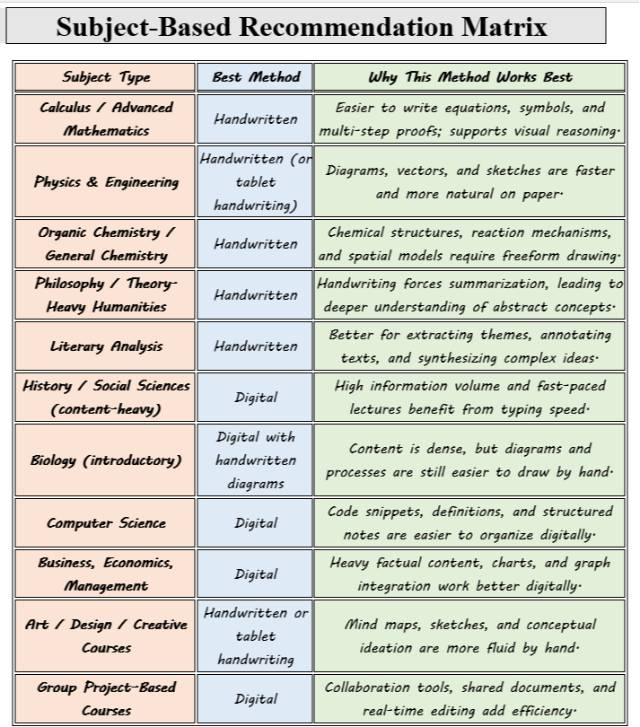
1. Complex Conceptual Material
Use handwritten notes for theoretical concepts, philosophical arguments, abstract mathematics, and any material that requires deep understanding rather than memorizing facts. The forced summarization inherent in handwriting strengthens conceptual grasp.
Subjects like calculus, organic chemistry, philosophy, and literary analysis benefit from handwriting's processing depth. Students' handwriting notes for these subjects show 28% better performance on application and analysis questions.
2. Mathematics and Scientific Notation
Equations, chemical structures, diagrams, and mathematical proofs remain easier to write by hand. While digital equation editors exist, they interrupt flow and slow note-taking. Hand-drawn diagrams capture complex spatial relationships more efficiently than digital tools.
Physics, chemistry, and advanced mathematics courses see students using handwritten notes at twice the rate of other subjects, even among predominantly digital note-takers.
3. Brainstorming and Creative Thinking
Freeform idea generation, mind mapping, and non-linear thinking benefit from handwriting's flexibility. Drawing arrows, circling concepts, and creating visual hierarchies happen more naturally on paper than through digital tools requiring menu selections.
Studies show creative problem-solving sessions produce 41% more novel ideas using handwritten versus digital brainstorming, likely due to reduced cognitive load from tool navigation.

4. Memory-Critical Exams
When preparing for exams that test detailed retention, handwriting study notes strengthens memory formation. The motor memory component of handwriting creates additional retrieval cues unavailable through typed review.
Students who handwrite exam review notes score 15% higher on closed-book exams compared to those reviewing typed notes, though this advantage disappears for open-book assessments where information retrieval matters more than memorization.
5. Distraction-Prone Environments
Paper notebooks eliminate digital distractions. No notifications, no browser tabs, no temptation to check social media. For students struggling with digital self-control, handwritten notes provide distraction-free focus.
Research indicates students using laptops for notes spend 37% of class time on non-academic activities compared to 8% for handwritten note-takers, significantly impacting learning.
When Should You Use Digital Notes?
Digital note-taking provides distinct advantages for specific use cases and learning approaches.
1. High-Volume Information Courses
Lecture-heavy courses covering extensive factual material benefit from typing speed. History surveys, introductory sciences, and overview courses where comprehension matters less than information capture suit digital notes.
Students can type 2.5x faster than handwriting, capturing more complete information for later review. When volume matters more than processing depth, digital wins decisively.
2. Collaborative Projects and Group Work
Digital notes enable real-time sharing, collaborative editing, and integrated feedback. Tools like Google Docs, Notion, or OneNote allow study groups to build collective knowledge bases impossible with handwritten notes.
Students in courses emphasizing group projects report 56% higher satisfaction with digital collaboration tools versus photocopying or scanning handwritten notes.
3. Courses with Multimedia Content
When lectures include slides, videos, or online resources, digital notes integrate these elements seamlessly. Embed images, link to resources, and attach recordings directly in notes. This multimedia integration creates comprehensive study materials.
Students taking courses with significant online components show a 43% preference for digital notes, enabling direct resource linking versus handwritten notes requiring separate resource tracking.
4. Long-Term Reference Materials
Digital notes remain accessible and searchable throughout your academic career and beyond. Search entire note collections instantly, access from any device, and organize across courses and years.
Graduate students and professionals consistently cite searchable note archives as digital note-taking's most valuable long-term benefit, particularly when material from multiple courses connects in later research or work.
5. Organizational System Integration
Digital notes integrate with task managers, calendars, and productivity systems. Link notes to assignments, embed reminders, and create interconnected knowledge systems. This integration streamlines academic workflow beyond what handwritten notes allow.
Students using integrated digital systems report spending 29% less time managing coursework logistics, freeing time for actual studying. Working with reliable essay writing services becomes more efficient when you can instantly share organized digital notes rather than scanning handwritten pages.
What Hybrid Approaches Combine Both Methods?
The most effective strategy often combines handwritten and digital notes, leveraging each method's strengths strategically.
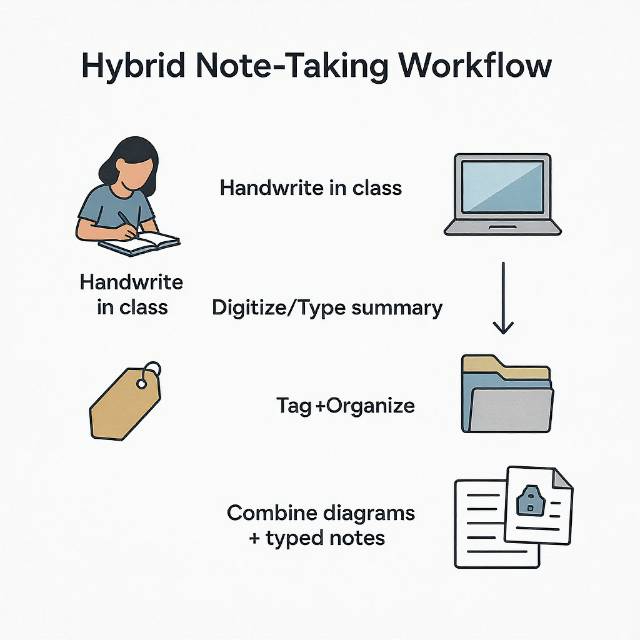
1. Initial Handwriting with Digital Organization
Take handwritten notes during class for better retention, then digitize key points into organized digital systems afterward. This combines processing depth from handwriting with the organizational benefits of digital tools.
Studies show this two-step approach produces 19% better retention than either method alone, though it requires 40% more time investment. Use selectively for the most important courses or challenging material.
2. Digital Notes with Handwritten Supplements
Type main lecture notes digitally but hand-draw diagrams, equations, and concept maps in margins or on tablet devices. This preserves typing efficiency while capturing complex visual information better suited to handwriting.
Students using tablets with styluses for supplementary handwritten content report satisfaction rates 31% higher than those using purely typed notes in STEM courses.
3. The Cornell Method Across Formats
Apply the Cornell note-taking system in either format. Digital or handwritten, divide notes into cue columns, note-taking areas, and summary sections. The structured approach improves retention regardless of medium.
Cornell method users score 24% higher on exams than unstructured note-takers, with similar benefits across handwritten and digital implementations when students follow the system consistently.
4. Strategic Format Selection
Choose format by course and content type: handwrite for conceptual courses, type for fact-heavy courses, use tablets for diagram-intensive subjects, and maintain digital master notes supplemented with handwritten review materials.
Students using strategic format selection based on course requirements report 37% higher confidence in note quality and 22% better exam performance than those using single methods universally.
5. Voice Recording with Written Notes
Record lectures while taking handwritten or typed notes, then review recordings while organizing notes afterward. This ensures complete information capture while maintaining active engagement during class.
However, students relying heavily on recordings without active note-taking show 28% lower retention, indicating that recordings supplement rather than replace active note-taking.
Students working with fast essay writing services can use hybrid approaches to provide comprehensive information—handwritten conceptual understanding plus organized digital facts—giving writers complete context for developing strong papers.
How Can You Maximize Note-Taking Effectiveness?
Regardless of format choice, certain principles improve note-taking across all methods.
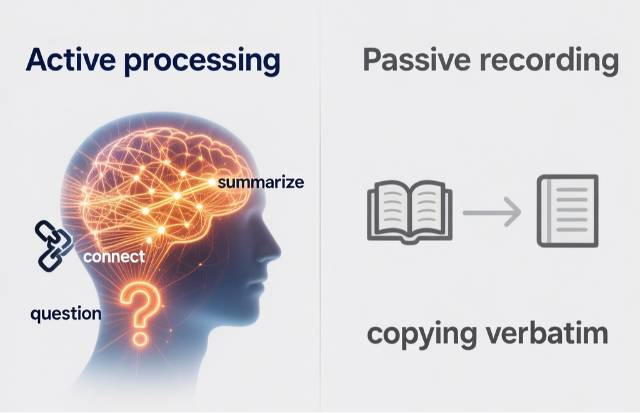
1. Active Processing Over Passive Recording
Summarize in your own words rather than transcribing verbatim. Ask questions, make connections, and identify main concepts. Active engagement matters more than note completeness.
Research consistently shows that students taking fewer, more processed notes outperform those with more extensive but passive notes by 15-20% on conceptual assessments.
2. Immediate Post-Class Review
Review notes within 24 hours, filling gaps and clarifying confusion while the material remains fresh. This review transforms notes from transcription to learning tools.
Students reviewing notes within one day retain 60% more information than those reviewing only before exams. The 10-minute review investment yields a significant return.
3. Systematic Organization
Create consistent organizational systems—dates, topics, course codes. Digital or handwritten, organized notes are usable notes. Disorganized notes become useless regardless of the taking method.
Students with organizational systems locate information 73% faster and report 44% less study stress than those with haphazard note collections.
4. Visual Enhancement
Add color coding, diagrams, and visual hierarchies to both digital and handwritten notes. Visual organization improves recall by creating additional retrieval cues.
Studies show notes with consistent color coding and visual structure produce 18% better retention than plain text notes, even when the content is identical.
5. Connection Building
Link new notes to previous material, related courses, and real-world applications. These connections strengthen memory and deepen understanding beyond isolated facts.
Students who regularly connect notes across lectures and courses demonstrate 31% better synthesis skills on integrative exam questions.
Conclusion: Finding Your Optimal Note-Taking Strategy
The handwritten versus digital debate misses the point—both methods work when used strategically for appropriate situations. Key takeaways:
- Handwritten notes provide 23% better retention for conceptual material through forced summarization and deeper processing
- Digital notes offer superior organization, speed, and searchability for information-heavy courses and long-term reference
- Hybrid approaches combining both methods produce the best results, using each format where it excels
- Active processing matters more than format—summarizing, questioning, and connecting beats passive transcription regardless of method
- Personal learning style and course type should guide format choice rather than universal rules
Experiment with both approaches across different courses. Track which format produces better exam performance, feels more natural for your thinking style, and integrates best with your study habits. The right answer is personal—some students thrive with primarily handwritten notes, others with digital systems, and many with strategic combinations.
Start by using handwritten notes for your most challenging conceptual course and digital notes for your most information-dense course. Compare your engagement, retention, and performance. Adjust based on results rather than assumptions about which "should" work better.
Note-taking is a tool for learning, not an end in itself. Whether handwritten or digital, effective notes actively process information, organize content logically, and facilitate later review. Master the cognitive principles of good note-taking—active processing, organization, and review—and you'll succeed regardless of format choice.