
What Are the Highest Paying College Majors in 2025?
The highest-paying college majors in 2025 are dominated by engineering and computer science fields, with petroleum engineering, computer engineering, chemical engineering, electrical engineering, and computer science consistently leading all majors for starting salary averages in the $80,000-$95,000 range.
These fields combine high demand, specialized skills requiring advanced education, and direct economic value creation that employers willingly compensate.
Top 15 Highest-Paying Major Categories (Approximate 2025 Starting Salary Ranges)
STEM Fields (Science, Technology, Engineering, Math):
Petroleum Engineering: $88,000-$95,000+
- Mid-career: $140,000-$160,000+
- Very low unemployment (under 3%)
- Note: Declining job growth due to renewable energy transition
Computer Engineering: $85,000-$92,000
- Mid-career: $130,000-$145,000
- Low unemployment (around 2-3%)
- Steady demand across industries
Chemical Engineering: $82,000-$88,000
- Mid-career: $125,000-$135,000
- Low unemployment (around 2-3%)
- Strong pharmaceutical and biotech demand
Electrical Engineering: $80,000-$87,000
- Mid-career: $120,000-$135,000
- Low unemployment (around 2-4%)
- Consistent demand across sectors
Computer Science: $80,000-$88,000
- Mid-career: $130,000-$150,000+
- Low unemployment (around 3%)
- Explosive growth in AI, cybersecurity, cloud computing
Aerospace Engineering: $78,000-$85,000
- Mid-career: $115,000-$130,000
- Low unemployment (around 2-3%)
- Growing commercial space industry
Software Engineering: $78,000-$86,000
- Mid-career: $125,000-$145,000
- Low unemployment (around 3%)
- Very high job growth across industries
Industrial Engineering: $75,000-$82,000
- Mid-career: $110,000-$125,000
- Low unemployment (around 3%)
- Strong manufacturing and logistics demand
Mechanical Engineering: $75,000-$82,000
- Mid-career: $105,000-$120,000
- Low unemployment (around 3%)
- Broad applications across industries
Data Science/Analytics: $75,000-$82,000
- Mid-career: $120,000-$140,000
- Low unemployment (around 3-4%)
- Rapid expansion across all sectors
Business and Finance:
Finance: $62,000-$70,000
- Mid-career: $90,000-$105,000
- Moderate unemployment (around 4-5%)
- Strong investment banking/corporate finance sectors
Accounting: $60,000-$68,000
- Mid-career: $80,000-$95,000
- Moderate unemployment (around 4%)
- Steady demand for CPAs
Economics: $58,000-$66,000
- Mid-career: $88,000-$100,000
- Moderate unemployment (around 4-5%)
- Versatile across industries
Healthcare:
Nursing (BSN): $60,000-$68,000
- Mid-career: $80,000-$95,000
- Very low unemployment (under 2%)
- Strong aging population demand
Health Sciences: $56,000-$64,000
- Mid-career: $75,000-$90,000
- Low unemployment (around 3-4%)
- Growing healthcare industry
These salary ranges represent national averages; actual earnings vary significantly by region, company size, and individual performance. Major tech hubs like San Francisco or Seattle often pay 40-60% above national averages, while smaller markets pay 20-30% below these figures.
Why Do These Majors Pay More?
High-paying majors share common characteristics explaining premium compensation:
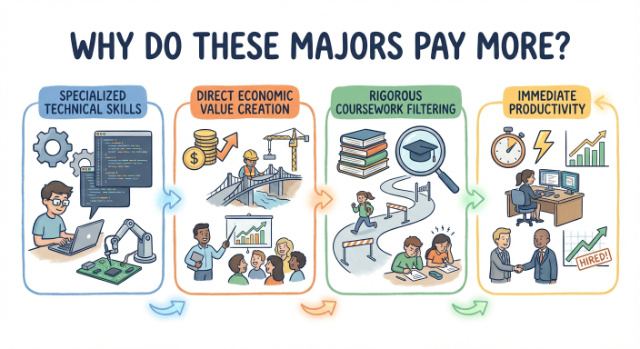
Specialized technical skills: Engineering and computer science require advanced mathematics, physics, and problem-solving abilities that fewer people possess. Limited supply drives higher wages.
Direct economic value creation: These fields solve expensive problems for organizations. A software engineer creating automation tools that save millions annually easily justifies six-figure compensation.
Rigorous coursework filtering: Difficult major requirements limit graduate supply. Approximately 40-50% of students who start engineering programs complete them, creating talent shortages that boost wages.
Immediate productivity: Technical majors produce job-ready graduates requiring minimal training. Many liberal arts majors need additional skill development before reaching full productivity.
How Do Liberal Arts and Humanities Majors Compare for Earnings?
Liberal arts and humanities majors typically start at significantly lower salaries (generally $38,000-$52,000 range) but offer greater career flexibility, with English, history, and philosophy majors working across diverse industries while engineering graduates concentrate in technical fields.
The earnings gap persists throughout careers but narrows for top performers who leverage transferable skills effectively.
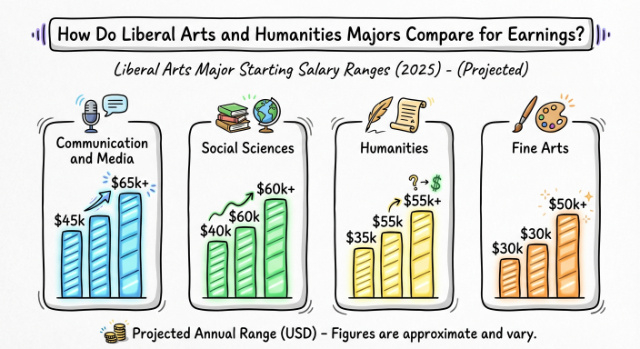
Liberal Arts Major Starting Salary Ranges (2025)
Communication and Media:
Advertising/Marketing: $48,000-$55,000
- Mid-career: $68,000-$80,000
- Requires a strong portfolio and networking
- Variable by company size and location
Journalism: $38,000-$45,000
- Mid-career: $55,000-$68,000
- Declining print, growing digital opportunities
- Geographic clustering in major metros
Public Relations: $44,000-$52,000
- Mid-career: $62,000-$75,000
- Corporate roles pay significantly more than agency roles
Social Sciences:
Psychology: $40,000-$48,000
- Mid-career: $52,000-$65,000 (without graduate degree)
- Graduate degrees required for clinical careers ($75,000-$90,000+)
- A bachelor's alone limits career options
Political Science: $42,000-$50,000
- Mid-career: $65,000-$80,000
- Government and policy careers boost earnings
- Law school common pathway for higher earnings
Sociology: $38,000-$46,000
- Mid-career: $52,000-$65,000
- Social services and research primary pathways
- Graduate education is common for advancement
Humanities:
English: $40,000-$48,000
- Mid-career: $58,000-$72,000
- Writing and editing skills are valuable across sectors
- Publishing careers are competitive but lower-paying
History: $38,000-$46,000
- Mid-career: $56,000-$70,000
- Education and research are common pathways
- Law school frequently for higher earnings
Philosophy: $42,000-$50,000
- Mid-career: $65,000-$80,000
- Strong critical thinking is valued in consulting, law
- Among liberal arts leaders for mid-career earnings
Fine Arts:
Visual Arts: $35,000-$42,000
- Mid-career: $48,000-$60,000
- Portfolio quality and entrepreneurship are critical
- High variability based on commercial vs. fine art focus
Music: $36,000-$43,000
- Mid-career: $50,000-$62,000
- Performance careers are highly competitive
- Teaching primary stable pathway
Salary Comparison Table: Top 20 Highest-Paying Major Categories 2025
| Rank | Major Category | Entry-Level Median (0-2 yrs) | Mid-Career Median (10+ yrs) | Growth Potential | Top Specializations | Key Industries |
|---|---|---|---|---|---|---|
| 1 | Computer & Information Sciences | $92,000 | $158,000 | Very High | AI/ML, Cybersecurity, Quantum Computing | Tech, Finance, Healthcare Tech |
| 2 | Engineering | $78,000 | $142,000 | High | Petroleum, Computer, Electrical, Nuclear | Energy, Tech, Aerospace, Automotive |
| 3 | Healthcare & Medical Sciences | $76,000 | $135,000 | High | Physician Assistant, Pharmacy, Biomedical | Healthcare, Pharma, Biotech |
| 4 | Mathematics & Statistics | $75,000 | $132,000 | Very High | Data Science, Actuarial, Quantitative Analysis | Finance, Tech, Insurance |
| 5 | Business & Management (Quantitative) | $72,000 | $145,000 | High | Finance, Investment Banking, Quantitative Finance | Banking, Private Equity, Consulting |
| 6 | Physical Sciences | $68,000 | $125,000 | Moderate-High | Physics, Chemistry (Research Focus) | Research, Energy, Materials Science |
| 7 | Economics | $67,000 | $128,000 | High | Econometrics, Financial Economics | Finance, Government, Consulting |
| 8 | Construction Trades & Management | $65,000 | $115,000 | Moderate | Construction Management, Civil Tech | Construction, Infrastructure, Real Estate |
| 9 | Nursing | $82,000 | $108,000 | Moderate | Nurse Practitioner, Anesthetist | Healthcare, Hospital Systems |
| 10 | Information Technology | $70,000 | $112,000 | Moderate-High | Cloud Architecture, DevOps, Systems Security | Tech, Corporate IT, Government |
| 11 | Aviation & Aerospace | $64,000 | $118,000 | Moderate | Aerospace Engineering, Aviation Management | Aerospace, Defense, Airlines |
| 12 | Business Analytics | $69,000 | $116,000 | High | Business Intelligence, Predictive Analytics | Retail, Tech, Consulting |
| 13 | Finance & Accounting | $66,000 | $114,000 | Moderate-High | Corporate Finance, Public Accounting, Forensic Accounting | All Industries, Public Accounting |
| 14 | Marketing (Digital/Data) | $63,000 | $110,000 | Moderate-High | Digital Marketing Analytics, Growth Marketing | Tech, E-commerce, Agencies |
| 15 | Supply Chain & Logistics | $62,000 | $105,000 | Moderate | Logistics Analytics, Procurement | Manufacturing, Retail, E-commerce |
| 16 | Environmental Science & Tech | $60,000 | $102,000 | High | Renewable Energy, Environmental Engineering | Energy, Government, Consulting |
| 17 | Geosciences | $59,000 | $115,000 | Moderate | Petroleum Geology, Environmental Geology | Energy, Mining, Environmental |
| 18 | Public Health | $58,000 | $98,000 | High | Epidemiology, Health Policy | Government, NGOs, Healthcare Systems |
| 19 | Architecture | $57,000 | $105,000 | Moderate | Sustainable Design, Urban Planning | Architecture Firms, Construction, Government |
| 20 | Communications (Technical) | $56,000 | $95,000 | Moderate | Technical Writing, UX Writing | Tech, Manufacturing, Healthcare |
The Career Flexibility Advantage
Liberal arts majors develop transferable skills such as communication, critical thinking, research, and writing skills that are valuable across industries. This flexibility creates optionality that technical majors often lack.
Career research shows liberal arts graduates work in significantly more diverse career categories compared to engineering graduates, who concentrate in fewer technical sectors. English majors become marketing directors, UX writers, lawyers, consultants, teachers, and corporate trainers. Chemical engineers overwhelmingly work in the chemical, pharmaceutical, or energy industries.
This flexibility matters when industries decline or personal interests evolve. Liberal arts graduates typically pivot careers more easily than specialized technical majors locked into narrower fields.
When Liberal Arts Majors Outearn STEM
At the highest performance levels, some liberal arts majors match or exceed STEM earnings. Top philosophy, economics, and political science graduates entering consulting, law, or business can earn $100,000-$150,000+ within their first decade.
The difference: STEM majors provide higher floor earnings (even average graduates earn well), while liberal arts majors create variable outcomes where top performers excel, but average graduates may struggle. Individual performance and career strategy matter substantially more in liberal arts than in technical fields with clearer salary structures.
What's the Return on Investment (ROI) by Major?
Engineering and computer science majors typically deliver the highest ROI, often recovering education costs within 2-4 years and generating $1-$2 million in additional lifetime earnings compared to high school graduates, while lower-earning majors may require 8-15 years to break even depending on education costs.
ROI calculations must account for both earnings and education costs, private universities charging $60,000-$80,000+ annually, which dramatically changes these calculations.
ROI Calculation Framework
True ROI considers multiple factors beyond starting salary:
Education cost variables:
- Tuition and fees over 4+ years
- Opportunity cost (earnings sacrificed while in school)
- Student loan interest if borrowing
Earnings variables:
- Starting salary
- Salary growth rate by field
- Career longevity and burnout rates
- Unemployment/underemployment risk
High ROI Scenarios (Faster Payback)
Computer Science at Public University:
- Approximate education cost: $70,000-$90,000 (4 years in-state tuition)
- Starting salary range: $80,000-$88,000
- Typical break-even: 2-3 years post-graduation
- Strong long-term earnings growth
Nursing (BSN) at Public University:
- Approximate education cost: $65,000-$85,000
- Starting salary range: $60,000-$68,000
- Typical break-even: 3-4 years post-graduation
- Stable career demand and growth
Mechanical Engineering at Public University:
- Approximate education cost: $75,000-$95,000
- Starting salary range: $75,000-$82,000
- Typical break-even: 2-3 years post-graduation
- Consistent mid-career growth
Lower ROI Scenarios (Slower Payback)
Psychology at Private University:
- Approximate education cost: $200,000-$280,000 (4 years private)
- Starting salary range: $40,000-$48,000
- Typical break-even: 10-15+ years post-graduation
- Requires graduate education for higher earnings
Fine Arts at Private University:
- Approximate education cost: $180,000-$260,000
- Starting salary range: $35,000-$42,000
- Break-even: 15+ years (if pursuing art career)
- Highly variable outcomes by individual success
The ROI gap between high and low-earning majors compounds significantly when factoring in private university costs. A computer science degree costs the same as an English degree at the same school, but the CS graduate typically recoups costs several times faster.
Does Expensive College Equal Better ROI?
Not automatically. Elite universities provide networking advantages and prestige that can boost earnings 10-25% for certain majors, but the premium rarely justifies paying $250,000+ for degrees when public universities offer similar education for $70,000-$100,000.
When prestige matters more:
- Investment banking, consulting (elite school networks dominate)
- Entrepreneurship (top school connections are valuable)
- Competitive graduate programs (prestigious undergrad helps admission)
When prestige matters less:
- Engineering (skills matter more than brand)
- Healthcare (licensing equalizes credentials)
- Tech (portfolio and skills often beat prestige)
A computer science degree from a solid state university often delivers similar ROI to one from an elite private school for most graduates, while the cost difference ($80,000 vs. $280,000) creates $200,000 additional wealth accumulation potential.
When you're applying to highly selective programs or prestigious scholarships where articulating your financial awareness and ROI thinking distinguishes applications, a trusted essay writing service can help you craft mature, financially-grounded personal statements that demonstrate the strategic thinking competitive programs value. Visit our comprehensive college application essay guide for personalized guidance.
How Should You Balance Passion and Earning Potential?
Balance passion and earnings by identifying overlap between genuine interests and financially viable fields, prioritizing majors you find engaging with strong earnings over pure passion fields with limited prospects, or pursuing practical majors while maintaining passion interests through minors and extracurriculars.
The key is honest assessment of which passions can sustain careers versus which serve better as hobbies.
The Passion-Earnings Matrix
Plot potential majors on two axes: passion/interest level (low to high) and earning potential (low to high). This creates four quadrants:
High Passion + High Earnings (Ideal Zone): Fields you genuinely enjoy that also pay well. Computer science for students who love programming. Nursing for those passionate about healthcare. Engineering for students who enjoy problem-solving and physics.
If you have authentic interests in high-earning fields, pursue them. These combinations create sustainable, satisfying careers with financial security.
High Passion + Low Earnings (Difficult Trade-off): Fields you love but that pay less fine arts, music performance, creative writing, and social work. These require careful consideration:
- Can you sustain this career on realistic earnings?
- Are you willing to accept financial constraints for work satisfaction?
- Could you pursue this passion part-time while earning income elsewhere?
- Might graduate education or entrepreneurship improve earnings?
Many students in this quadrant eventually pivot to related higher-earning fields (music education instead of performance, UX writing instead of creative writing, arts administration instead of fine arts) that preserve some passion while improving finances.
Low Passion + High Earnings (Burnout Risk): Lucrative fields you find boring or actively dislike. Pre-med students who hate biology. Engineering students who struggle with math but want high salaries.
This combination rarely works long-term. The money doesn't compensate for daily work dissatisfaction. Many people in this situation eventually switch careers anyway, making the initial sacrifice feel pointless in retrospect.
Low Passion + Low Earnings (Avoid): Majors you neither enjoy nor that pay well. Generally no reason to choose these fields unless you're still exploring and using them to discover interests.
Practical Compromise Strategies
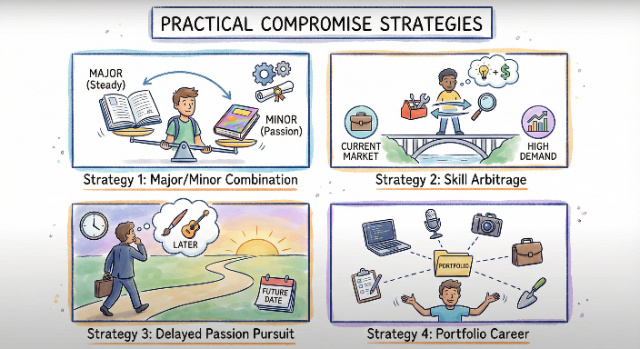
Strategy 1: Major/Minor Combination
- Major in a financially viable field, minor in a passion area.
- Business major with creative writing minor.
- Computer science major with music minor.
- Maintain passion and engagement while building earning potential.
Strategy 2: Skill Arbitrage
Find careers at the intersection of passion and money.
- Love art? Consider UX design ($70,000-$80,000 starting) over fine arts ($35,000-$42,000).
- Love writing? Consider technical writing ($60,000-$68,000) over journalism ($38,000-$45,000).
- Passionate about helping people? Consider occupational therapy ($65,000-$75,000) over social work ($42,000-$50,000).
Strategy 3: Delayed Passion Pursuit
Spend 20s-30s building wealth in a high-earning field, then transition to a passion career when a financial foundation exists. Many artists, writers, and nonprofit leaders follow this path, using corporate earnings to fund later passion pursuits without financial stress.
Strategy 4: Portfolio Career
Maintain a stable income through practical work while pursuing a passion part-time. Teach English while writing novels. Work as a software engineer while playing music on weekends. This combination provides financial security and creative fulfillment without forcing your passion to generate income.
The Lifestyle Cost Question
Different earning levels support different lifestyles. Honestly assess required income:
$40,000-$50,000 starting salary typically supports:
- Shared apartment or roommate situation
- Basic transportation (older car or public transit)
- Limited discretionary spending and travel
- Extended student loan repayment timelines
- Delayed major purchases (home, new car)
$80,000-$90,000 starting salary typically supports:
- Independent living in most markets
- Newer reliable vehicle
- Regular travel and entertainment
- Aggressive debt repayment or saving
- Earlier homeownership potential
Neither is objectively "better," but understanding that a $42,000 salary won't support the lifestyle, and a $85,000 salary enables, prevents disappointment. Choose earnings aligned with your actual lifestyle priorities.
Conclusion
The highest-paying college majors in 2025 concentrate in engineering, computer science, and technical fields, commanding $80,000-$95,000+ starting salaries and offering strong career growth trajectories, while liberal arts and creative majors typically start $30,000-$50,000 lower but provide greater career flexibility.
Key insights for major selection balancing passion and earnings:
- Highest-paying major categories include petroleum engineering, computer engineering, chemical engineering, electrical engineering, and computer science (generally $80,000-$95,000+ starting range)
- Liberal arts majors typically start 40-50% lower ($38,000-$52,000 range) but offer career flexibility, allowing pivots into diverse industries that technical majors may lack
- ROI calculations must factor both earnings and costs. High-paying majors at public universities typically deliver optimal financial outcomes, while expensive private schools rarely justify premium pricing for most students
- Balance passion and earnings by finding overlap between genuine interests and viable fields, pursuing practical majors with passion minors, or choosing careers at the intersection of interests and financial security
- Individual performance, networking, internships, and geographic location impact earnings substantially. Top performers in any field can outearn average performers in "better-paying" majors
Start your decision process by honestly assessing your quantitative abilities, genuine interests, and lifestyle requirements. If you have strong math/science aptitudes and find technical fields engaging, pursue high-earning STEM majors. If your strengths lie elsewhere, identify the highest-earning fields matching your natural abilities rather than forcing yourself into misaligned high-paying majors.
Salary data provides critical information for informed decisions, but remember that many graduates eventually work in fields unrelated to their undergraduate major. Your choice matters significantly for your early career trajectory, but doesn't permanently constrain your future. Prioritize majors that develop broadly transferable skills while acknowledging financial realities you'll face post-graduation.
When you're articulating your major choice and career trajectory in personal statements for competitive programs or graduate school applications, a reliable essay writing service can help you craft sophisticated narratives demonstrating both financial awareness and authentic passion that distinguish compelling applications.
Download our free Major Salary Comparison Tool with customizable location adjustments, ROI calculators, and career trajectory projections for data-driven major decisions.